

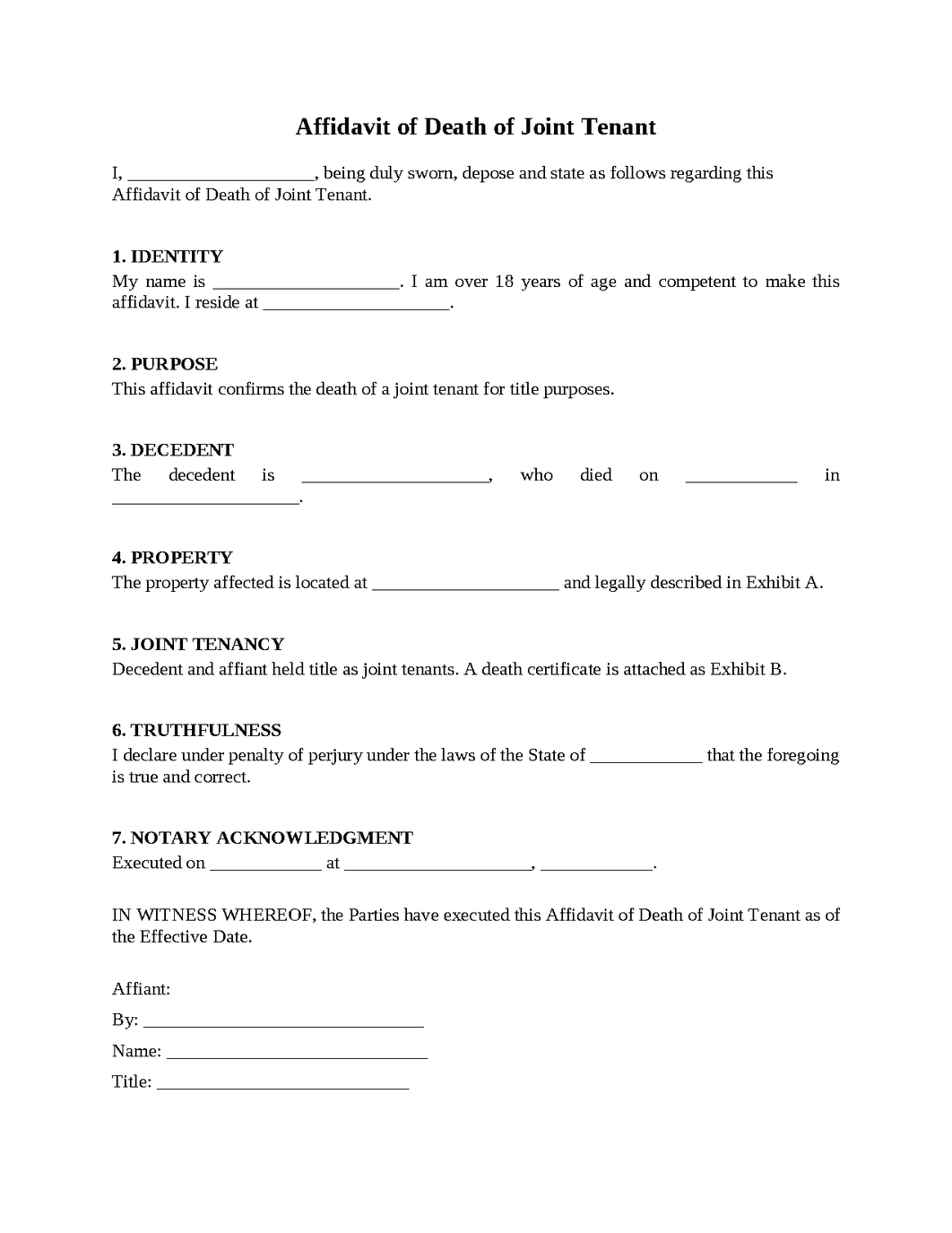
Affidavit of Death of Joint Tenant
An Affidavit of Death of Joint Tenant is a legal document used to formally notify third parties that one of the owners of jointly held property has died. The affidavit is commonly used when real estate, bank accounts, investment accounts, or other assets are owned through a joint tenancy arrangement with rights of survivorship. Under this type of ownership, the surviving joint tenant generally becomes the sole owner upon the death of the other owner. However, before title companies, lenders, financial institutions, and government agencies update their records, they often require documentation confirming the death and identifying the surviving owner. An Affidavit of Death of Joint Tenant helps establish those facts and provides a formal record that can be used to update ownership records, clear title issues, and facilitate future transactions.
A Property Record Still Lists a Deceased Owner
A married couple purchases a home as joint tenants with rights of survivorship. They live in the home for more than twenty years before one spouse passes away. Although ownership automatically transfers to the surviving spouse under the joint tenancy arrangement, county property records continue to show both individuals as owners.
Several years later, the surviving spouse decides to refinance the property. During the title review process, the lender discovers that the deceased spouse still appears on the recorded deed. The lender requests documentation proving that the deceased owner has passed away and that the surviving spouse now owns the property.
Situations like this occur frequently because property ownership records do not automatically update when someone dies. While ownership rights may transfer immediately under state law, public records often remain unchanged until specific documentation is filed.
The issue may not seem important initially because the surviving owner continues living in the property without interruption. However, problems often emerge when the owner attempts to refinance, obtain a home equity loan, transfer ownership, or sell the property. At that point, title companies and lenders typically require evidence showing why one owner no longer appears in future transactions.
Without proper documentation, closing timelines can be delayed while additional records are gathered. In some situations, attorneys may need to become involved to resolve questions regarding ownership.
An Affidavit of Death of Joint Tenant helps address this problem by creating a formal record of the owner's death and documenting the surviving owner's continued interest in the property. When recorded alongside a certified death certificate, the affidavit often allows title records to be updated and ownership questions to be resolved more efficiently.
A Bank Refuses to Release Funds Without Documentation
An elderly father and daughter maintain a joint bank account for many years. The account is structured as a joint tenancy account so that either individual can access funds and the surviving owner can continue using the account after the other's death.
When the father passes away, the daughter assumes she can continue managing the account without interruption. However, when she visits the bank, she discovers that the institution has placed restrictions on certain transactions until ownership documentation is reviewed.
From the bank's perspective, caution is necessary. Financial institutions have legal obligations to verify ownership before making significant changes to account records. The bank wants to ensure that the account was truly held in joint tenancy and that the surviving owner is entitled to continue controlling the funds.
Without sufficient documentation, the bank may delay access to certain assets or require additional paperwork before updating account ownership. These delays can create frustration, particularly when the surviving owner needs immediate access to funds for funeral expenses, household bills, or other financial obligations.
An Affidavit of Death of Joint Tenant helps provide the documentation financial institutions often need to verify ownership changes. By formally identifying the deceased owner and confirming the joint tenancy arrangement, the affidavit can support requests to update account records and remove unnecessary uncertainty.
The document may not eliminate every requirement imposed by a financial institution, but it often serves as an important part of the ownership verification process.
Family Members Dispute Ownership After the Death
A mother and son own a vacation cabin as joint tenants. The arrangement was established years earlier because the son helped maintain the property and contributed to ongoing expenses. When the mother passes away, the son assumes he now owns the property entirely under the joint tenancy arrangement.
Several other family members disagree. They believe the property should be distributed through the mother's estate and shared among all heirs. They question whether the joint tenancy was established properly and argue that the son should not become the sole owner.
Disputes like this often occur when family members misunderstand how joint tenancy works. Many individuals assume that all property automatically passes through a will or probate proceeding. However, jointly owned property with rights of survivorship typically transfers directly to the surviving owner outside of probate.
Family disagreements can become emotionally charged because they often involve long-standing relationships, expectations, and substantial financial interests. Even when ownership rules are relatively clear, surviving family members may challenge transfers if they believe the outcome is unfair.
These disputes can delay property transfers, increase legal expenses, and create significant stress during an already difficult time. Questions regarding ownership may prevent refinancing, sales, or other transactions until the matter is resolved.
An Affidavit of Death of Joint Tenant helps establish a clear factual record regarding the deceased owner's death and the surviving owner's rights under the joint tenancy arrangement. While the document may not eliminate all disputes, it provides evidence supporting the ownership transition and can help clarify the legal basis for the transfer.
A Property Sale Is Delayed Because Title Records Are Incomplete
A widower decides to sell a home that he previously owned with his spouse as joint tenants. The property is listed for sale, a buyer is found, and the transaction appears ready to close.
During the title company's review, however, an issue emerges. The property's ownership records still show the deceased spouse as a co-owner. The title company cannot issue clear title insurance until the ownership history has been updated properly.
The buyer becomes concerned because they want assurance that the seller has the legal authority to transfer ownership. The lender financing the purchase also wants confirmation that title issues have been resolved before funding the transaction.
What began as a routine sale suddenly faces delays. Additional documentation must be gathered, title requirements must be satisfied, and closing dates may need to be postponed.
This situation is extremely common in real estate transactions involving deceased joint tenants. Property owners often assume that because ownership transferred automatically upon death, no additional paperwork is necessary. While the transfer itself may occur automatically, title records frequently require updating before future transactions can proceed smoothly.
An Affidavit of Death of Joint Tenant helps resolve these issues by providing documentation that title companies can use to update ownership records. Recording the affidavit before listing or selling the property can often prevent delays and reduce the likelihood of last-minute title complications.
Government Agencies Require Proof Before Updating Records
A surviving joint tenant seeks to update property tax records, utility accounts, government registrations, and other official records after the death of a co-owner. The individual assumes that providing a death certificate will be sufficient to complete the process.
Instead, several agencies request additional documentation showing how ownership transferred after the death occurred. The agencies want confirmation that the surviving individual has legal authority to act regarding the property or asset in question.
Government agencies frequently require more than proof of death alone. They often need evidence connecting the death to the ownership rights being asserted by the surviving individual. This requirement helps prevent fraud and ensures that records are updated accurately.
Without appropriate documentation, agencies may delay processing requests or require additional information. These delays can create practical problems when the surviving owner needs to manage taxes, utilities, registrations, permits, or other matters tied to the property.
An Affidavit of Death of Joint Tenant helps provide the missing link between the death itself and the surviving owner's ownership rights. By documenting the joint tenancy relationship and identifying the surviving owner, the affidavit often helps agencies process updates more efficiently.
Although specific requirements vary depending on the agency involved, having a properly prepared affidavit available can simplify many post-death administrative tasks and reduce the need for repeated explanations.
The death of a joint tenant often triggers a variety of administrative, financial, and legal responsibilities for the surviving owner. While ownership may transfer automatically under a joint tenancy arrangement, third parties frequently require documentation before updating records or approving transactions. Whether the issue involves property records, financial accounts, family disputes, real estate sales, or government filings, an Affidavit of Death of Joint Tenant provides an important tool for documenting ownership changes and establishing the surviving owner's rights. When prepared accurately and supported by appropriate records, the affidavit can help reduce delays, clarify ownership, and make future transactions significantly easier to complete.
:::

Get started with Upsign today!
Easily send, sign and track your documents