

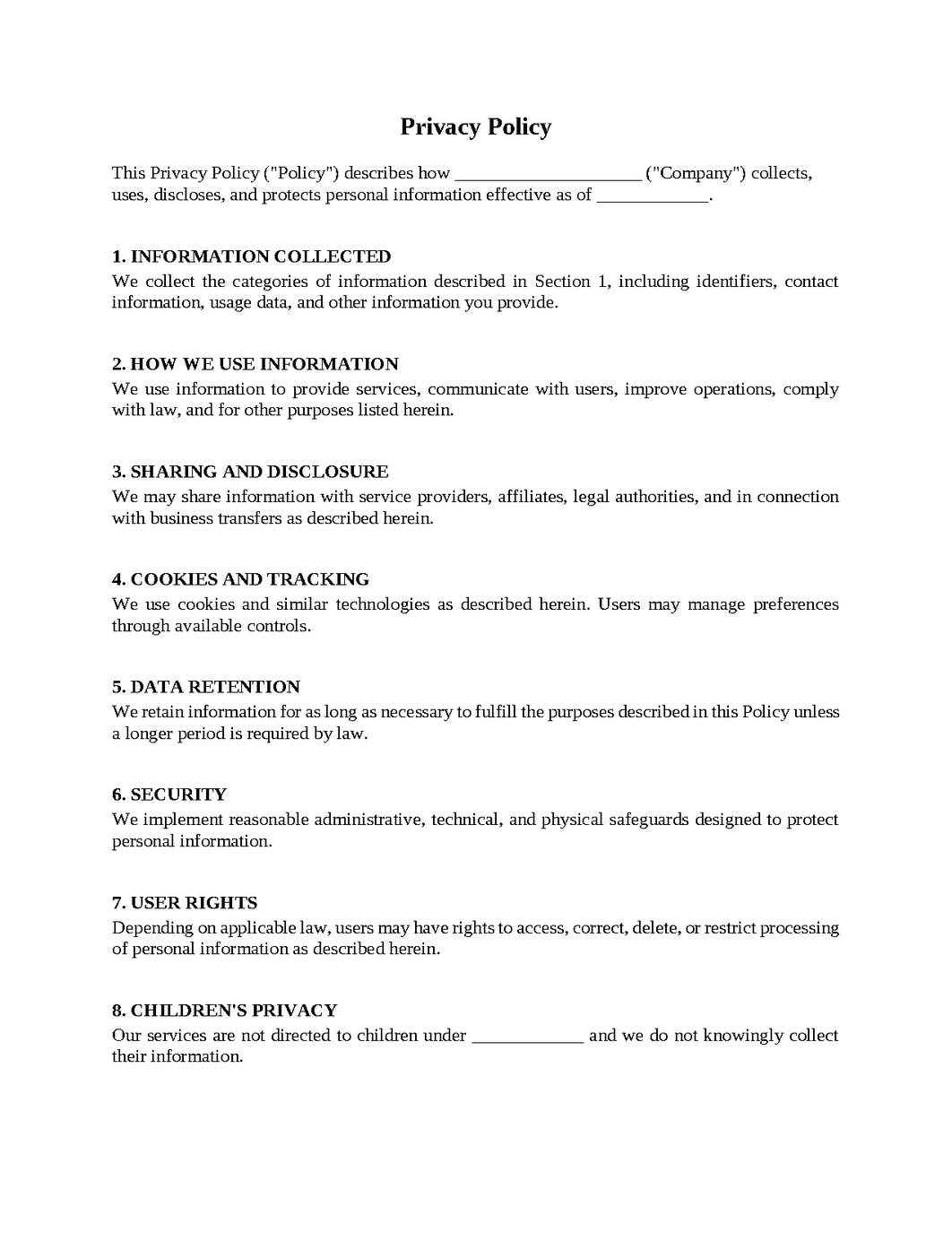
Privacy Policy
A Privacy Policy is a legal document that explains how a business, organization, website, mobile application, or service collects, uses, stores, shares, protects, and manages personal information obtained from users, customers, employees, or other individuals. Privacy Policies are required or strongly recommended under many privacy laws and regulations around the world, including laws governing consumer protection, data security, and online services. Because personal information has become increasingly valuable and privacy regulations continue to evolve, disputes frequently arise when organizations fail to communicate clearly how information will be handled. A well-drafted Privacy Policy helps build trust, support legal compliance, and reduce the risk of privacy-related conflicts.
Users Discover Their Information Is Being Used Unexpectedly
A technology company launches a successful online platform that collects customer information during account registration. Users provide names, email addresses, preferences, and other information necessary to access the service.
Initially, customers are comfortable sharing information because they believe it will be used solely to provide the services they requested. As the company grows, however, it begins using customer information for additional purposes such as marketing campaigns, analytics projects, and business partnerships.
Some users become concerned when they receive communications or advertisements they did not expect. Others question whether their information was shared with third parties without their knowledge.
The company believes its practices are reasonable and beneficial to users. Customers argue that they never fully understood how their information would be used.
The disagreement develops because expectations regarding data usage were never communicated clearly.
To help avoid this problem, a Privacy Policy should clearly explain what information is collected, how it will be used, whether it may be shared with third parties, and what choices users have regarding their information.
A Data Breach Raises Questions About Security Practices
An online business stores customer information in databases used to provide services and support operations.
For years, the company experiences no major security issues. Eventually, however, unauthorized individuals gain access to certain customer records through a cybersecurity incident.
Customers immediately begin asking how the information was protected, what safeguards were in place, and whether the company responded appropriately. Regulators, business partners, and affected users all seek answers regarding the organization's security practices.
The company explains that reasonable measures were implemented and that no system can guarantee absolute protection. Some customers believe stronger safeguards should have prevented the incident.
The breach creates significant legal, financial, and reputational consequences.
To reduce these risks, a Privacy Policy should explain security practices at an appropriate level, address incident response procedures where applicable, and accurately describe the organization's commitment to protecting personal information.
International Privacy Laws Create Compliance Challenges
A growing online business initially serves customers in a single jurisdiction. Over time, however, users begin accessing the service from multiple countries.
As operations expand internationally, the company discovers that different privacy laws impose different requirements regarding consent, disclosures, user rights, and data transfers.
The organization believes it is treating customer information responsibly, yet regulators in certain jurisdictions question whether the company's disclosures satisfy local legal requirements.
Customers also begin requesting access to information, corrections to records, and deletion of personal data under laws unfamiliar to the business.
What started as a local operation becomes a complex compliance challenge.
To help avoid these problems, a Privacy Policy should address applicable legal requirements, explain user privacy rights, identify international data practices when relevant, and remain updated as laws and business operations evolve.
Third-Party Service Providers Create Unexpected Risks
A company relies on various third-party providers to support operations, including payment processors, cloud hosting services, analytics platforms, customer support vendors, and marketing partners.
Although these providers help improve efficiency, they may receive access to certain user information in order to perform their services.
Customers later discover that information is being processed by organizations they have never heard of and begin asking questions regarding who has access to their data.
The company explains that third-party providers are necessary to operate the business. Users remain concerned because they were unaware of the extent of the data-sharing relationships.
The issue becomes a source of mistrust despite the fact that the company never intended to hide its practices.
To help prevent these issues, a Privacy Policy should identify categories of third-party recipients, explain why information is shared, and describe the safeguards used when working with outside service providers.
Users Request Deletion of Information
A customer decides to stop using an online service and requests that all personal information be deleted.
The customer assumes the process will be simple and immediate. The company explains that certain records must be retained for legal, accounting, security, contractual, or operational reasons.
The customer becomes frustrated because expectations regarding deletion differ significantly from reality. The company wants to honor privacy requests while also satisfying legitimate business and legal obligations.
Neither side necessarily acts unreasonably, but both have different assumptions regarding how information should be handled after the relationship ends.
The disagreement highlights the importance of setting expectations before issues arise.
To help avoid these problems, a Privacy Policy should explain data retention practices, identify circumstances in which information may be retained, describe deletion procedures, and outline any rights users have regarding access, correction, or removal of personal information.
Privacy Policies have become an essential component of modern business operations, particularly as organizations collect and process increasing amounts of personal information. However, issues involving data usage, security incidents, regulatory compliance, third-party sharing, and data retention can become significant sources of conflict when expectations are not communicated clearly. A carefully drafted Privacy Policy provides a structured framework for explaining information practices and protecting both organizations and users. When prepared thoughtfully, it can help build trust, support compliance efforts, reduce misunderstandings, and promote responsible data management.

Get started with Upsign today!
Easily send, sign and track your documents