

Affidavit of Debt
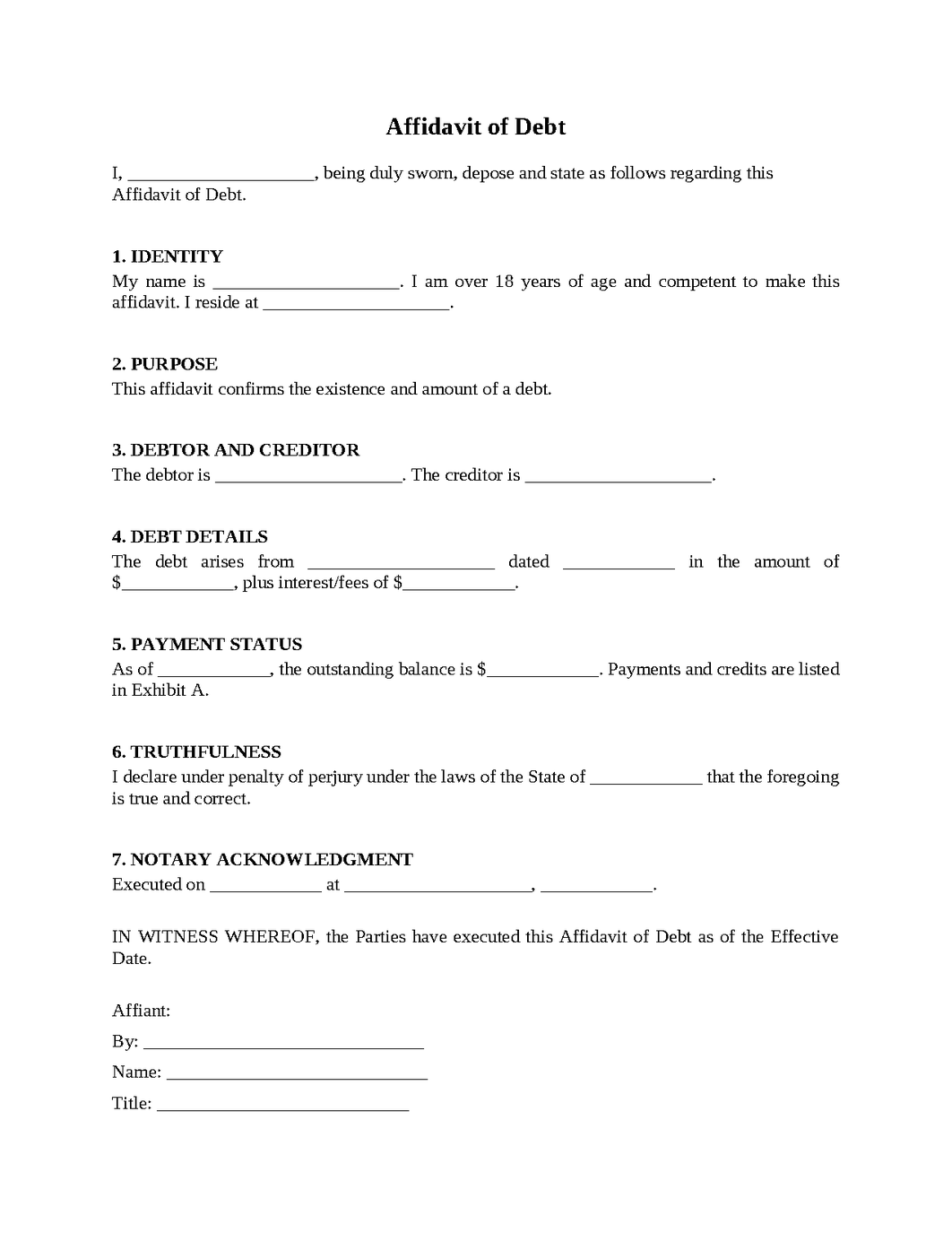
An Affidavit of Debt is a sworn legal statement in which a creditor, lender, business representative, collection agent, or other authorized individual certifies the existence, amount, and status of a debt owed by another party. These affidavits are commonly used in loan enforcement actions, collection proceedings, bankruptcy matters, contract disputes, judgment enforcement, probate proceedings, commercial litigation, and financial transactions requiring verification of outstanding obligations. The affidavit typically identifies the debtor, describes the origin of the debt, specifies the amount owed, and confirms the basis upon which the creditor believes the debt remains outstanding. Because courts, lenders, and other third parties often rely on these sworn statements when making important decisions, disputes can arise when the debt history, calculation, or supporting documentation is unclear. A carefully prepared Affidavit of Debt helps establish a reliable record of the obligation and supports the efficient resolution of financial disputes.
The Debtor Claims the Amount Owed Is Incorrect
A business extends credit to a long-standing customer for the purchase of goods and services.
For several years, payments are made regularly and the account remains in good standing. Eventually, financial difficulties arise, and the customer falls behind on payment obligations. After repeated collection efforts, the creditor prepares an Affidavit of Debt to document the outstanding balance.
When the debtor reviews the affidavit, concerns are raised regarding the amount claimed. The debtor believes certain payments were not credited properly and argues that portions of the balance include charges that were never authorized.
The creditor maintains that all invoices, payments, adjustments, and finance charges were recorded accurately. The debtor believes accounting errors inflated the amount being claimed.
What began as a routine collection matter becomes a dispute regarding the calculation of the debt itself.
To help avoid this problem, an Affidavit of Debt should clearly identify the basis of the obligation, explain how the balance was calculated, and be supported by records demonstrating the history of the account.
The Debt Has Been Assigned to Another Creditor
A lender originates a loan and services the account for several years.
At some point, the lender sells or assigns the debt to another company as part of a larger portfolio transaction. The new creditor assumes responsibility for servicing and collecting the account and eventually prepares an Affidavit of Debt when payment issues arise.
The debtor questions whether the new creditor actually owns the debt and has authority to enforce it. The debtor requests proof showing how ownership of the account transferred from the original lender.
The current creditor believes the assignment documents clearly establish its rights. The debtor argues that the chain of ownership is incomplete or difficult to verify.
The disagreement shifts from the debt itself to the question of who is legally entitled to collect it.
To help prevent these issues, an Affidavit of Debt should clearly identify the current creditor, describe any assignment history, and establish the affiant's authority to certify the debt on behalf of the party entitled to enforce it.
Interest and Fees Become a Source of Conflict
A borrower defaults on a financial obligation after several years of successful repayment.
The creditor calculates the outstanding balance and prepares an Affidavit of Debt reflecting principal, accrued interest, late fees, collection costs, and other charges permitted under the governing agreement. The resulting balance is significantly larger than the original unpaid amount.
The borrower acknowledges owing money but disputes portions of the claimed balance. Questions arise regarding interest calculations, penalty charges, and the timing of certain fees.
The creditor believes the charges are authorized by the underlying agreement and consistent with applicable law. The borrower believes some amounts exceed what was originally contemplated.
The disagreement becomes substantial because the disputed charges represent a significant portion of the total balance.
To help avoid these problems, an Affidavit of Debt should clearly distinguish principal from interest, fees, and other charges, while providing sufficient detail to explain how each component of the debt was determined.
The Records Supporting the Debt Are Incomplete
A company acquires another business and inherits responsibility for managing numerous customer accounts.
Years later, one of those accounts becomes the subject of a collection action. In preparing an Affidavit of Debt, the company discovers that some records relating to the account are missing, incomplete, or stored in multiple systems.
The creditor believes enough information exists to establish the validity of the debt. The debtor argues that the absence of complete records raises questions regarding the accuracy of the claim.
Both parties rely on different pieces of historical information to support their positions. The lack of a complete record makes it difficult to reconstruct exactly what occurred.
The dispute becomes more complicated because documentation that could resolve the issue may no longer exist.
To help prevent these issues, an Affidavit of Debt should be supported by reliable records and should clearly explain the source of the information being certified.
The Person Signing the Affidavit Is Challenged
A financial institution prepares an Affidavit of Debt in connection with a legal proceeding.
The affidavit is signed by an employee who reviews account records and certifies the outstanding balance. When the affidavit is presented, the debtor questions whether the individual possesses sufficient knowledge to make the sworn statements contained in the document.
The institution argues that the employee is authorized to review business records and certify account information in the ordinary course of business. The debtor believes additional evidence is necessary to establish the affiant's personal knowledge and authority.
The dispute does not focus primarily on the debt itself but rather on the reliability of the affidavit supporting the claim.
The issue creates delays because the parties must address procedural concerns before resolving the underlying financial dispute.
To help avoid these problems, an Affidavit of Debt should clearly identify the affiant's position, explain the basis of the affiant's knowledge, and establish authority to certify the information contained in the affidavit.
Affidavits of Debt are important legal tools used to document and verify financial obligations in collection matters, litigation, and commercial transactions. However, issues involving debt calculations, assignment history, interest and fee charges, supporting records, and affiant authority can become significant sources of conflict when the underlying information is not presented clearly. A carefully prepared Affidavit of Debt provides a structured framework for documenting the existence and amount of a financial obligation. When drafted thoughtfully, it can help reduce disputes, improve transparency, strengthen the reliability of financial claims, and support the efficient resolution of debt-related matters.

Get started with Upsign today!
Easily send, sign and track your documents