

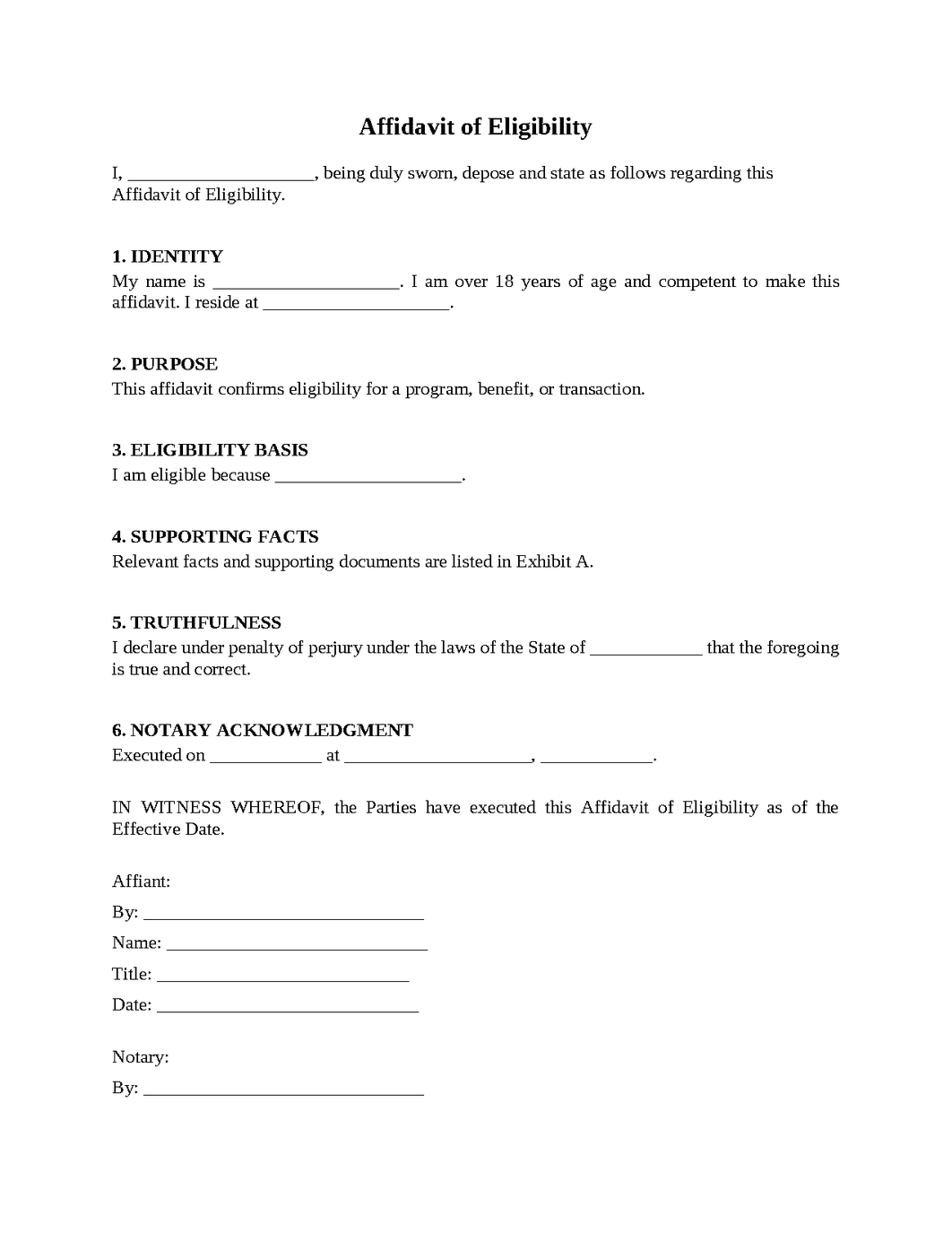
Affidavit of Eligibility
An Affidavit of Eligibility is a sworn statement used to confirm that an individual, business, or organization meets specific requirements necessary to participate in a program, receive a benefit, qualify for a transaction, claim a prize, obtain a license, enter a competition, receive government assistance, or satisfy another eligibility requirement. The affidavit is commonly used when a third party needs assurance that the person making the claim satisfies established rules or qualifications. By signing the document under oath, the affiant formally attests that the information provided is accurate and that they meet the applicable eligibility standards. Affidavits of Eligibility are frequently used by government agencies, employers, contest sponsors, lenders, insurers, educational institutions, and regulatory bodies. When prepared accurately, the affidavit helps establish trust and streamline decision-making. When inaccurate information is provided, however, eligibility disputes, delays, financial losses, and legal consequences can result.
An Applicant Claims Eligibility but Does Not Meet the Requirements
A small business owner applies for a government grant designed specifically for businesses with fewer than 25 employees. During the application process, the owner signs an Affidavit of Eligibility stating that the company satisfies all program requirements.
Several months later, program administrators discover that the company actually employs more than 40 individuals when part-time workers are included in the calculation. The business owner believed only full-time employees counted toward the limit and therefore assumed the company qualified.
Situations like this occur frequently because eligibility requirements are often more detailed than applicants realize. Individuals may focus on general qualifications while overlooking technical definitions contained within program rules.
In some cases, applicants intentionally misrepresent information in hopes of obtaining benefits they would not otherwise receive. More commonly, however, misunderstandings arise because requirements are interpreted incorrectly or supporting documentation is not reviewed carefully.
The consequences can be significant. Grant funds may need to be repaid. Applications may be denied. Future participation in programs may be restricted. In certain situations, agencies may investigate whether false statements were made intentionally.
An Affidavit of Eligibility helps reduce these problems by requiring applicants to review requirements carefully before certifying that they qualify. The sworn nature of the document encourages greater diligence and creates accountability for the information being provided.
A Contest Winner Must Verify Eligibility Before Receiving a Prize
A national company sponsors a promotional sweepstakes offering a grand prize valued at $100,000. After the drawing is completed, a winner is selected and notified.
Before awarding the prize, the sponsor requests that the winner complete an Affidavit of Eligibility. The document requires the winner to confirm that they meet all contest rules, including age requirements, residency requirements, and restrictions regarding employees, family members, and affiliated individuals.
The winner is surprised by the request. After all, the drawing has already occurred and they have already been informed that they won. However, from the sponsor's perspective, verifying eligibility is an essential part of protecting the integrity of the contest.
Imagine a situation where the winner turns out to be an employee of the sponsoring company. Most contest rules prohibit employees from participating because doing so could create concerns regarding fairness. If eligibility is not verified before prizes are awarded, disputes and public criticism may follow.
Contest sponsors use Affidavits of Eligibility to confirm that winners satisfy applicable requirements before benefits are distributed. The affidavit creates a formal record showing that the winner represented themselves as eligible under the official rules.
Without this verification process, sponsors may face legal challenges, public relations issues, and accusations that contests were administered improperly.
A Business Qualifies Initially but No Longer Meets Eligibility Standards
A nonprofit organization applies for funding available only to entities serving low-income communities. At the time of application, the organization satisfies every eligibility requirement and signs an Affidavit of Eligibility accordingly.
Several months later, circumstances change. The organization expands into additional markets and significantly alters the populations it serves. By the time funding decisions are finalized, questions emerge regarding whether the organization still qualifies under the original program criteria.
This situation highlights an issue that many applicants overlook: eligibility can change over time. An individual or organization may qualify when an application is submitted but fail to qualify when benefits are ultimately awarded.
For example, a business may exceed employee limits, a student may lose enrollment status, an organization may change its mission, or a participant may move to a different jurisdiction. These changes can affect eligibility even when the original affidavit was accurate when signed.
Determining how these changes should be handled often depends on the rules governing the program. Some programs evaluate eligibility only at the time of application. Others require eligibility to continue throughout the entire process.
An Affidavit of Eligibility helps establish what information was accurate at the time it was signed. The document also encourages applicants to monitor ongoing eligibility requirements and disclose material changes when necessary.
Supporting Documentation Contradicts the Affidavit
A homeowner applies for a property tax exemption available only to individuals who use a property as their primary residence. As part of the application process, the homeowner signs an Affidavit of Eligibility confirming that the property qualifies.
During the review process, however, officials discover that utility records, driver's license information, and tax filings indicate that the applicant may actually reside elsewhere. The supporting documentation appears inconsistent with the statements made in the affidavit.
This creates an immediate problem. Decision-makers must determine whether the affidavit is inaccurate, whether the documentation is incomplete, or whether additional investigation is necessary.
Conflicts between affidavits and supporting evidence occur in many contexts. A student may claim residency while records suggest otherwise. A business may claim employee counts that do not match payroll records. An applicant may assert income levels that differ from tax filings.
When discrepancies emerge, delays often follow. Additional documentation may be requested. Applications may be suspended pending review. Investigations may be conducted to determine which information is correct.
An Affidavit of Eligibility encourages applicants to verify facts carefully before making sworn statements. By reviewing supporting records before signing, applicants can often identify inconsistencies and resolve them before they become obstacles.
A Third Party Challenges an Eligibility Determination
A company participates in a procurement process reserved for small businesses. As part of the submission requirements, the company signs an Affidavit of Eligibility certifying that it satisfies all size and ownership requirements.
After the contract is awarded, a competing bidder challenges the decision. The competitor alleges that the winning company is actually controlled by a larger parent organization and therefore should not have qualified for the program.
The challenge triggers a formal review. Ownership records, financial statements, organizational charts, and contractual relationships are examined to determine whether the company truly meets eligibility requirements.
These challenges are common whenever benefits, contracts, licenses, grants, or opportunities are limited to specific groups. Competitors, stakeholders, and regulators often have incentives to scrutinize eligibility claims when significant financial interests are involved.
Even when the company ultimately prevails, responding to the challenge can require substantial time and resources. Documentation must be gathered, explanations must be provided, and legal counsel may become involved.
An Affidavit of Eligibility helps establish a clear record of the representations made by the applicant. While the document does not prevent challenges, it creates an important piece of evidence regarding the applicant's understanding of the requirements and the basis for their eligibility claim.
Eligibility requirements play an important role in ensuring that programs, benefits, contests, contracts, and opportunities are distributed fairly and according to established rules. Questions regarding qualifications, documentation, changing circumstances, conflicting evidence, and third-party challenges frequently arise when eligibility must be verified. An Affidavit of Eligibility provides a formal mechanism for documenting eligibility claims and creating accountability for the information being presented. When completed accurately and supported by reliable evidence, the affidavit can help reduce disputes, streamline reviews, and provide decision-makers with greater confidence when evaluating eligibility determinations.
:::

Get started with Upsign today!
Easily send, sign and track your documents