

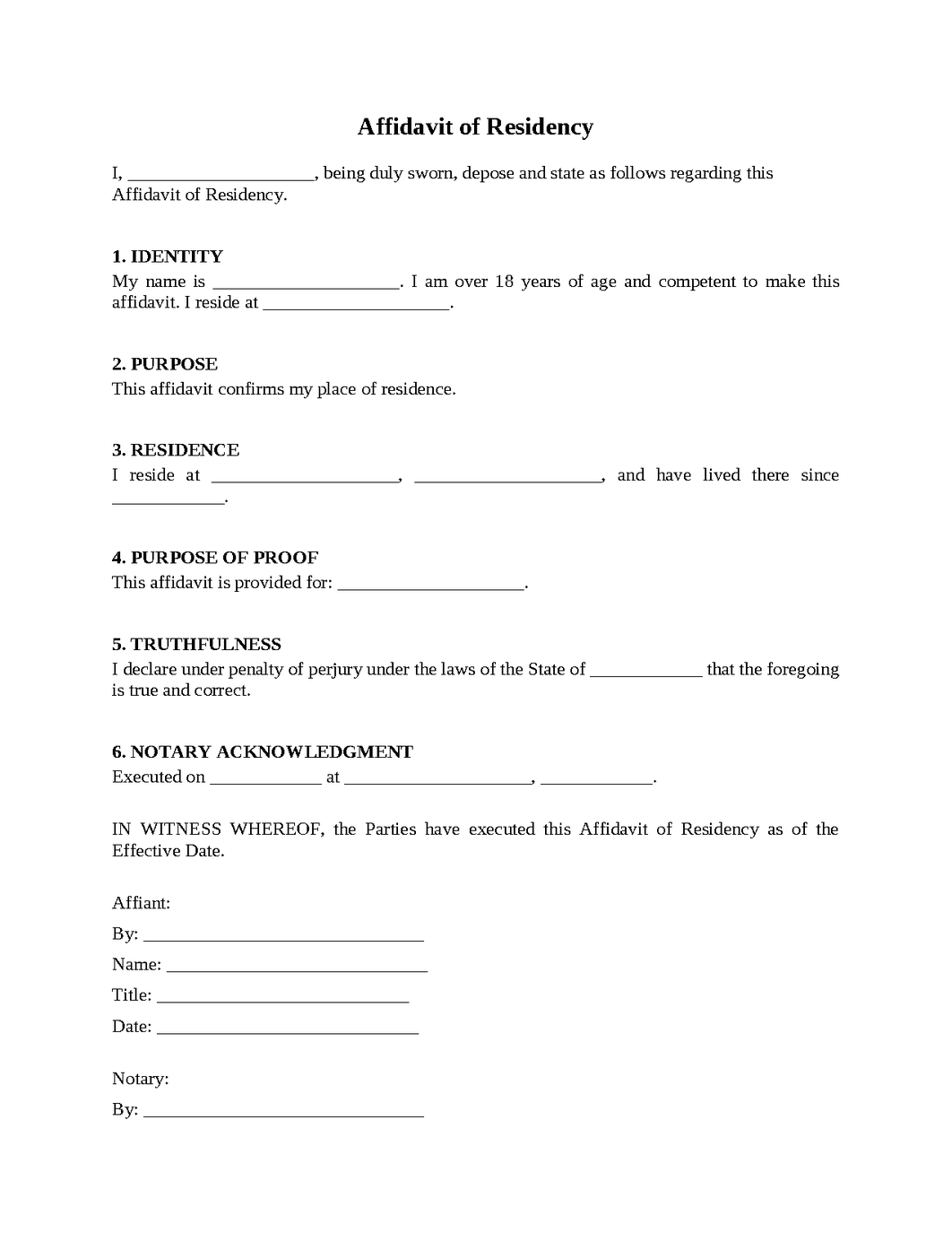
Affidavit of Residency
An Affidavit of Residency is a sworn statement used to verify that an individual resides at a particular address. The document is commonly required when a person must establish residency for school enrollment, government benefits, tax purposes, voting registration, licensing, insurance coverage, employment requirements, court proceedings, or financial transactions. While utility bills, driver's licenses, leases, and other records often serve as evidence of residency, situations sometimes arise where additional verification is needed. An Affidavit of Residency allows an individual—or in some cases another person with knowledge of the living arrangement—to formally attest to the resident's address under oath. When prepared accurately, the affidavit helps organizations verify residency and make informed decisions. When residency questions remain unresolved, however, applications, benefits, enrollments, and transactions may be delayed or denied.
A Student Cannot Enroll in School Because Residency Is Unclear
A mother moves into her sister's home after accepting a new job in a different city. Her children are scheduled to begin school in the local district, but when she attempts to register them, school officials request proof that the family actually resides within district boundaries.
The mother quickly discovers that she has very little documentation available. Utility bills remain in her sister's name, the family does not yet have a formal lease agreement, and recent mail still reflects the previous address.
From the school's perspective, residency verification is important because enrollment eligibility often depends on where a student lives. School districts typically receive funding based on local residents and must ensure that students attending district schools qualify under applicable rules.
Without adequate proof, enrollment may be delayed. Parents may become frustrated, particularly when school is about to begin and children need certainty regarding attendance.
Situations like this occur frequently when families move in with relatives, transition between residences, or relocate unexpectedly. Standard residency documents may not exist immediately after the move.
An Affidavit of Residency helps address this problem by allowing the resident or host to formally confirm the living arrangement. The affidavit provides school officials with additional evidence supporting residency claims and can help families complete enrollment requirements more efficiently.
A Government Agency Questions Eligibility for Benefits
A state assistance program provides benefits only to residents of a particular jurisdiction. An applicant submits the required paperwork and believes everything is in order.
During the review process, however, agency staff identify inconsistencies. The applicant's driver's license lists one address, tax records reference another location, and recent correspondence contains a third address.
The agency requests additional documentation establishing where the applicant actually resides. Until the issue is resolved, eligibility cannot be determined.
Government agencies frequently encounter situations where records do not align perfectly. Individuals may move recently, maintain multiple residences, or fail to update records promptly after relocating.
Because benefits are often restricted to residents of specific states, counties, or municipalities, agencies must verify residency carefully. Providing benefits to ineligible individuals could create compliance issues and misuse public funds.
Without sufficient evidence, applications may be delayed or denied. Applicants may miss important deadlines or experience interruptions in services while residency questions remain unresolved.
An Affidavit of Residency provides a sworn statement regarding the applicant's actual residence and can help agencies evaluate conflicting information. While additional documentation may still be required, the affidavit often becomes an important part of the verification process.
A Tenant Has No Traditional Proof of Address
A young professional rents a room in a private residence owned by a family friend. The arrangement works well, but there is no formal lease agreement. Most utilities remain in the homeowner's name, and the tenant receives very little mail at the property.
When the tenant applies for a professional license, proof of residency becomes necessary. The licensing agency requests documentation establishing where the applicant lives.
The tenant discovers that traditional residency records are limited. Bank statements, utility bills, and lease agreements are either unavailable or do not clearly identify the residence.
This problem affects many individuals, including students, roommates, elderly parents living with relatives, temporary workers, and individuals transitioning between housing arrangements.
Organizations often rely on standard forms of documentation because they provide objective evidence. When those records do not exist, however, alternative methods of verification become necessary.
An Affidavit of Residency helps fill this gap by allowing the homeowner or resident to provide a sworn statement confirming the living arrangement. The affidavit creates a formal record that can support residency claims when traditional documentation is unavailable.
A Tax Authority Challenges Residency Status
A business executive spends substantial time working in multiple states throughout the year. During a tax review, state authorities question whether the executive qualifies as a resident for tax purposes.
The distinction is important because residency status may affect tax obligations significantly. Different jurisdictions often have different tax rules, and determining residency can influence filing requirements and financial liability.
The executive believes residency is obvious because most personal belongings are located in one state. Tax authorities, however, review numerous factors, including where the individual spends time, maintains a home, registers vehicles, votes, and conducts personal affairs.
Questions regarding residency can become surprisingly complex. Individuals with multiple residences, seasonal homes, or extensive travel schedules often encounter challenges when establishing where they legally reside.
Without sufficient evidence, tax disputes may continue for months or even years. Additional records may be requested, audits may occur, and significant financial consequences may result.
An Affidavit of Residency helps document the individual's position regarding residency and provides a sworn statement explaining living arrangements. While the affidavit alone may not resolve a tax dispute, it can support the individual's overall evidence and help clarify relevant facts.
Residency Questions Delay a Financial Transaction
A first-time homebuyer applies for a mortgage program available only to residents of a particular county. The buyer satisfies income requirements and credit standards, but the lender requests additional proof of residency before approving the loan.
The buyer recently moved and has not yet updated every official record. Some documents show the new address, while others continue to reflect the prior residence.
The lender wants certainty that program requirements are satisfied before proceeding. If residency requirements are not met, the borrower may not qualify for the financing program.
Situations like this occur regularly during mortgage applications, insurance transactions, banking relationships, and other financial arrangements. Eligibility often depends on where an individual resides, making accurate verification essential.
Even minor discrepancies can trigger additional review. What appears to be a routine application may become delayed while supporting documentation is gathered and evaluated.
An Affidavit of Residency provides a sworn explanation regarding the applicant's residence and can help lenders reconcile conflicting records. By creating a formal statement regarding residency, the affidavit often helps move financial transactions toward completion.
Residency requirements affect many aspects of daily life, including education, government benefits, taxation, licensing, financial transactions, and legal rights. Questions regarding where a person lives can arise for many reasons, particularly when records are incomplete, inconsistent, or unavailable. An Affidavit of Residency provides a practical method for documenting residency and supporting claims when additional verification is needed. When prepared accurately and supported by appropriate evidence, the affidavit can help reduce delays, resolve questions, and provide decision-makers with greater confidence when evaluating residency-related issues.
:::

Get started with Upsign today!
Easily send, sign and track your documents