

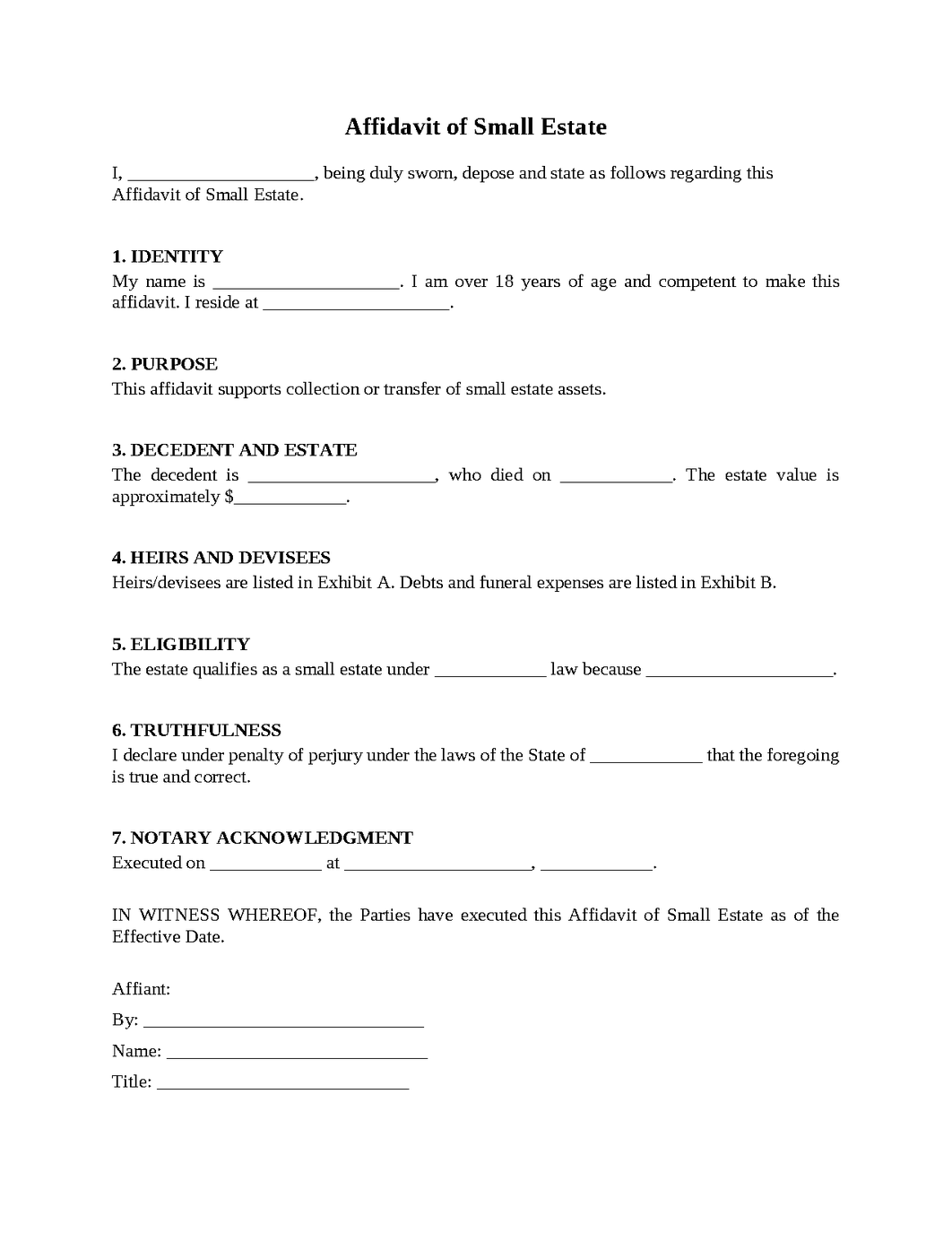
Affidavit of Small Estate
An Affidavit of Small Estate is a legal document used to transfer a deceased person's assets without going through a full probate proceeding. Many states allow heirs to use a small estate affidavit when the value of the estate falls below certain statutory limits and specific legal requirements are satisfied. The affidavit is commonly used to transfer bank accounts, personal property, vehicles, and other assets after someone's death. Heirs, family members, financial institutions, government agencies, and courts frequently rely on these affidavits to simplify the administration process when an estate qualifies for streamlined treatment. While the procedure is often faster and less expensive than traditional probate, questions regarding eligibility, ownership, heirs, creditors, and asset values frequently arise. An Affidavit of Small Estate helps document the relevant facts and provides a formal basis for transferring property.
Family Members Disagree About Whether the Estate Qualifies
A widowed father passes away leaving behind a bank account, a vehicle, household belongings, and several small investment accounts. One of his children believes the family can use a small estate affidavit because the estate appears modest. Another sibling argues that the estate is too large and must go through probate.
The disagreement begins with a simple question: what assets count toward the estate's value?
Some family members assume only bank accounts should be considered. Others believe vehicles, personal property, and investment accounts must also be included. As the discussion continues, uncertainty grows regarding whether the estate actually qualifies for the simplified procedure.
This issue is common because small estate laws vary by state. Different jurisdictions establish different value thresholds and may treat certain assets differently when determining eligibility.
If the estate does not qualify, using a small estate affidavit improperly could create legal complications later. Financial institutions may refuse transfers, heirs may challenge distributions, and creditors may question whether proper procedures were followed.
An Affidavit of Small Estate helps organize the relevant information and requires the person signing the document to identify assets, heirs, and eligibility factors. By documenting these facts carefully, the affidavit can help determine whether the estate qualifies for the simplified process.
A Bank Refuses to Release Funds Without Additional Documentation
A woman dies leaving a savings account containing $18,000. Her children believe they can access the funds easily because the estate qualifies as a small estate under state law.
When they visit the bank, however, the institution refuses to release the money immediately. Bank representatives explain that they need documentation proving the account holder has died, that the estate qualifies under applicable law, and that the individuals requesting the funds are entitled to receive them.
The family becomes frustrated because they assumed a death certificate would be sufficient. The bank, however, has legal obligations to verify ownership before releasing assets.
Financial institutions regularly encounter competing claims involving deceased account holders. Releasing funds to the wrong individual could expose the institution to liability.
The situation becomes even more complicated if multiple heirs exist. The bank may need assurance that all required parties have been identified and that applicable legal procedures have been followed.
An Affidavit of Small Estate helps provide the documentation financial institutions often require. By identifying the deceased person, listing heirs, and establishing eligibility for the small estate process, the affidavit can help support requests for asset transfers.
A Previously Unknown Creditor Appears
A family uses a small estate affidavit to transfer assets after a relative's death. Several months later, a creditor contacts the heirs claiming that the deceased owed a substantial amount of money before death.
The heirs are surprised because they were unaware of the debt. They have already distributed estate assets among themselves and assumed all matters had been resolved.
Creditors often create complications in estate administration. While heirs may focus primarily on inheritance issues, outstanding obligations can affect how assets should be handled.
In some situations, state laws require certain debts to be paid before heirs receive distributions. Failure to address valid creditor claims may create legal complications for those who received estate assets.
The problem becomes more difficult when heirs no longer possess the distributed property or when funds have already been spent.
An Affidavit of Small Estate generally requires disclosure regarding known debts and obligations. Completing the affidavit carefully encourages heirs to investigate potential creditor claims before assets are transferred. While the affidavit cannot eliminate every future dispute, it helps establish what information was known when the estate was administered.
Ownership of an Asset Is Unclear
A deceased individual leaves behind a vehicle that family members believe should pass through the small estate process. However, when ownership records are reviewed, questions emerge regarding who actually owns the vehicle.
One family member believes the vehicle belonged solely to the deceased. Another discovers documents suggesting a co-owner may exist. Additional records indicate the vehicle may have been pledged as collateral for a loan.
What initially appeared to be a straightforward transfer becomes significantly more complicated.
Ownership issues frequently arise during estate administration. Assets may be jointly owned, subject to liens, transferred before death, or titled in ways that are not immediately obvious.
Before an asset can be transferred through a small estate procedure, it is important to determine whether the deceased actually owned the property and whether others have rights that affect the transfer.
Mistakes can create significant problems. Assets may be distributed incorrectly, ownership disputes may emerge, and transactions may be delayed while title issues are resolved.
An Affidavit of Small Estate helps identify estate assets and document the basis for ownership claims. The process encourages careful review of records before transfers occur.
An Heir Challenges the Distribution After Assets Are Transferred
A small estate affidavit is used to transfer a deceased person's property to surviving family members. Everyone believes all heirs have been identified and distributions are completed properly.
Nearly a year later, an individual comes forward claiming to be an heir who was never notified about the estate. According to the individual, they are entitled to receive a share of the assets that were distributed previously.
The challenge immediately creates uncertainty. If the claim is valid, questions arise regarding whether distributions must be adjusted and whether recipients must return property.
Heirship disputes are among the most common estate-related conflicts. Family relationships may be complicated by prior marriages, adoptions, estrangements, or previously unknown relatives.
Even when the original distributions were made in good faith, the discovery of an additional heir can create legal and practical challenges.
An Affidavit of Small Estate requires the person signing the document to identify heirs and explain their entitlement to inherit. While the affidavit cannot guarantee that no future claims will emerge, it provides a formal record regarding the information available when the estate was administered.
Administering a small estate is often faster and less expensive than traditional probate, but important questions regarding eligibility, heirs, creditors, ownership, and asset values can still arise. Families frequently encounter challenges when determining whether the simplified process applies and how assets should be transferred. An Affidavit of Small Estate provides a practical tool for documenting the facts necessary to administer qualifying estates and transfer property efficiently. When completed accurately and supported by reliable information, the affidavit can help reduce uncertainty, facilitate asset transfers, and provide institutions and heirs with greater confidence throughout the estate administration process.
:::

Get started with Upsign today!
Easily send, sign and track your documents