

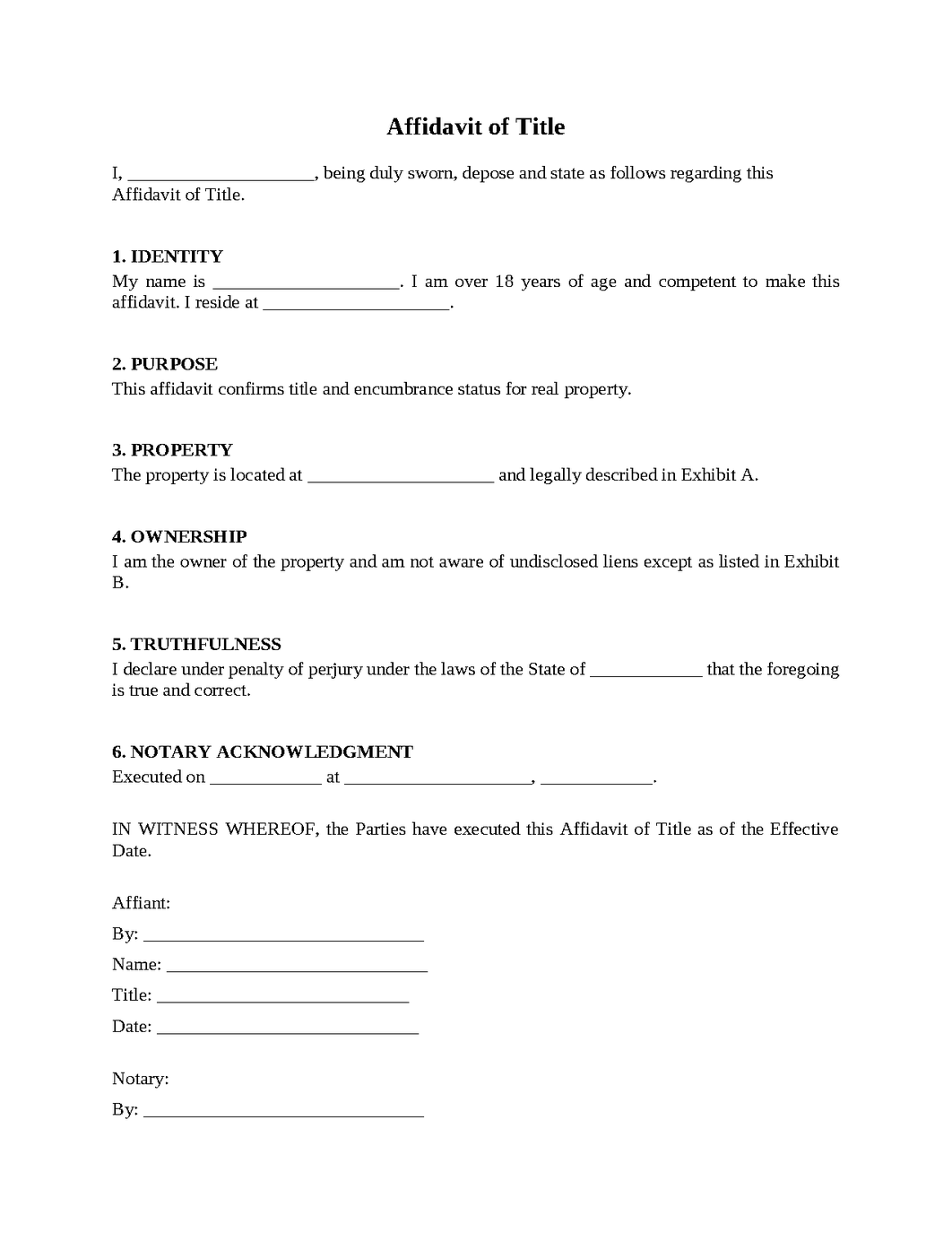
Affidavit of Title
An Affidavit of Title is a sworn statement used to confirm important facts regarding ownership of real property and the condition of the property's title. Buyers, sellers, title companies, lenders, attorneys, and closing agents frequently rely on this document during real estate transactions to verify that the seller owns the property, has the authority to transfer it, and is not aware of undisclosed claims that could affect ownership rights. The affidavit often addresses matters such as liens, judgments, unpaid taxes, boundary disputes, easements, ownership interests, pending legal actions, and other issues that may not appear in public records. Because title companies and lenders depend heavily on accurate information when evaluating real estate transactions, an Affidavit of Title serves as an important tool for identifying risks before a sale or refinancing is completed.
A Hidden Lien Surfaces After a Property Sale
A homeowner agrees to sell a residential property after living there for more than ten years. The transaction appears straightforward. A buyer is found, financing is approved, and closing preparations are underway.
During the title review process, however, an old contractor's lien appears in the records. The seller believed the work had been paid for years earlier and assumed all obligations had been satisfied. Unfortunately, the lien was never properly released.
The discovery creates immediate concern for everyone involved. The buyer does not want to purchase a property burdened by unresolved claims. The lender refuses to fund the loan until the issue is addressed. The title company cannot issue a clean title insurance policy while uncertainty remains.
Situations like this occur more often than many property owners realize. Liens may arise from construction work, unpaid taxes, court judgments, homeowner association obligations, or other financial disputes. In some cases, owners are unaware that claims remain attached to the property.
Resolving the issue may require obtaining releases, negotiating with creditors, or gathering historical records proving that obligations were satisfied. What should have been a routine closing can quickly become delayed.
An Affidavit of Title helps address these concerns by requiring the seller to disclose known claims affecting the property. By creating a sworn record regarding liens and encumbrances, the affidavit helps buyers and title companies evaluate risks before closing.
An Unknown Ownership Interest Is Discovered
A property owner inherits a parcel of land from a parent and later decides to sell it. During the transaction, the title company uncovers records suggesting that another individual may have held an ownership interest decades earlier.
The seller is surprised because they have always believed they owned the property outright. However, historical deeds and family records create uncertainty regarding whether all ownership interests were transferred properly.
Ownership issues like this can arise through inheritance disputes, divorce proceedings, business arrangements, family transfers, and clerical errors. Sometimes an ownership interest was never properly conveyed. In other situations, documentation simply cannot be located.
The consequences can be significant. Buyers may hesitate to proceed. Lenders may refuse financing. Title companies may require corrective actions before issuing insurance.
Even when competing ownership claims ultimately prove invalid, resolving the uncertainty often requires substantial time and expense. Attorneys may need to review historical records, locate former owners, or prepare corrective documents.
An Affidavit of Title helps sellers confirm their understanding of ownership and disclose any known competing interests. The affidavit creates an important record that can assist title companies in evaluating potential risks.
A Boundary Dispute Threatens the Transaction
A homeowner places a property on the market and quickly receives an attractive offer. During inspections, however, the buyer discovers that a neighbor's fence appears to cross onto the property being sold.
The buyer becomes concerned. If the fence is located improperly, questions may exist regarding property boundaries, access rights, and future ownership disputes.
Boundary disagreements frequently arise because fences, driveways, landscaping features, sheds, and other improvements are not always constructed precisely along legal property lines. In some situations, neighbors have coexisted peacefully for years without realizing that an encroachment exists.
When a transaction is pending, however, even minor encroachments can become important. Buyers want certainty regarding what they are purchasing, and lenders want confidence that collateral is not subject to unresolved disputes.
The title company may request additional surveys or documentation before proceeding. Negotiations between neighbors may become necessary. Closing dates may be postponed while the issue is investigated.
An Affidavit of Title helps identify known boundary disputes and encroachments before closing occurs. By documenting these issues in advance, parties can address concerns early and reduce the likelihood of unexpected surprises.
Unrecorded Agreements Affect the Property
A property owner agrees to sell a commercial building. During due diligence, the buyer asks whether any agreements exist that affect the property beyond those appearing in public records.
The seller remembers granting a neighboring business informal access across part of the property years earlier. No written easement was recorded, and the arrangement was based primarily on verbal understandings.
Although the agreement seemed insignificant at the time, it now raises questions regarding the buyer's future rights. Will the neighboring business continue using the property? Could a dispute arise if access is restricted after closing?
Unrecorded agreements can create substantial uncertainty. Access arrangements, shared maintenance obligations, utility agreements, and informal property rights may exist without appearing in title records.
Because these arrangements are not always obvious, buyers and title companies depend on sellers to disclose information that may affect ownership rights.
Failure to disclose such matters can lead to disputes after closing. Buyers may claim they were unaware of restrictions or obligations affecting the property.
An Affidavit of Title helps address these concerns by requiring disclosure of known agreements and circumstances that could affect ownership or use of the property.
A Lawsuit Creates Questions About Ownership Rights
A property owner enters into a purchase agreement to sell real estate. Shortly before closing, the buyer learns that the seller is involved in ongoing litigation unrelated to the property itself.
The buyer immediately wonders whether the lawsuit could affect ownership rights. If a judgment is entered against the seller, could creditors attempt to place liens on the property? Could the litigation interfere with the transfer?
Pending legal actions often create uncertainty in real estate transactions. Even when a lawsuit appears unrelated to the property, title companies and lenders may want additional information before proceeding.
The issue becomes more significant when judgments, bankruptcy proceedings, divorce actions, or creditor claims are involved. These matters can potentially affect ownership rights or create future title concerns.
Buyers generally want assurance that they will receive clear title free from undisclosed risks. Lenders and title companies share the same objective.
An Affidavit of Title helps sellers disclose pending legal matters that could affect ownership interests or title quality. The affidavit provides an opportunity to identify potential issues and address concerns before closing occurs.
Real estate transactions involve significant financial commitments, and buyers, lenders, and title companies all rely on accurate information regarding ownership and title condition. Questions involving liens, ownership interests, boundary disputes, unrecorded agreements, and pending legal matters frequently arise during property transfers. An Affidavit of Title provides a practical method for documenting important facts regarding the property's title and identifying risks that may affect ownership rights. When completed accurately and supported by reliable information, the affidavit can help reduce uncertainty, facilitate transactions, and provide all parties with greater confidence during the closing process.
:::

Get started with Upsign today!
Easily send, sign and track your documents