

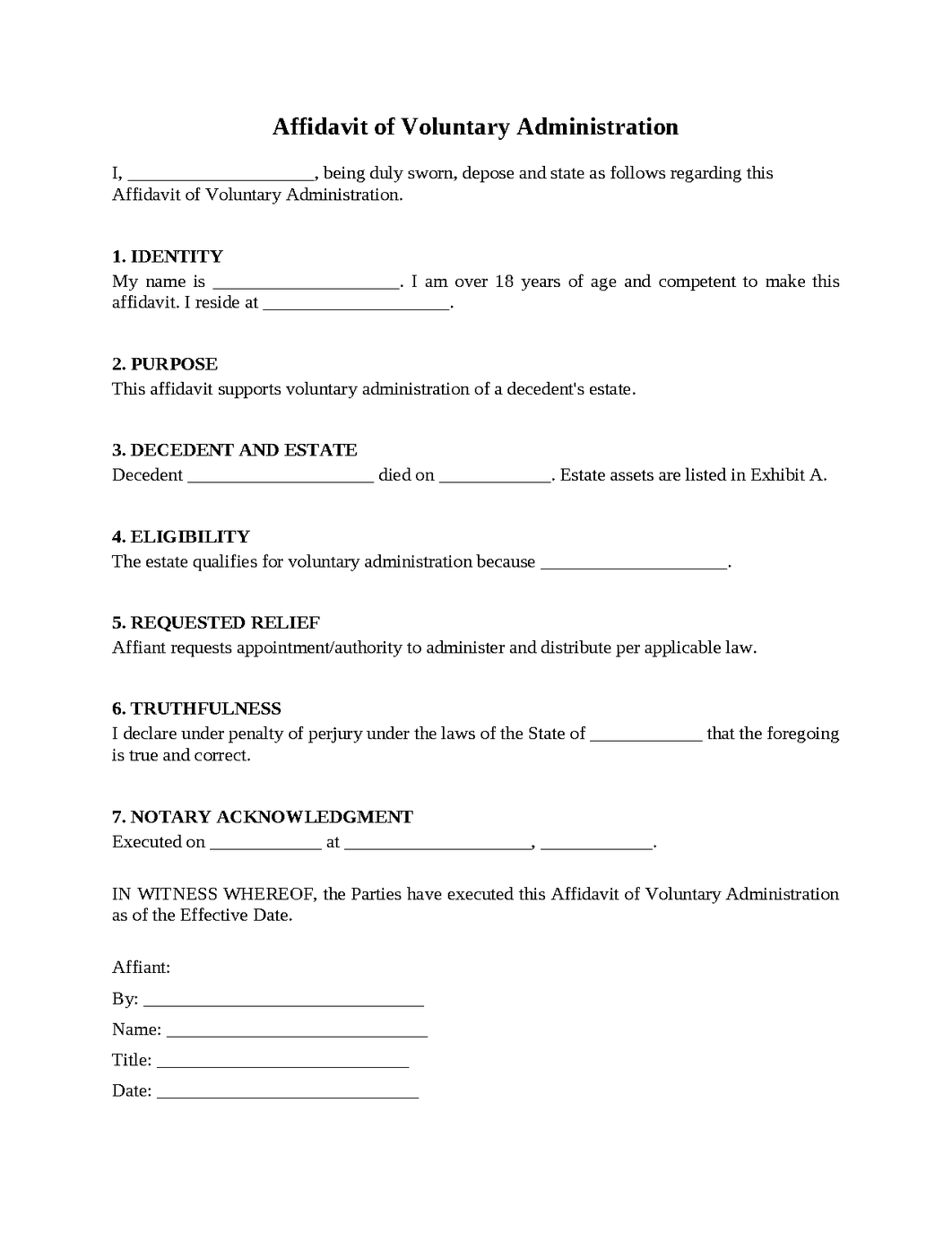
Affidavit of Voluntary Administration
An Affidavit of Voluntary Administration is a legal document used to simplify the administration of a deceased person's estate when the estate qualifies for a streamlined process under applicable law. Rather than going through a full probate proceeding, eligible family members or heirs may use a voluntary administration procedure to collect assets, pay obligations, and transfer property. The affidavit is commonly used for smaller estates that meet specific statutory requirements regarding value, asset types, and family relationships. Financial institutions, courts, government agencies, heirs, and estate representatives often rely on the affidavit when determining who has authority to act on behalf of the estate. While voluntary administration can save significant time and expense, questions regarding eligibility, heirs, creditors, and authority frequently arise. An Affidavit of Voluntary Administration helps document the relevant facts and establish the legal basis for handling the estate.
Family Members Disagree About Who Should Handle the Estate
A widowed mother passes away leaving behind a checking account, a vehicle, and several personal belongings. Her adult children agree that the estate appears small enough to qualify for voluntary administration, but they immediately disagree about who should be responsible for handling the process.
One child believes they should manage the estate because they lived closest to their mother. Another argues that they have more financial experience and should be responsible. A third sibling believes all decisions should be made collectively.
The disagreement creates delays before any paperwork is even filed. Bills remain unpaid, financial accounts remain inaccessible, and family members become increasingly frustrated.
Disputes regarding authority are common in estate administration. Even when family members generally agree regarding inheritance, disagreements often arise concerning who should communicate with banks, sign documents, collect assets, and manage estate affairs.
Without clear authority, institutions may hesitate to release information or transfer assets. Family members may duplicate efforts or make conflicting decisions. Administrative costs can increase unnecessarily.
An Affidavit of Voluntary Administration helps establish who is seeking authority to act on behalf of the estate and documents the basis for that authority. By creating a formal record, the affidavit can help reduce uncertainty and provide third parties with confidence regarding who may handle estate matters.
A Bank Refuses to Release Assets Without Proper Documentation
A son attempts to access his deceased father's savings account to pay funeral expenses and outstanding household bills. He assumes that providing a death certificate and proof of relationship will be sufficient.
Instead, the bank requests additional documentation demonstrating that he has authority to collect the funds. Although the account balance is relatively small, the institution cannot simply release money without verifying legal authority.
Banks face significant risks when handling deceased customers' accounts. Releasing assets to the wrong individual could expose the institution to legal liability. As a result, financial institutions often require clear documentation before transferring funds.
Family members frequently become frustrated by these requirements. They may believe ownership is obvious and that additional paperwork is unnecessary. However, institutions must protect themselves and other potential heirs.
Without appropriate documentation, access to funds may be delayed. This can create practical problems when estate expenses need immediate attention.
An Affidavit of Voluntary Administration helps provide the evidence financial institutions often require. By identifying the deceased person, describing the estate, and documenting the applicant's authority, the affidavit supports requests to collect and distribute assets.
The Estate Appears Small but Exceeds Eligibility Limits
A family believes a deceased relative's estate qualifies for voluntary administration because the person owned only a vehicle, a bank account, and personal belongings.
As the family begins gathering records, however, additional assets are discovered. An old brokerage account contains several thousand dollars. A forgotten savings account is located. The total value of the estate may now exceed the statutory limit for voluntary administration.
This situation occurs frequently because families do not always know the full extent of a deceased person's assets immediately after death. Financial accounts, refund claims, insurance proceeds, and personal property may be discovered gradually.
The eligibility issue becomes important because voluntary administration procedures are generally available only to estates meeting specific requirements. If those requirements are not satisfied, a more formal probate proceeding may be necessary.
Using the wrong procedure can create complications. Asset transfers may be challenged later, institutions may refuse to honor requests, and additional legal steps may become necessary.
An Affidavit of Voluntary Administration requires the applicant to identify estate assets and certify eligibility. The process encourages careful review of financial information before relying on simplified administration procedures.
A Creditor Appears After Assets Have Been Distributed
A family successfully uses voluntary administration procedures to transfer assets and distribute property among heirs. Several months later, a creditor contacts the family claiming that the deceased owed a substantial amount of money before death.
The heirs are surprised because they were unaware of the debt. Most of the estate assets have already been distributed, and some funds have been spent.
Creditors frequently create challenges during estate administration. While heirs often focus on inheritance issues, outstanding obligations may affect how assets should be handled.
Depending on applicable law, creditors may have rights that must be addressed before heirs receive distributions. Failure to consider legitimate claims can create legal complications later.
The situation becomes particularly difficult when distributed assets are no longer available or when multiple heirs received portions of the estate.
An Affidavit of Voluntary Administration generally requires disclosure regarding known debts and obligations. By documenting what was known at the time of administration, the affidavit helps establish a record of the information available when decisions were made.
An Unknown Heir Challenges the Estate Distribution
A deceased individual is survived by two children, both of whom participate in the voluntary administration process. The estate is administered and assets are distributed according to everyone's understanding of the family structure.
Nearly a year later, another individual comes forward claiming to be a child of the deceased. According to the claimant, they were unaware of the estate proceedings and never received notice regarding the distribution.
The challenge immediately creates uncertainty. If the claim is valid, the individual may be entitled to inherit part of the estate and could challenge prior distributions.
Unknown heirs can emerge for many reasons. Family histories may involve prior marriages, adoptions, estrangements, or relationships that were not widely known. Information available at the time of administration may later prove incomplete.
These situations can create emotional and financial difficulties for everyone involved. Property may need to be redistributed, and prior decisions may be questioned.
An Affidavit of Voluntary Administration requires the applicant to identify known heirs and explain their relationship to the deceased. While the affidavit cannot prevent future claims, it creates an important record showing the information relied upon during administration.
Voluntary administration procedures provide families with a simplified method for handling qualifying estates, often saving considerable time and expense compared to traditional probate proceedings. However, questions regarding authority, eligibility, creditors, heirs, and asset values can still arise. An Affidavit of Voluntary Administration helps document the facts necessary to establish eligibility and transfer estate assets properly. When completed accurately and supported by reliable information, the affidavit can help reduce uncertainty, facilitate estate administration, and provide institutions and heirs with greater confidence throughout the process.
:::

Get started with Upsign today!
Easily send, sign and track your documents