

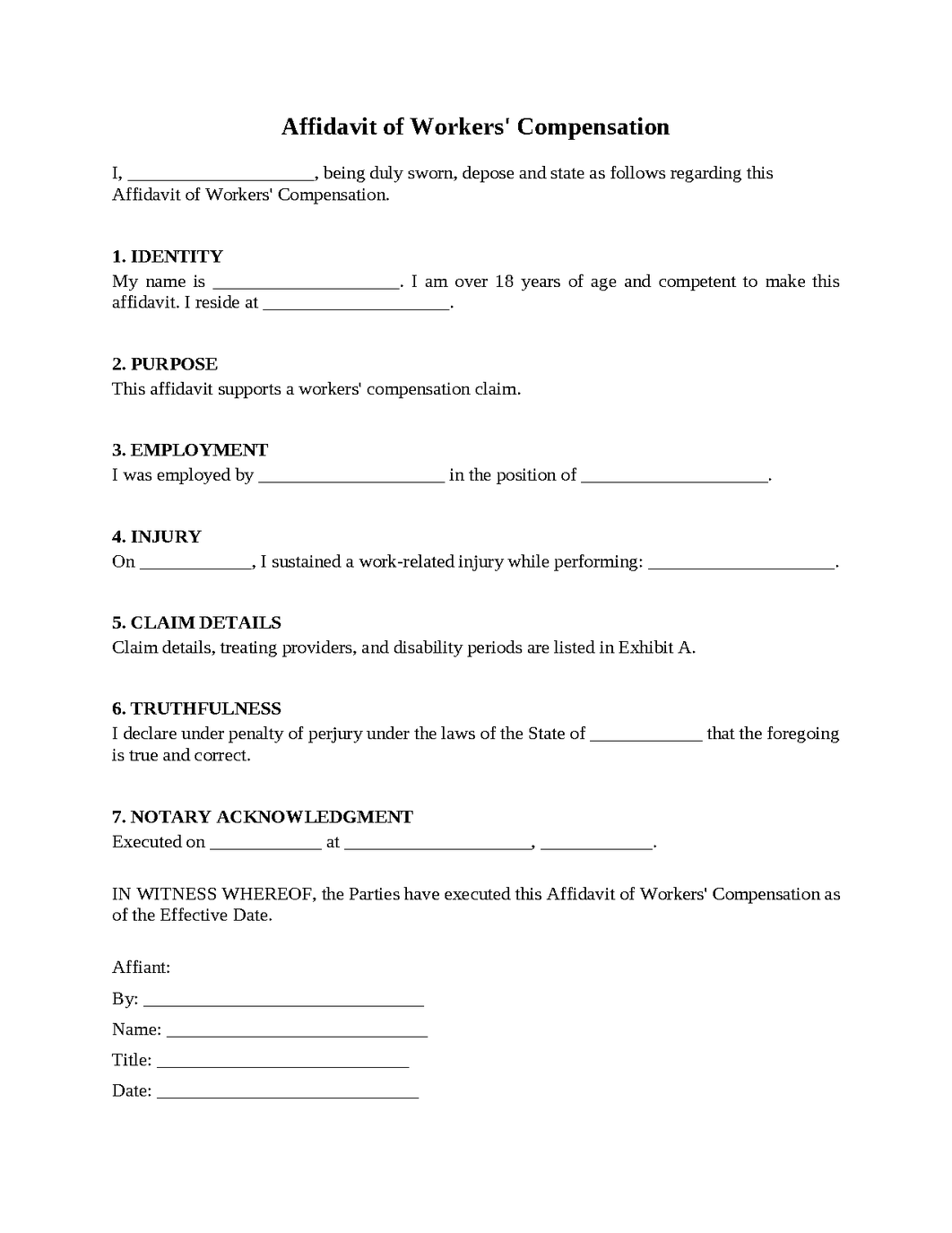
Affidavit of Workers' Compensation
An Affidavit of Workers' Compensation is a sworn statement used to verify facts relating to a workplace injury, workers' compensation coverage, benefits eligibility, claim status, employment circumstances, or compliance with workers' compensation laws. Employers, employees, insurance carriers, attorneys, government agencies, contractors, and courts frequently rely on these affidavits when evaluating workplace injury claims and determining whether workers' compensation requirements have been satisfied. The affidavit may be used to confirm coverage exists, verify that an injury occurred during employment, establish employment status, document benefit payments, or support legal and administrative proceedings. Because workers' compensation claims often involve substantial financial and legal consequences, accurate documentation is critical. An Affidavit of Workers' Compensation helps create a formal record of important facts and can reduce uncertainty when disputes arise.
An Employer Claims an Injured Worker Was Not an Employee
A construction laborer suffers a serious injury while working on a residential building project. Following the accident, the worker files a workers' compensation claim expecting that medical expenses and lost wages will be covered.
The employer responds by arguing that the worker was actually an independent contractor rather than an employee. According to the employer, workers' compensation coverage does not apply because the worker was responsible for their own insurance and taxes.
The injured worker strongly disagrees. They point out that the employer controlled their schedule, assigned daily tasks, supplied equipment, and supervised their work. From the worker's perspective, they functioned exactly like every other employee on the job site.
Disputes regarding employment status are among the most common workers' compensation issues. Employers and workers may have very different interpretations of the relationship, particularly in industries such as construction, transportation, delivery services, and home services.
The outcome can significantly affect the worker's ability to obtain medical treatment and wage replacement benefits. If workers' compensation coverage does not apply, the injured individual may need to pursue other legal remedies.
An Affidavit of Workers' Compensation helps document important facts regarding the employment relationship and can provide evidence regarding the worker's status at the time of the accident.
The Insurance Company Questions Whether the Injury Happened at Work
A warehouse employee reports a shoulder injury after lifting heavy inventory. The employee states that the injury occurred during a routine work assignment and files a workers' compensation claim.
During its investigation, the insurance carrier discovers that the employee recently participated in a recreational softball league and had previously complained about shoulder pain.
The insurer begins questioning whether the injury actually arose from work activities. The company wants to determine whether employment caused the injury or whether a preexisting condition or outside activity played a substantial role.
These disputes are common because many injuries involve symptoms that develop gradually rather than resulting from a single dramatic accident. Back injuries, joint problems, repetitive stress injuries, and muscle strains frequently lead to disagreements regarding causation.
The employee may feel that the answer is obvious because symptoms became worse while performing job duties. The insurer may view the situation differently and seek additional evidence before approving benefits.
An Affidavit of Workers' Compensation can help preserve the employee's account of how the injury occurred and provide a formal record of the circumstances surrounding the claim.
A Contractor Cannot Prove Workers' Compensation Coverage
A general contractor is preparing to bid on a large commercial construction project. As part of the qualification process, the project owner requires evidence that all contractors maintain appropriate workers' compensation coverage.
The contractor believes coverage exists and has maintained insurance for years. However, when documentation is requested, confusion arises regarding policy details and coverage periods.
The project owner refuses to move forward until proof of compliance is provided. The concern is understandable. If a worker is injured and proper coverage is not in place, significant liability exposure may result.
Many industries require proof of workers' compensation coverage before contracts are awarded. Government agencies, private businesses, and property owners frequently verify compliance before allowing work to begin.
Without adequate documentation, contractors may lose opportunities, experience delays, or face regulatory penalties.
An Affidavit of Workers' Compensation helps establish the existence of coverage and document compliance with workers' compensation requirements. The affidavit often serves as supplemental evidence when proof of insurance is requested.
A Worker Claims Benefits Were Never Paid Properly
An employee suffers a workplace injury and begins receiving workers' compensation benefits. Several months later, the employee alleges that benefit payments were calculated incorrectly and that certain wage replacement amounts remain unpaid.
The insurance carrier disagrees and maintains that all required payments have been made. Records are reviewed, payment histories are examined, and both sides present different interpretations of the claim.
Benefit disputes frequently arise because workers' compensation calculations can be complex. Average wage determinations, overtime earnings, temporary disability benefits, permanent disability awards, and medical reimbursements may all affect payment amounts.
Even when everyone agrees that an injury occurred, disagreements may emerge regarding how much compensation is owed.
Without clear documentation, resolving these disputes can become difficult. Administrative hearings, mediation proceedings, or court involvement may be required.
An Affidavit of Workers' Compensation helps create a formal record regarding benefits, claim history, and payment issues. The document may assist decision-makers when evaluating competing claims regarding compensation.
A Lawsuit Challenges Workers' Compensation Compliance
A manufacturing company experiences a serious workplace accident involving multiple employees. During the investigation, questions arise regarding whether workers' compensation requirements were satisfied fully before the incident occurred.
Attorneys representing injured workers begin examining employment records, insurance policies, safety programs, and compliance procedures. Government regulators also become involved.
The company maintains that all legal requirements were satisfied. Injured workers argue that certain obligations may have been overlooked.
Workers' compensation compliance issues can create substantial exposure for employers. Penalties, fines, benefit disputes, and additional legal claims may result if coverage requirements are not met.
Years after an accident occurs, organizations often need documentation establishing what coverage existed, what actions were taken, and what information was known at the time.
An Affidavit of Workers' Compensation helps preserve important facts regarding coverage, employment relationships, compliance efforts, and claim administration. The document can provide valuable evidence during audits, investigations, administrative proceedings, and litigation.
Workers' compensation systems exist to provide financial and medical support when employees suffer work-related injuries. Questions regarding employment status, injury causation, insurance coverage, benefit payments, and legal compliance frequently arise during the claims process. An Affidavit of Workers' Compensation provides a practical method for documenting important facts and creating a sworn record regarding workplace injury matters. When completed accurately and supported by reliable information, the affidavit can help reduce disputes, support claims administration, and provide employers, employees, insurers, and decision-makers with greater confidence when evaluating workers' compensation issues.
:::

Get started with Upsign today!
Easily send, sign and track your documents