

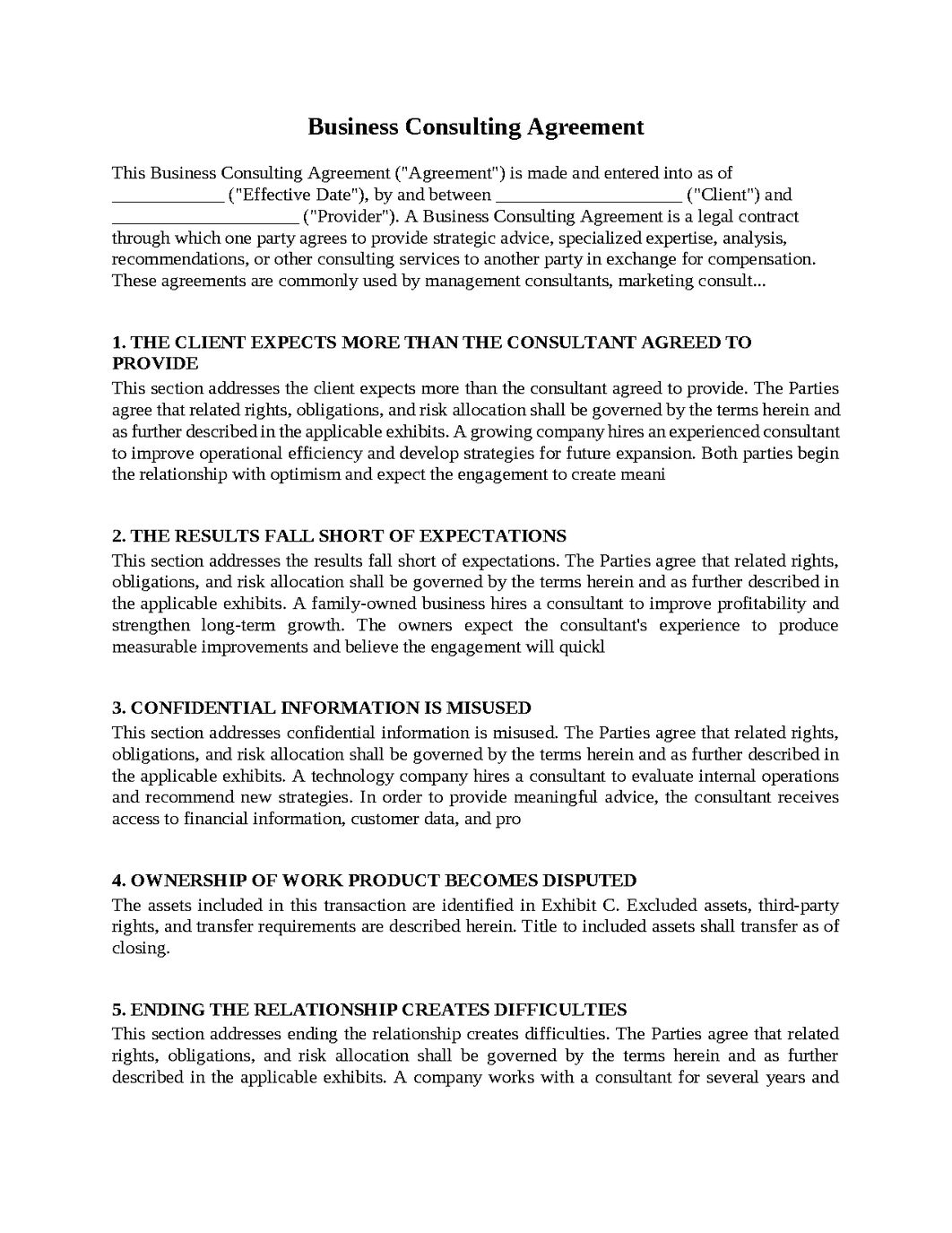
Business Consulting Agreement
A Business Consulting Agreement is a legal contract through which one party agrees to provide strategic advice, specialized expertise, analysis, recommendations, or other consulting services to another party in exchange for compensation. These agreements are commonly used by management consultants, marketing consultants, financial advisors, operations specialists, technology consultants, human resources professionals, and industry experts. A Business Consulting Agreement typically addresses the scope of services, compensation, deliverables, confidentiality obligations, intellectual property rights, and procedures for modifying or terminating the engagement. Because consulting relationships often involve subjective expectations and intangible results, disputes can arise when the parties fail to define responsibilities and performance standards clearly. A carefully drafted Business Consulting Agreement helps establish certainty and preserve productive business relationships.
The Client Expects More Than the Consultant Agreed to Provide
A growing company hires an experienced consultant to improve operational efficiency and develop strategies for future expansion. Both parties begin the relationship with optimism and expect the engagement to create meaningful improvements throughout the business.
Initially, the consultant performs the services described during the negotiations and delivers recommendations designed to address key challenges. As management becomes increasingly satisfied with the consultant's work, additional requests begin emerging that extend beyond the original project.
The client believes the consultant's role naturally includes helping implement recommendations, training employees, and assisting with unrelated projects. The consultant believes those responsibilities were never part of the engagement and that additional work should require separate compensation. As expectations continue expanding, frustrations develop because each side believes the other has changed the original understanding of the relationship.
To help avoid this problem, a Business Consulting Agreement should clearly define the scope of services and establish procedures for approving additional projects and compensation.
The Results Fall Short of Expectations
A family-owned business hires a consultant to improve profitability and strengthen long-term growth. The owners expect the consultant's experience to produce measurable improvements and believe the engagement will quickly generate positive results.
Over the following months, the consultant provides reports, recommendations, and strategic guidance. Although certain improvements are implemented, revenues and profits fail to increase as dramatically as the owners originally anticipated.
The owners become disappointed and believe the consultant's advice should have produced stronger results. The consultant argues that recommendations were delivered appropriately but that external market conditions and management decisions influenced the outcome. As financial pressures increase, both sides begin questioning whether the engagement provided the value that had originally been expected.
To help prevent these issues, a Business Consulting Agreement should clearly establish performance expectations and distinguish recommendations from guaranteed outcomes.
Confidential Information Is Misused
A technology company hires a consultant to evaluate internal operations and recommend new strategies. In order to provide meaningful advice, the consultant receives access to financial information, customer data, and proprietary processes.
At the beginning of the engagement, both parties focus on improving performance and creating competitive advantages. Over time, however, concerns emerge when information shared during the engagement appears to be referenced in unrelated projects involving other businesses.
The company believes confidential information should remain protected and used solely for purposes connected with the engagement. The consultant believes industry knowledge and experience naturally overlap among clients and denies disclosing proprietary information. As concerns about confidentiality grow, trust begins deteriorating and both sides become increasingly protective of their interests.
To help avoid these problems, a Business Consulting Agreement should clearly define confidential information and establish obligations governing its use, protection, and return.
Ownership of Work Product Becomes Disputed
A manufacturing company hires a consultant to develop new procedures and create specialized documentation for internal use. Throughout the engagement, both parties work closely together and contribute ideas that improve efficiency and productivity.
As the project progresses, valuable reports, training materials, and proprietary methodologies are created. The company assumes ownership of everything developed during the engagement because the work was performed for its benefit.
The consultant believes certain tools, templates, and methodologies represent years of experience and should remain available for future clients. The company believes the materials were created specifically for the project and should belong exclusively to the business. As the value of the work product becomes increasingly apparent, disagreements emerge regarding ownership and future use.
To help prevent these issues, a Business Consulting Agreement should clearly define ownership rights and distinguish between preexisting materials and work product created during the engagement.
Ending the Relationship Creates Difficulties
A company works with a consultant for several years and gradually incorporates many of the consultant's recommendations and systems into daily operations. Both parties expect the relationship to continue and develop a strong level of trust over time.
Eventually, changes in strategy lead the company to terminate the engagement. Although both sides expect the transition to proceed smoothly, disagreements quickly arise regarding unfinished projects, access to records, and the amount of support that should continue after termination.
The company believes continued assistance is necessary to avoid disrupting operations and to ensure a successful transition. The consultant believes responsibilities should conclude promptly and wishes to focus on other opportunities. As discussions become more difficult, both sides realize that ending the relationship is more complicated than they originally anticipated.
To help avoid this problem, a Business Consulting Agreement should clearly establish termination procedures and identify any obligations that survive the conclusion of the engagement.
Business Consulting Agreements are valuable tools for businesses seeking specialized expertise and strategic guidance. However, issues involving expanding scopes of work, unmet expectations, confidentiality concerns, ownership of work product, and termination responsibilities can become significant sources of conflict when expectations are not documented clearly. A carefully drafted Business Consulting Agreement provides a structured framework for defining responsibilities and protecting the interests of both parties. When prepared thoughtfully, it can reduce uncertainty, strengthen professional relationships, support successful projects, and provide the foundation necessary for productive long-term consulting engagements.

Get started with Upsign today!
Easily send, sign and track your documents