

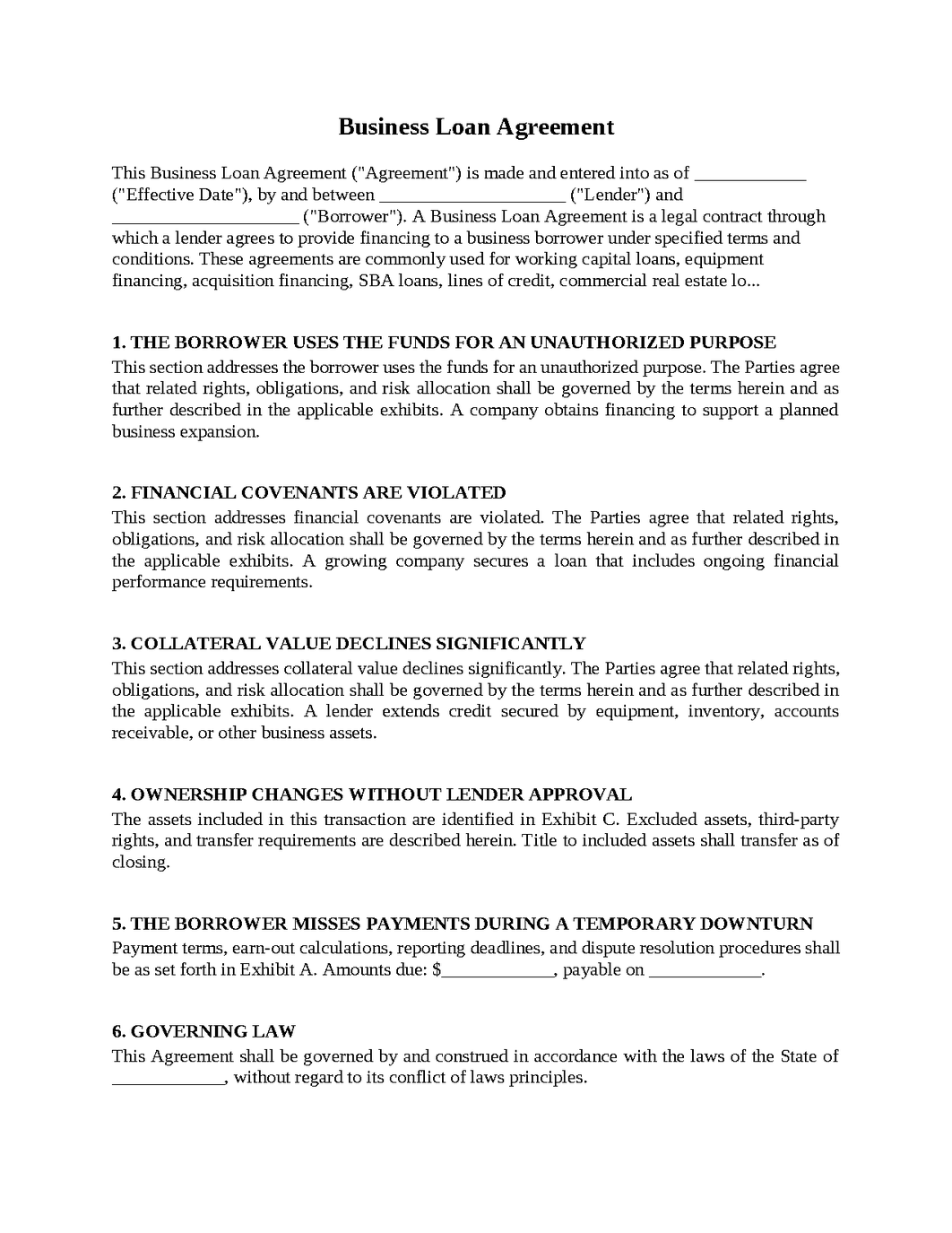
Business Loan Agreement
A Business Loan Agreement is a legal contract through which a lender agrees to provide financing to a business borrower under specified terms and conditions. These agreements are commonly used for working capital loans, equipment financing, acquisition financing, SBA loans, lines of credit, commercial real estate loans, inventory financing, expansion projects, and general business purposes. A Business Loan Agreement typically addresses the loan amount, interest rate, repayment schedule, collateral requirements, financial covenants, reporting obligations, events of default, and the rights and remedies of the parties. Because commercial loans often involve substantial amounts of money and long-term financial commitments, disputes can arise when expectations regarding repayment, financial performance, or lender rights are not documented clearly. A carefully drafted Business Loan Agreement helps establish certainty and protect both lenders and borrowers.
The Borrower Uses the Funds for an Unauthorized Purpose
A company obtains financing to support a planned business expansion.
The lender approves the loan after reviewing financial projections, business plans, and the intended use of proceeds. Both parties expect the funds to be used for the specific purposes described during underwriting.
After the loan is funded, the borrower redirects a significant portion of the proceeds toward unrelated activities. The lender later discovers that the funds were not used as originally represented.
The borrower believes the business should have flexibility in determining how capital is deployed. The lender argues that the financing decision was based on a particular business purpose and risk profile.
The disagreement centers on whether the borrower complied with the obligations associated with the loan.
To help avoid this problem, a Business Loan Agreement should clearly define permitted uses of loan proceeds and establish reporting requirements that allow the lender to verify compliance.
Financial Covenants Are Violated
A growing company secures a loan that includes ongoing financial performance requirements.
The Business Loan Agreement contains covenants relating to profitability, leverage, liquidity, debt service coverage, or other financial metrics. At closing, the borrower expects to satisfy these requirements without difficulty.
Unexpected market conditions, rising expenses, or operational challenges cause financial performance to deteriorate. Periodic reporting reveals that one or more covenants have been breached.
The borrower believes the violations are temporary and do not justify lender intervention. The lender views covenant compliance as an important part of the credit relationship.
The disagreement focuses on the consequences of the covenant breach and the lender's available remedies.
To help prevent these issues, a Business Loan Agreement should clearly define financial covenants, reporting obligations, cure rights, and the consequences of noncompliance.
Collateral Value Declines Significantly
A lender extends credit secured by equipment, inventory, accounts receivable, or other business assets.
At the time the loan is approved, the collateral appears sufficient to support the financing arrangement. Both parties are comfortable with the collateral structure.
Over time, economic conditions change and the value of the collateral declines substantially. Equipment depreciates faster than expected, inventory becomes obsolete, or receivables prove difficult to collect.
The lender becomes concerned about its ability to recover the loan balance if repayment problems arise. The borrower believes the decline is temporary and should not affect the loan relationship.
The disagreement centers on whether additional collateral or other protective measures are required.
To help avoid these problems, a Business Loan Agreement should clearly address collateral maintenance requirements and establish procedures for responding to material declines in collateral value.
Ownership Changes Without Lender Approval
A business obtains financing and continues operating successfully for several years.
The owners later decide to sell a significant ownership interest to new investors or reorganize the company's ownership structure. The transaction appears beneficial from the owners' perspective.
After learning of the change, the lender questions whether the new ownership group presents different risks than those evaluated during underwriting. The lender argues that approval should have been obtained before the transaction occurred.
The borrower believes ownership decisions are internal business matters that do not affect repayment obligations. The lender believes ownership was an important factor in the original credit decision.
The disagreement focuses on whether the ownership change violated the loan agreement.
To help prevent these issues, a Business Loan Agreement should clearly address ownership changes, control transactions, and circumstances requiring lender consent.
The Borrower Misses Payments During a Temporary Downturn
A company experiences a temporary decline in revenue due to economic conditions, customer losses, or industry disruptions.
Although management believes the business will recover, cash flow becomes strained and scheduled loan payments are missed. The lender begins evaluating available remedies under the Business Loan Agreement.
The borrower requests additional time and argues that the difficulties are temporary. The lender must balance the desire to support the customer against the need to protect its financial interests.
The parties disagree regarding the appropriate response to the payment default. The borrower seeks flexibility while the lender seeks assurance that repayment will occur.
The disagreement becomes increasingly important as missed payments continue.
To help avoid these problems, a Business Loan Agreement should clearly define events of default, grace periods, workout options, and the remedies available to the lender.
Business Loan Agreements are among the most important documents in commercial lending because they govern the relationship between borrowers and lenders throughout the life of a loan. However, issues involving use of proceeds, financial covenants, collateral value, ownership changes, and payment defaults can become significant sources of conflict when expectations are not documented clearly. A carefully drafted Business Loan Agreement provides a structured framework for allocating risk and defining the rights and responsibilities of both parties. When prepared thoughtfully, it can reduce uncertainty, support successful lending relationships, protect financial interests, and provide the clarity necessary for businesses and lenders to achieve their objectives.

Get started with Upsign today!
Easily send, sign and track your documents