

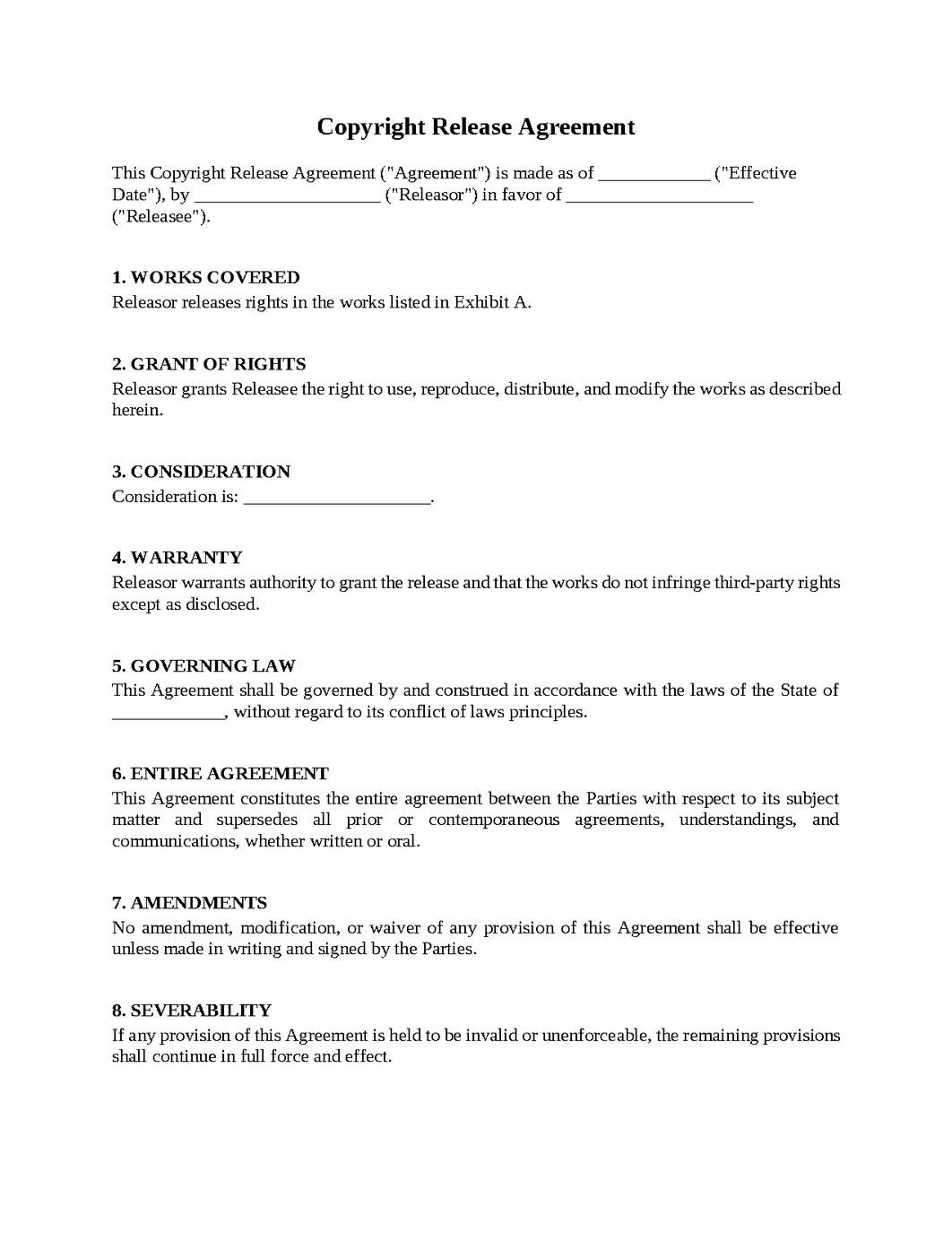
Copyright Release Agreement
A Copyright Release Agreement is a legal contract through which a copyright owner transfers, releases, assigns, waives, or relinquishes certain rights relating to a copyrighted work. These agreements are commonly used by authors, photographers, graphic designers, software developers, musicians, filmmakers, publishers, marketing agencies, content creators, and businesses that create or use intellectual property. A Copyright Release Agreement may transfer ownership entirely, grant broad usage rights, release claims relating to prior uses, or otherwise clarify who controls the copyrighted material going forward. Because creative works often increase in value over time and may be used in ways not originally anticipated, disputes can arise when the parties have different understandings regarding ownership and usage rights. A carefully drafted Copyright Release Agreement helps establish certainty regarding intellectual property rights while reducing the risk of future conflicts.
The Creator Believes Only Limited Rights Were Intended
A freelance designer creates a collection of original graphics for a growing business.
The project is completed successfully, and the business pays the agreed compensation. As part of the transaction, the parties execute a Copyright Release Agreement intended to address ownership and usage rights.
Several years later, the business expands and begins using the graphics in new products, national advertising campaigns, and additional marketing materials. The designer becomes concerned because the scope of the usage is far broader than originally anticipated.
The business believes the Copyright Release Agreement transferred all necessary rights to use the work without restriction. The designer believes only limited rights were intended and that broader commercial uses should require additional compensation.
The disagreement develops because the parties never shared the same understanding regarding the extent of the released copyright rights.
To help avoid this problem, a Copyright Release Agreement should clearly define the rights being transferred or released and explain whether the recipient receives limited usage rights or complete ownership.
The Work Becomes More Valuable Than Anyone Expected
An author creates written content for a small publishing project.
At the time the Copyright Release Agreement is signed, neither party expects the work to generate substantial revenue. The creator receives compensation and transfers the agreed rights to the publisher.
Over the following years, the content becomes unexpectedly successful. The work is republished, translated, licensed internationally, and incorporated into additional products that generate significant revenue.
The creator begins to believe that the original compensation was inadequate given the value ultimately created. The publisher maintains that the agreement was negotiated fairly and that the transferred rights belong entirely to the publisher.
The disagreement is fueled by success that neither side anticipated when the agreement was signed.
To help prevent these issues, a Copyright Release Agreement should clearly address ownership rights and explain whether the creator retains any continuing interest in future revenue or derivative uses.
Derivative Works Become a Source of Conflict
A software developer creates custom code for a business project.
The parties execute a Copyright Release Agreement as part of the engagement and move forward without incident. The business later modifies the software and uses portions of the original code to develop additional products and services.
The developer becomes concerned that the new products differ substantially from the original project and were never discussed during the engagement. The business believes the released copyright rights include the ability to modify, adapt, and build upon the original work.
Both sides agree that the original project was covered by the agreement. The disagreement centers on whether the recipient also obtained the right to create derivative works.
The issue becomes increasingly important as the value of the new products grows.
To help avoid these problems, a Copyright Release Agreement should clearly address derivative works, modifications, adaptations, and other future uses of the copyrighted material.
Multiple Contributors Claim Ownership
A marketing agency coordinates a large creative project involving writers, photographers, graphic designers, and videographers.
The final product combines contributions from multiple individuals into a single campaign. Copyright Release Agreements are obtained from some contributors, while others rely on informal understandings regarding ownership.
Years later, questions arise regarding who owns various portions of the project. Certain contributors claim that their work was never properly transferred and that they retain copyright interests in portions of the campaign.
The agency believes it obtained all necessary rights to use and distribute the completed project. The contributors point to gaps in documentation and argue that ownership was never fully resolved.
The disagreement creates uncertainty regarding who controls the intellectual property.
To help prevent these issues, a Copyright Release Agreement should clearly identify the copyrighted works involved and ensure that ownership rights are addressed consistently for all contributors.
A Former Creator Challenges Continued Use
A company acquires copyrighted materials through a Copyright Release Agreement and incorporates them into its long-term branding strategy.
For several years, the relationship between the parties remains positive. The company continues using the materials in advertisements, websites, packaging, and customer communications.
Eventually, the creator becomes dissatisfied with the company's business practices or public image and no longer wants the work associated with the organization. The creator asks the company to stop using the copyrighted materials.
The company explains that the Copyright Release Agreement granted rights intended to survive indefinitely. The creator believes personal objections should allow the use to be discontinued.
The disagreement focuses on whether transferred rights can effectively be withdrawn after the agreement has been executed.
To help avoid these problems, a Copyright Release Agreement should clearly define the duration of the transferred rights and explain whether any rights may be revoked after the agreement becomes effective.
Copyright Release Agreements play a critical role in clarifying ownership and usage rights relating to creative works and intellectual property. However, issues involving the scope of transferred rights, unexpected commercial success, derivative works, multiple contributors, and ongoing usage rights can become significant sources of conflict when expectations are not documented clearly. A carefully drafted Copyright Release Agreement provides a structured framework for allocating intellectual property rights and establishing clear ownership. When prepared thoughtfully, it can reduce uncertainty, protect creative and business interests, support commercial use of copyrighted materials, and provide lasting certainty for all parties involved.

Get started with Upsign today!
Easily send, sign and track your documents