

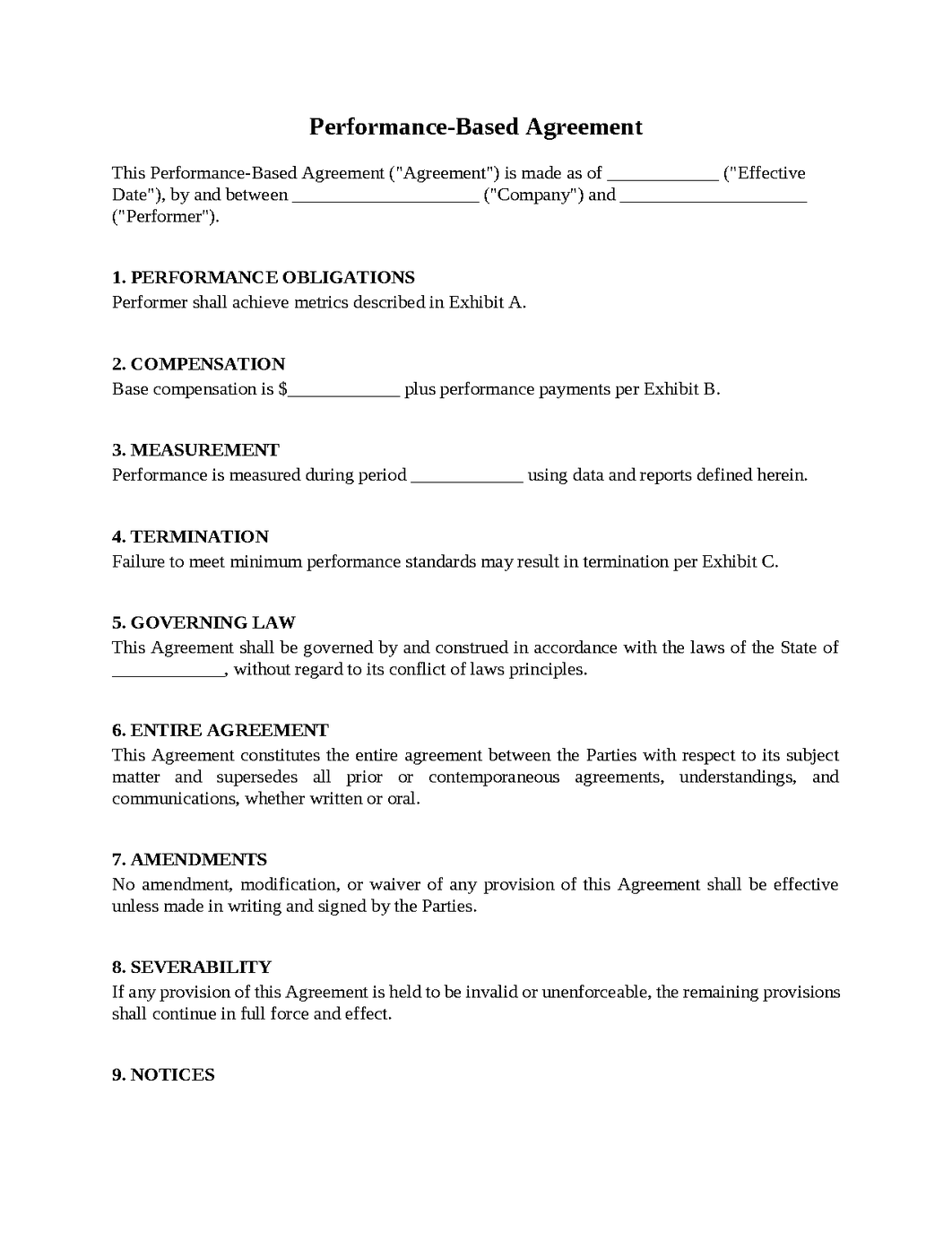
Performance-Based Agreement
A Performance-Based Agreement is a legal contract in which compensation, incentives, bonuses, payments, or other benefits are tied to the achievement of specific performance metrics, milestones, outcomes, or results. Unlike traditional agreements that compensate a party based solely on time, effort, or fixed deliverables, Performance-Based Agreements focus on measurable achievements. These agreements are commonly used in sales arrangements, consulting engagements, marketing services, executive compensation plans, construction projects, vendor relationships, government contracts, and business development partnerships. While performance-based structures can align incentives and encourage results, disputes frequently arise when expectations, measurement standards, or performance criteria are not defined clearly. A well-drafted Performance-Based Agreement helps establish objective standards for evaluating success and determining compensation.
The Parties Disagree About What Constitutes Success
A software company hires a business development consultant to help generate new customers.
Rather than paying a large fixed fee, the company proposes a performance-based arrangement. The consultant will receive substantial compensation if certain growth objectives are achieved.
Both parties are enthusiastic about the structure because it appears to align incentives.
The agreement states that compensation will be paid if the consultant helps "increase sales significantly."
Initially, neither side views this language as problematic.
Several months later, sales increase dramatically. The consultant claims success and requests payment under the agreement.
The company disagrees.
Management argues that sales growth resulted primarily from a new product launch and broader market conditions. The consultant insists that customer introductions and strategic advice were responsible for much of the increase.
Because "increase sales significantly" was never defined objectively, both parties interpret success differently.
What should have been a straightforward compensation decision becomes a dispute regarding performance measurement.
To help avoid this problem, a Performance-Based Agreement should define success using specific, measurable criteria. Revenue targets, customer acquisition numbers, profit thresholds, timelines, and calculation methods should be documented clearly so both parties understand how performance will be evaluated.
External Factors Affect the Results
A manufacturer hires a sales agency under a performance-based arrangement.
Compensation is tied directly to achieving specified sales growth targets over the next twelve months.
The sales agency works aggressively to generate new business and invests significant resources into promoting the manufacturer's products.
Midway through the contract term, however, an unexpected economic downturn affects the industry. Customer demand declines sharply, purchasing budgets shrink, and sales opportunities become increasingly difficult to close.
Although the agency performs its responsibilities diligently, the agreed-upon targets are not achieved.
The manufacturer argues that compensation should not be paid because the required results were not obtained.
The agency responds that external market conditions—not poor performance—prevented achievement of the targets.
The disagreement becomes increasingly contentious because both sides believe their position is reasonable.
To reduce these risks, a Performance-Based Agreement should address how external factors, market disruptions, economic conditions, regulatory changes, and force majeure events will affect performance measurements. The agreement should establish whether targets may be adjusted under extraordinary circumstances.
The Client Controls Information Needed to Measure Performance
A marketing firm enters into a performance-based agreement with an online retailer.
The firm's compensation depends on increasing sales generated through digital advertising campaigns.
The marketing firm launches campaigns successfully and begins generating customer traffic. To calculate compensation, however, the firm must rely on sales data maintained by the retailer.
As revenue grows, disagreements emerge regarding the numbers.
The retailer reports lower sales figures than the marketing firm expected. The marketing firm questions whether all relevant transactions are being included in the calculations.
Because the retailer controls the data, the marketing firm has limited visibility into the underlying records.
Trust begins deteriorating.
The dispute is not necessarily caused by dishonesty but by uncertainty regarding how performance is being measured.
To help prevent these issues, a Performance-Based Agreement should establish reporting requirements, audit rights, access to supporting documentation, and detailed procedures for calculating performance metrics. Transparency can significantly reduce disagreements regarding results.
The Parties Never Defined When Payment Is Earned
A commercial real estate broker enters into a performance-based arrangement with a property owner.
The broker will receive substantial compensation if a large tenant is secured for a vacant property.
After months of effort, the broker successfully negotiates a lease agreement with a prospective tenant.
Shortly before occupancy begins, however, the tenant experiences financial difficulties and terminates the lease.
The broker argues that payment was earned when the lease was executed.
The property owner argues that compensation should only be paid if the tenant actually occupies the property and begins making rent payments.
The agreement provides little guidance.
Both parties believed they understood the arrangement when it was signed, yet neither anticipated this specific situation.
The dispute centers on when performance was achieved and when compensation became payable.
To reduce these risks, a Performance-Based Agreement should clearly identify the events that trigger payment. The agreement should specify whether compensation is earned upon signing, completion, implementation, collection of revenue, or some other milestone.
Performance Incentives Encourage Unintended Behavior
A healthcare company implements a performance-based compensation program for its sales representatives.
Bonuses are tied almost entirely to the number of new customer accounts generated.
The program initially appears successful. Customer acquisition increases rapidly, and management is pleased with the results.
Over time, however, problems emerge.
Sales representatives become focused exclusively on opening new accounts. Existing customer relationships receive less attention. Some representatives prioritize quantity over quality and pursue customers that are unlikely to remain profitable long term.
The company achieves the target metric but experiences unintended consequences.
Customer retention declines, service issues increase, and profitability suffers.
Management realizes that the performance incentives encouraged behavior that was technically compliant with the agreement but inconsistent with broader business objectives.
To help avoid these issues, a Performance-Based Agreement should use balanced performance metrics whenever possible. Quality standards, customer retention measures, compliance requirements, profitability thresholds, and other factors may be necessary to ensure incentives promote desired outcomes rather than unintended behavior.
Performance-Based Agreements can be powerful tools for aligning incentives and rewarding results. By linking compensation to measurable outcomes, these agreements often encourage accountability, efficiency, and strong performance. However, disputes frequently arise when success metrics, measurement methods, payment triggers, or external influences are not defined clearly. A well-drafted Performance-Based Agreement provides a structured framework for evaluating performance and allocating rewards fairly. When prepared carefully, it can help reduce misunderstandings, align expectations, and create stronger relationships between the parties involved.

Get started with Upsign today!
Easily send, sign and track your documents