

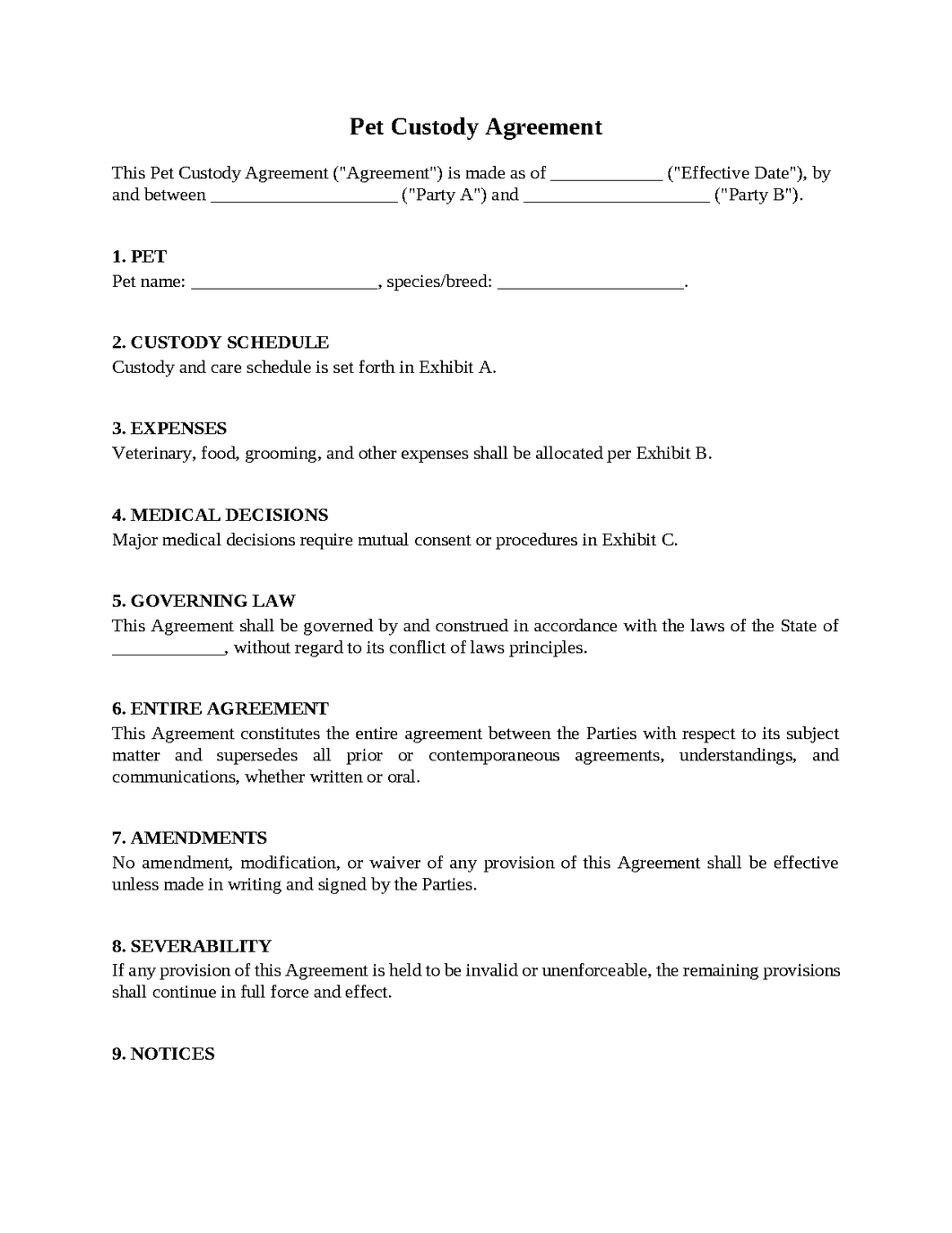
Pet Custody Agreement
A Pet Custody Agreement is a legal contract that establishes ownership, possession, care responsibilities, and decision-making rights regarding a pet when two or more individuals have competing claims or ongoing interests in the animal. Pet Custody Agreements are commonly used following divorces, breakups, roommate separations, family disputes, co-ownership arrangements, and situations where multiple individuals have shared responsibility for a pet over an extended period. Because many people consider pets to be family members rather than property, disagreements regarding custody can become highly emotional and difficult to resolve. A well-drafted Pet Custody Agreement helps establish clear expectations regarding possession, expenses, visitation rights, medical decisions, and future ownership issues before disputes escalate.
Both Parties Believe They Are the Pet's Primary Owner
A couple adopts a golden retriever during a long-term relationship. One person pays the adoption fee, while the other covers most veterinary expenses. Both participate in training, daily care, and exercise.
For several years, ownership is never questioned because the relationship remains stable and both parties share responsibility for the dog.
Eventually, the relationship ends.
As the couple separates, each person believes they should keep the dog. One argues that the adoption paperwork is in their name. The other points out that they have been responsible for most of the daily care and financial support.
The disagreement becomes increasingly emotional because both individuals have developed a strong bond with the animal. Friends and family members become involved, and what should be a manageable separation turns into a highly personal conflict.
Neither party can agree on who should have permanent possession.
To help avoid this problem, a Pet Custody Agreement should clearly identify ownership rights, establish which party will have primary custody, and document the factors considered when determining future possession. Addressing ownership questions directly can eliminate significant uncertainty if the relationship later ends.
Shared Custody Becomes Difficult to Manage
After an amicable separation, two former partners agree to share custody of their dog.
Initially, the arrangement works well. The dog spends alternating weeks with each person, and both parties remain committed to maintaining the schedule.
Over time, however, practical challenges begin emerging.
Work schedules change. Vacations are planned. New relationships develop. One party relocates farther away, making exchanges increasingly inconvenient. The dog begins missing scheduled transitions because the parties cannot coordinate effectively.
Disagreements arise regarding pickup locations, transportation responsibilities, and schedule modifications.
The flexibility that initially made the arrangement appealing now creates uncertainty and frustration.
To reduce these risks, a Pet Custody Agreement should establish a detailed custody schedule, identify exchange procedures, allocate transportation responsibilities, and provide mechanisms for resolving scheduling conflicts. Specific terms can help prevent ongoing disagreements about possession and visitation.
Veterinary Decisions Create Conflict
Two individuals share ownership of a cat under an informal arrangement.
For several years, no major issues arise. Then the cat develops a medical condition requiring significant treatment.
One owner wants to pursue an expensive surgical procedure recommended by a veterinarian. The other believes less costly alternatives should be considered first.
The disagreement quickly becomes emotional because both individuals care deeply about the animal's well-being.
At the same time, substantial financial commitments are involved, and neither party wants to bear the full cost of treatment alone.
As the dispute continues, important medical decisions are delayed.
The parties eventually realize they never established procedures for handling healthcare decisions or allocating veterinary expenses.
To help prevent these problems, a Pet Custody Agreement should identify who has authority to make medical decisions, establish procedures for obtaining treatment, and allocate responsibility for veterinary expenses. The agreement should also address emergency situations where immediate action may be required.
One Party Wants to Relocate with the Pet
A divorced couple enters into a shared custody arrangement involving their dog.
Several years later, one party receives a job opportunity in another state and plans to relocate permanently. The move would make the existing custody schedule impossible to maintain.
The relocating owner believes the dog should move as well because the new home offers a stable environment and better living conditions.
The other owner strongly disagrees.
The dog has spent years dividing time between both households, and the non-relocating owner does not want to lose regular contact with the animal.
What initially appeared to be a personal career decision becomes a major dispute regarding the pet's future.
The parties discover that their agreement never addressed relocation issues.
To reduce these risks, a Pet Custody Agreement should establish procedures for relocation, identify notice requirements, and explain how custody arrangements may be modified if one party moves a significant distance away. Planning for future life changes can help avoid contentious disputes later.
Future Expenses Become a Source of Resentment
Two roommates adopt a dog together while living in the same apartment.
After moving into separate residences, they continue sharing responsibility for the pet. Initially, both contribute equally toward food, grooming, veterinary care, and other expenses.
Over time, however, disagreements begin developing.
One person believes they are paying more than their fair share. Unexpected medical expenses arise, and neither party wants to assume primary responsibility for the costs.
Receipts are disputed. Reimbursements are delayed. Small disagreements gradually grow into larger conflicts.
The relationship becomes strained because financial expectations were never documented clearly.
The parties care about the dog but become increasingly frustrated with one another.
To help avoid these issues, a Pet Custody Agreement should clearly allocate responsibility for routine expenses, emergency medical costs, insurance premiums, grooming, training, and other financial obligations. The agreement should also establish reimbursement procedures and payment deadlines to reduce future misunderstandings.
Pets often occupy a unique place in people's lives, serving as companions, family members, and sources of emotional support. As a result, disputes regarding ownership and custody can become far more personal than ordinary property disagreements. A Pet Custody Agreement provides a structured framework for addressing ownership rights, possession schedules, healthcare decisions, financial responsibilities, and future life changes before conflicts arise. When drafted carefully, it can help reduce uncertainty, protect the pet's well-being, preserve relationships, and provide clear guidance for managing shared responsibilities over time.

Get started with Upsign today!
Easily send, sign and track your documents