

Accountant Contract
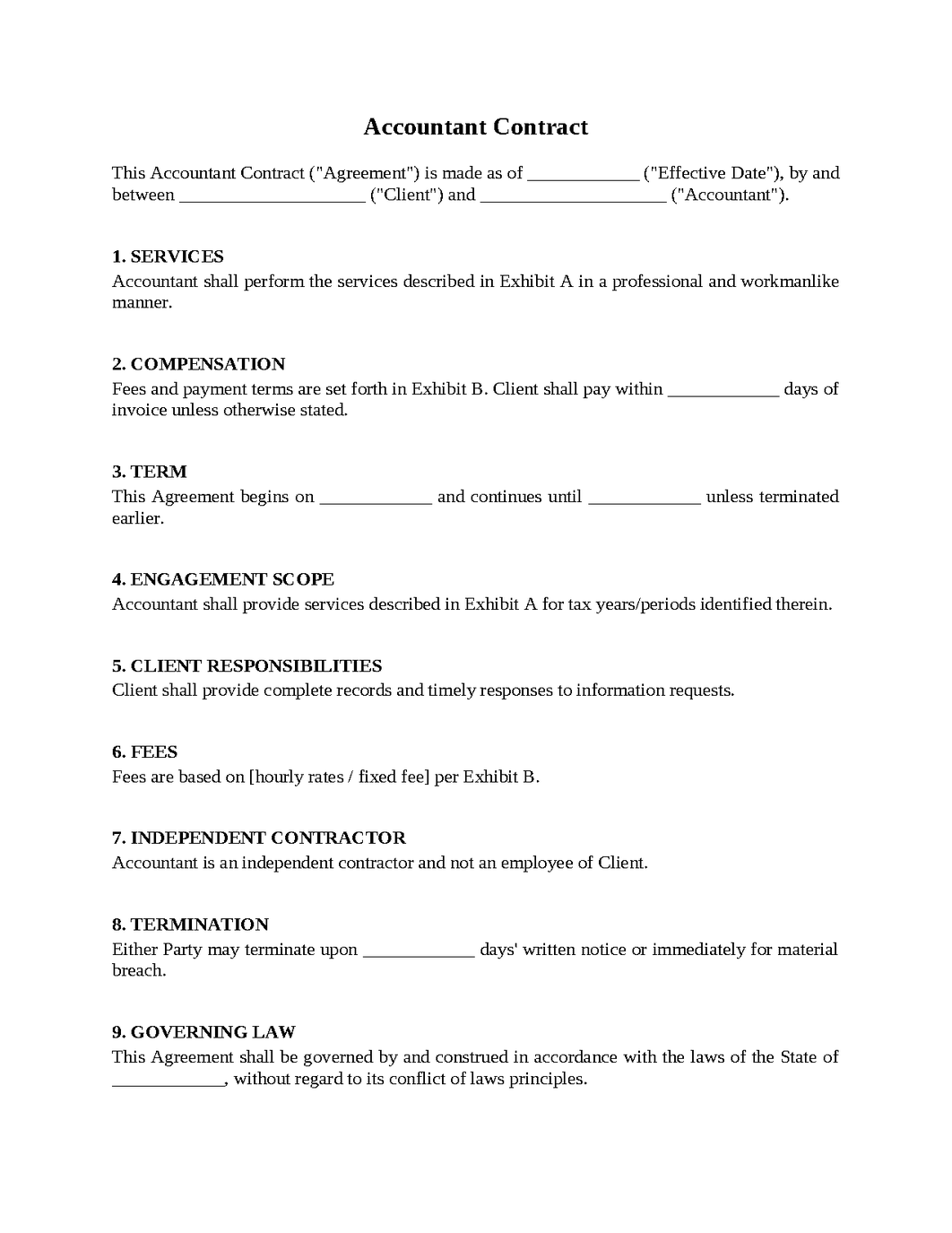
An Accountant Contract is a legal agreement that establishes the terms under which an accountant, accounting firm, bookkeeper, CPA, or financial professional provides accounting-related services to a client. These agreements are commonly used for bookkeeping, tax preparation, payroll administration, financial reporting, audit support, budgeting, business consulting, and other accounting services. An Accountant Contract typically addresses the scope of services, client responsibilities, fees, confidentiality obligations, recordkeeping requirements, professional standards, and termination rights. Because accountants often rely on information supplied by clients and work with sensitive financial data, disputes can arise when expectations and responsibilities are not documented clearly. A well-drafted Accountant Contract helps protect both the accountant and the client while promoting a productive professional relationship.
The Client Expects Services Beyond the Original Engagement
A small business hires an accountant to prepare monthly financial statements and assist with routine bookkeeping matters.
At the beginning of the relationship, both parties have a clear understanding of the services being provided. The accountant organizes records, prepares reports, and delivers the agreed work on schedule.
As the business grows, the owner begins requesting additional assistance with tax planning, budgeting, lender presentations, payroll issues, and strategic business decisions. The owner views these requests as a natural extension of the accounting relationship.
The accountant believes the additional tasks require substantially more time and expertise than originally contemplated. While willing to help, the accountant expects the expanded work to be addressed separately.
What began as a straightforward engagement becomes a disagreement regarding which services are included and which services require additional compensation.
To help avoid this problem, an Accountant Contract should clearly define the scope of services, establish procedures for approving additional work, and explain how expanded services will affect fees and responsibilities.
Incomplete Records Lead to Tax Problems
A business owner hires an accountant to prepare annual tax filings and financial reports.
The accountant provides a list of documents and information needed to complete the engagement accurately. Throughout the year, however, the client delays providing records and submits information that is incomplete or inconsistent.
Working under time pressure, the accountant prepares filings based on the information available. Months later, tax authorities question certain items and request additional support for reported figures.
The client believes the accountant should have identified every issue before the filings were submitted. The accountant explains that professional services depend heavily on the accuracy and completeness of the information provided by the client.
The disagreement grows because both parties believe the other bears responsibility for the resulting complications.
To help prevent these issues, an Accountant Contract should clearly identify client recordkeeping responsibilities, establish deadlines for providing information, and explain the accountant's reliance on client-supplied data.
A Regulatory Examination Creates Tension
A company undergoes a tax audit, lender review, or regulatory examination several years after engaging an accountant.
The accountant originally prepared financial reports and tax filings based on information supplied by management. During the examination, regulators request explanations, supporting documentation, and additional analysis relating to prior filings.
The client expects the accountant to provide extensive assistance throughout the review process. The accountant is willing to cooperate but views audit support and examination assistance as services separate from the original engagement.
As requests for meetings, research, and document preparation increase, questions arise regarding fees and responsibilities.
The client believes the accountant should remain involved without additional cost. The accountant believes the additional work falls outside the scope of the original engagement.
To help avoid these problems, an Accountant Contract should address examination support, define post-engagement responsibilities, and explain how additional professional services will be billed if regulatory inquiries arise.
Confidential Financial Information Is Mishandled
An accounting firm receives access to sensitive financial records, payroll information, tax documents, and business performance data.
Both parties understand that confidentiality is critical because the information includes proprietary business details and personal financial information. For years, the relationship operates without incident.
Eventually, concerns arise regarding the handling of confidential information. A report is sent to the wrong recipient, unauthorized individuals gain access to records, or questions emerge regarding data security procedures.
The client becomes concerned about privacy, reputational harm, and regulatory compliance. The accountant believes reasonable safeguards were implemented but recognizes the seriousness of the situation.
Trust begins to deteriorate because confidentiality is fundamental to the accounting relationship.
To help prevent these issues, an Accountant Contract should clearly define confidentiality obligations, establish data protection requirements, and identify procedures for responding to unauthorized disclosures or security incidents.
The Relationship Ends During an Important Financial Project
A company engages an accountant to assist with year-end reporting, tax filings, and financial planning.
Partway through the engagement, the client decides to hire a different accounting firm or bring accounting functions in-house. Alternatively, the accountant may determine that continuing the relationship is no longer appropriate.
At the time the relationship ends, important projects remain unfinished. Tax filings are pending, financial statements are in progress, and records must be transferred to a new provider.
The client wants a seamless transition and immediate access to all relevant information. The accountant wants to ensure outstanding invoices are paid and professional obligations are concluded appropriately.
The transition becomes more difficult because expectations regarding termination were never discussed in detail.
To help avoid these problems, an Accountant Contract should establish termination procedures, define record-transfer responsibilities, address unfinished work, and clarify each party's obligations during the transition process.
Accountant Contracts are essential tools for defining expectations and responsibilities in professional accounting relationships. However, issues involving scope expansion, client-provided information, regulatory examinations, confidentiality obligations, and engagement termination can become significant sources of conflict when expectations are not documented clearly. A carefully drafted Accountant Contract provides a structured framework for managing these relationships and protecting both accountants and clients. When prepared thoughtfully, it can help reduce misunderstandings, improve communication, support professional compliance, and promote successful long-term financial management.

Get started with Upsign today!
Easily send, sign and track your documents