

Assignment of Berth Agreement
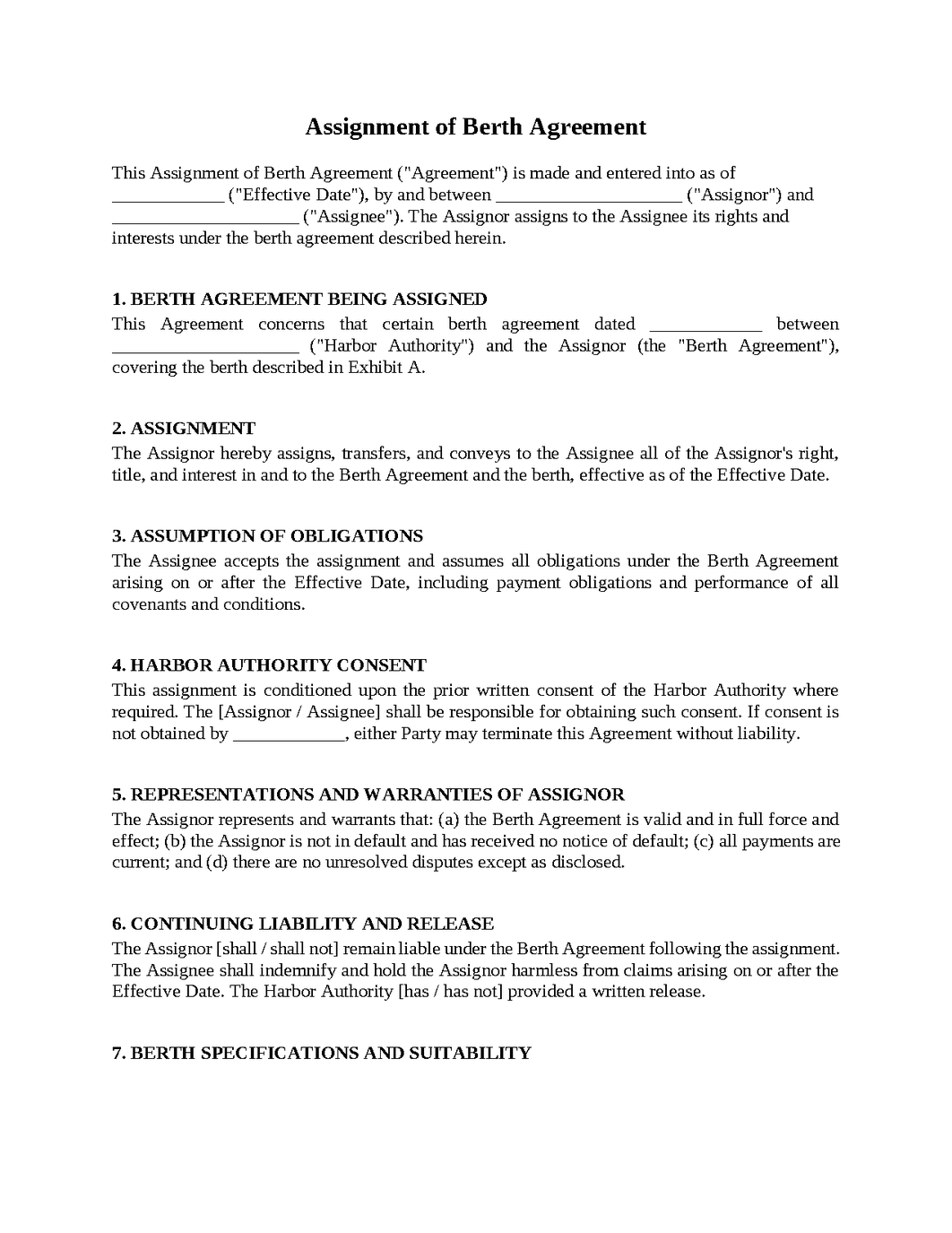
An Assignment of Berth Agreement is a legal contract used when a party transfers its rights and obligations under a berth agreement to another person or business. The party transferring the berth rights is known as the assignor, while the party receiving those rights is known as the assignee. Berth agreements are commonly used in commercial shipping, marina operations, yacht clubs, fishing harbors, cargo terminals, and private boating facilities. A berth may provide access to valuable waterfront infrastructure, utilities, loading facilities, security services, and navigational advantages that are difficult to obtain elsewhere. Because berth rights are often limited in supply and subject to detailed operational rules, disputes can arise regarding transfer approvals, vessel eligibility, payment obligations, maintenance responsibilities, and operational restrictions. An Assignment of Berth Agreement helps establish who assumes responsibility for the berth and what rights and obligations transfer as part of the assignment.
The Berth Is Assigned Without Harbor Authority Approval
A commercial fishing company holds rights to a highly desirable berth within a busy harbor. The berth provides direct access to processing facilities, fuel services, and loading equipment that significantly improve operational efficiency.
After reducing the size of its fleet, the company determines that it no longer needs the berth and identifies another fishing operator interested in taking over the space. Both businesses view the arrangement as mutually beneficial because obtaining a berth through the harbor's normal application process can take years.
The parties negotiate privately and execute an assignment agreement. The new operator begins using the berth immediately and starts conducting daily operations from the location.
Several months later, harbor management discovers that a different company is occupying the berth. A review of harbor records reveals that berth transfers require prior written approval from the harbor authority.
No approval was obtained.
Harbor officials immediately question the transfer and raise concerns regarding vessel classifications, insurance requirements, environmental compliance obligations, and operational qualifications. The assignee suddenly faces uncertainty regarding continued access to a berth that has become critical to its business.
The assignor also faces potential penalties for violating harbor regulations and may remain responsible for obligations under the original agreement.
To help avoid this problem, an Assignment of Berth Agreement should clearly identify all approval requirements and make harbor or marina consent a condition of the assignment. The agreement should specify who is responsible for obtaining approvals and establish procedures if approval is denied or delayed.
The Assignee Learns the Berth Has Operational Restrictions
A marine transportation company assumes a berth agreement because the location appears ideal for expanding regional shipping operations.
The berth offers convenient access to major transportation routes and appears capable of supporting the company's vessels. During negotiations, the parties focus primarily on pricing and occupancy timelines.
After taking possession, however, the assignee discovers numerous restrictions governing berth usage.
The harbor limits operating hours for certain vessel types. Environmental regulations restrict fueling activities. Noise ordinances affect loading schedules. Additional rules limit cargo handling operations during peak periods.
The assignee is surprised because these restrictions significantly affect operational efficiency.
Several customer contracts must be modified because vessels cannot be loaded and unloaded according to the original schedule. Labor costs increase as crews adapt to new operating requirements.
The value of the berth proves substantially different than expected.
The assignee argues that these limitations should have been disclosed before the assignment occurred. The assignor responds that the harbor rules were publicly available and incorporated into the berth agreement.
To reduce these risks, an Assignment of Berth Agreement should require disclosure of material operating restrictions, environmental requirements, scheduling limitations, and harbor rules that may affect the assignee's intended use of the berth.
The Original Berth Holder Remains Responsible Years Later
A cargo operator assigns its berth agreement after relocating operations to a larger terminal facility.
The assignee assumes possession of the berth and begins conducting business from the location. For several years, the arrangement appears successful and uneventful.
Eventually, however, the assignee experiences financial difficulties and falls behind on berth fees, utility charges, environmental assessments, and other harbor-related obligations.
The harbor authority initiates collection efforts and contacts the original berth holder.
Management is surprised.
The company has not used the berth for years and assumed all obligations ended when the assignment was completed. Harbor officials point to provisions in the original agreement stating that the assignor remains liable unless formally released.
The assignor now faces significant financial exposure arising from obligations created by another business.
The situation becomes increasingly frustrating because the assignor has no practical ability to control how the berth is being used or managed.
To avoid these problems, an Assignment of Berth Agreement should address continuing liability directly. The agreement should require the assignee to indemnify the assignor for future claims and should clarify whether the harbor authority has released the assignor from ongoing obligations. Whenever possible, a written release should be obtained before the transfer becomes effective.
The Berth Cannot Accommodate the Assignee's Vessel
A shipping company acquires rights under a berth agreement because it believes the location will support a recently acquired vessel.
The berth appears suitable based on general specifications and visual inspections. Because operations need to begin quickly, the company proceeds without conducting a detailed technical review.
After arrival, problems emerge immediately.
The vessel's draft exceeds preferred operating limits during certain tidal conditions. Maneuvering space is more restricted than anticipated. Utility connections require upgrades, and loading infrastructure is not designed for the vessel's cargo-handling requirements.
Harbor personnel express concerns regarding safety and operational efficiency.
The assignee becomes frustrated because significant investments were made based on assumptions about the berth's suitability.
Alternative berths are difficult to obtain, and modifying the existing infrastructure may be prohibitively expensive.
What initially appeared to be a valuable operational asset now presents unexpected challenges.
To help prevent these disputes, an Assignment of Berth Agreement should identify berth specifications, vessel limitations, infrastructure capabilities, and operational requirements. The agreement should also confirm that the assignee has independently verified that the berth is suitable for its intended use.
An Environmental Incident Creates a Liability Dispute
A marine services company assumes a berth agreement at an industrial waterfront facility.
Several months after the assignment, a fuel spill occurs during routine vessel operations. Environmental agencies launch investigations, cleanup efforts begin, and substantial remediation costs are incurred.
As the investigation progresses, questions arise regarding the condition of fueling equipment, containment systems, and environmental safeguards associated with the berth.
The assignee argues that deficiencies in the berth infrastructure existed before the assignment occurred. The assignor maintains that the berth was transferred in acceptable condition and that all responsibility shifted to the new operator.
Regulators, insurers, and attorneys become involved.
The potential financial exposure is substantial because environmental remediation costs can be significant and regulatory penalties may apply.
What began as a routine berth assignment evolves into a complex dispute involving multiple parties and competing theories of responsibility.
To reduce these risks, an Assignment of Berth Agreement should clearly allocate responsibility for environmental conditions, maintenance obligations, regulatory compliance matters, and liabilities arising before and after the transfer. The agreement should also require disclosure of known environmental concerns and prior regulatory issues affecting the berth.
Berth rights often represent valuable operational assets in commercial and recreational maritime environments. Whether used for cargo operations, fishing activities, passenger transportation, or private vessel access, berth agreements frequently involve important business opportunities and substantial responsibilities. An Assignment of Berth Agreement provides a structured framework for documenting these transfers and clarifying expectations regarding approvals, operational requirements, continuing liability, and regulatory compliance. When drafted carefully, it can help reduce disputes, protect valuable harbor access rights, and provide confidence regarding the successful transfer of berth-related obligations and benefits.

Get started with Upsign today!
Easily send, sign and track your documents