

Assignment of Mooring Agreement
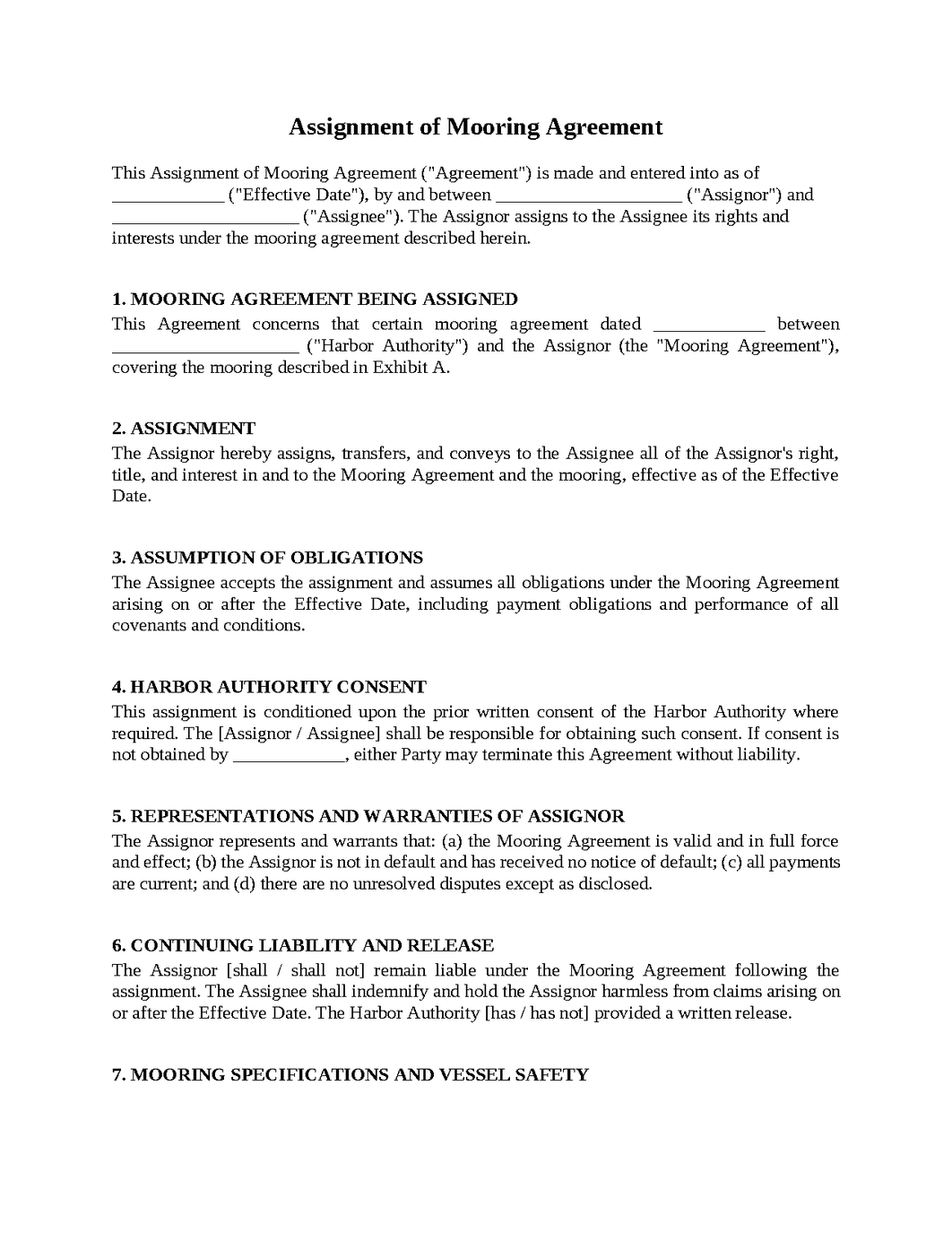
An Assignment of Mooring Agreement is a legal contract used when a party transfers its rights and obligations under a mooring agreement to another person or entity. The party transferring the mooring rights is known as the assignor, while the party receiving those rights is known as the assignee. Mooring agreements are commonly used by boat owners, marinas, harbor authorities, yacht clubs, waterfront developments, and commercial marine operators. A mooring location can be a valuable asset because it provides a designated location for securing a vessel in areas where dock space is limited or unavailable. Because mooring rights often involve regulatory approvals, vessel restrictions, maintenance obligations, insurance requirements, and environmental responsibilities, disputes can arise if a transfer is not documented properly. An Assignment of Mooring Agreement helps establish who assumes responsibility for the mooring and what rights and obligations transfer as part of the assignment.
The Mooring Is Transferred Without Harbor Approval
A sailboat owner holds rights to a mooring located in a protected harbor where available moorings are scarce and highly sought after. After purchasing a larger vessel and moving to a marina with dock access, the owner decides the mooring is no longer needed.
Another boat owner has been waiting for years to secure a location in the harbor. The opportunity appears ideal, and both parties quickly agree to transfer the mooring rights.
The new owner begins using the mooring immediately. The vessel is secured regularly at the location, and for several months everything appears normal.
Eventually, harbor officials notice that a different vessel is occupying the assigned mooring. A review of harbor records reveals that the mooring agreement prohibits assignments without prior approval from the harbor authority.
No approval was requested.
Harbor officials notify both parties that the transfer violates harbor regulations. Questions arise regarding vessel eligibility, insurance requirements, registration records, and compliance with harbor management policies.
The assignee now faces the possibility of losing access to a mooring that was a primary reason for purchasing the vessel. The assignor faces potential penalties and may remain liable under the original agreement.
To help avoid this problem, an Assignment of Mooring Agreement should clearly identify all required approvals and make harbor consent a condition of the assignment. The agreement should also establish who is responsible for obtaining approval and how the parties will proceed if approval is denied.
The Assignee Learns the Mooring Cannot Safely Accommodate the Vessel
A recreational boater assumes rights under a mooring agreement after purchasing a larger cruising vessel.
The mooring appears attractive because it is located close to shore, provides easy harbor access, and is significantly less expensive than nearby marina slips.
During negotiations, little attention is given to the technical specifications of the mooring system. The parties assume that because another boat occupied the location previously, the mooring will be suitable.
After taking possession, concerns emerge.
Marine inspectors determine that the mooring tackle was designed for a smaller vessel. Anchor systems, chains, and hardware may not be adequate for the weight and windage of the new boat.
Harbor officials warn that continued use could create safety risks during severe weather conditions.
The assignee becomes frustrated because replacing or upgrading the mooring system will be expensive. Alternative mooring locations are difficult to obtain, and relocating the vessel may require significant effort.
What initially appeared to be a valuable assignment now involves unexpected costs and operational challenges.
To reduce these risks, an Assignment of Mooring Agreement should require disclosure of mooring specifications, vessel limitations, inspection reports, and maintenance records. The agreement should also confirm that the assignee has independently verified that the mooring is suitable for the intended vessel.
The Original Mooring Holder Remains Responsible for Future Obligations
A boat owner assigns a mooring agreement after relocating to another coastal community.
The assignee takes possession of the mooring, pays the required fees, and begins using the location regularly. The assignor assumes that all responsibilities ended when the transfer occurred.
Several years later, the assignee stops paying harbor fees and fails to maintain the mooring equipment properly.
The harbor authority begins enforcement efforts and contacts the original mooring holder regarding unpaid charges and maintenance deficiencies.
The assignor is surprised.
Although the mooring has not been used personally for years, the harbor authority points to provisions in the original agreement stating that the assignor remains liable unless formally released.
The assignor now faces unexpected financial exposure and administrative headaches related to a mooring that was transferred long ago.
The situation becomes increasingly frustrating because the assignor has no ability to control the assignee's conduct or maintenance practices.
To avoid these problems, an Assignment of Mooring Agreement should address continuing liability directly. The agreement should require the assignee to indemnify the assignor against future claims and should specify whether the harbor authority has released the assignor from ongoing obligations. Whenever possible, a written release should be obtained before the assignment becomes effective.
Deferred Maintenance Creates a Major Dispute
A powerboat owner assigns a mooring agreement to another vessel owner after deciding to move the boat to a different harbor.
Before the transfer, the assignor performs only a limited inspection of the mooring equipment. The mooring appears functional, and neither party sees a need for a detailed evaluation.
Several months after the assignment, a routine harbor inspection identifies significant wear and deterioration in the mooring system. Chains are corroded, hardware is approaching failure, and portions of the anchoring system require replacement.
The harbor authority orders immediate repairs.
The assignee argues that these conditions existed before the transfer and should have been disclosed. The assignor responds that the mooring was accepted in its existing condition and that no known defects were concealed.
Repair costs escalate quickly because underwater inspections, marine contractors, and replacement equipment are required.
The disagreement damages the relationship between the parties and results in significant legal and financial costs.
To reduce these risks, an Assignment of Mooring Agreement should require disclosure of maintenance history, recent inspections, known deficiencies, and anticipated repairs. The agreement should also allocate responsibility for conditions existing before the transfer date.
A Vessel Breaks Free and Causes Property Damage
A yacht owner assumes rights under a mooring agreement located in a harbor that occasionally experiences severe storms and strong tidal conditions.
The assignment appears successful, and the vessel remains safely secured for many months.
During a major storm, however, the vessel breaks free from the mooring and collides with nearby boats and harbor infrastructure.
Insurance companies, harbor authorities, and vessel owners immediately begin investigating the incident.
Questions arise regarding the condition of the mooring equipment, prior maintenance practices, inspection records, and whether the mooring was suitable for the vessel involved.
The assignee argues that deficiencies in the mooring system existed before the assignment occurred. The assignor insists that the mooring was transferred in acceptable condition and that responsibility shifted completely to the new owner.
The resulting claims involve substantial property damage, legal expenses, and insurance disputes.
What began as a routine transfer of mooring rights becomes the center of a complex liability dispute involving multiple parties.
To help avoid these situations, an Assignment of Mooring Agreement should clearly allocate responsibility for mooring maintenance, inspections, insurance requirements, and liabilities arising before and after the transfer. The agreement should also document the condition of the mooring equipment at the time of assignment.
Mooring rights can be valuable assets, particularly in harbors where space is limited and demand is high. However, transferring those rights can create significant challenges involving approvals, vessel compatibility, maintenance obligations, continuing liability, and accident-related risks. An Assignment of Mooring Agreement provides a structured framework for documenting these transfers and clarifying expectations regarding future rights and responsibilities. When drafted carefully, it can help reduce disputes, protect valuable harbor access, and provide confidence regarding the successful transfer of mooring rights and obligations.

Get started with Upsign today!
Easily send, sign and track your documents