

Assignment of Freight Terminal Agreement
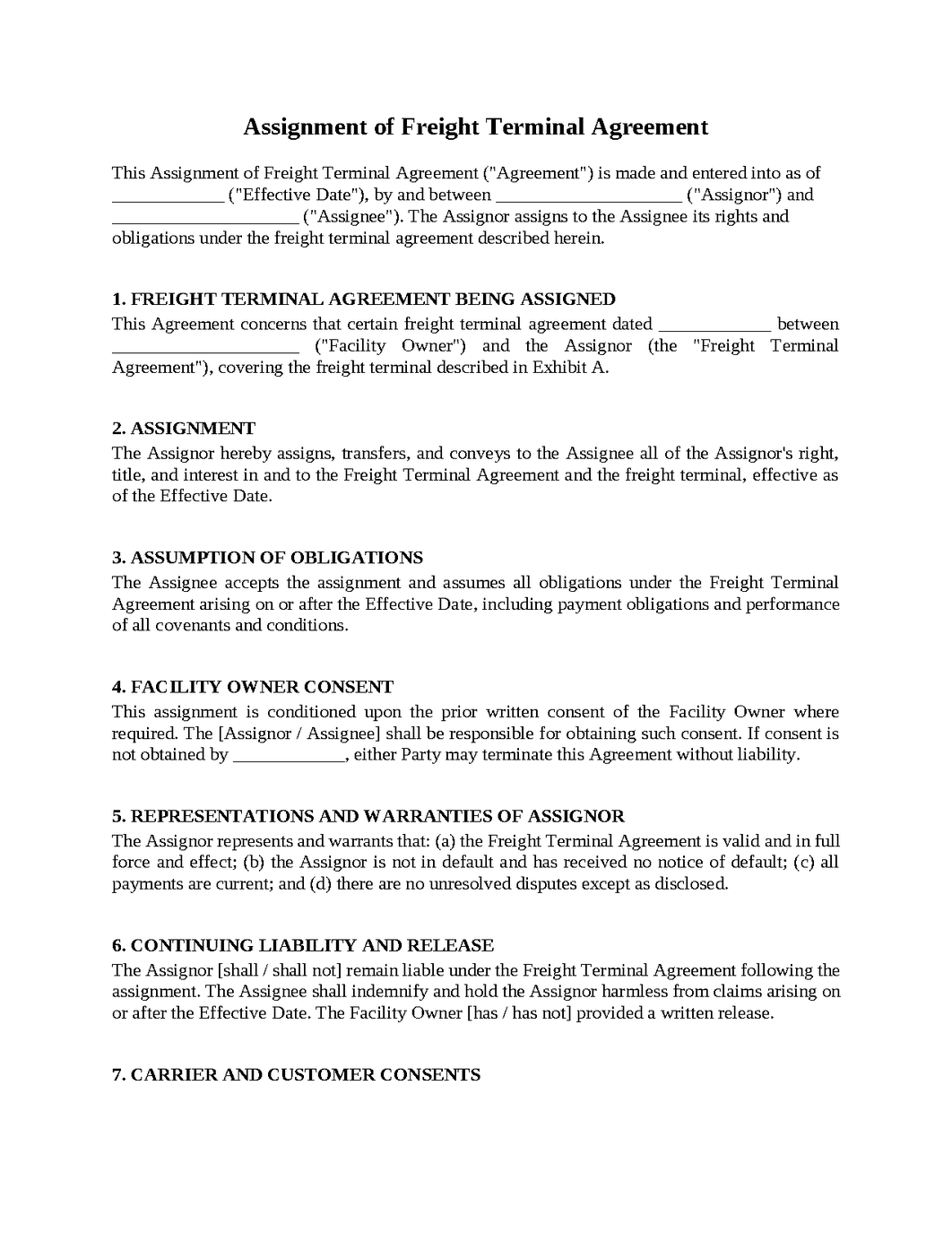
An Assignment of Freight Terminal Agreement is a legal contract used when a party transfers its rights and obligations under a freight terminal agreement to another person or business. The party transferring the rights is known as the assignor, while the party receiving the rights is known as the assignee. Freight terminal assignments commonly occur during transportation company acquisitions, logistics reorganizations, regional expansion efforts, carrier consolidations, and operational restructurings. Freight terminals serve as critical hubs where cargo is received, sorted, transferred, stored temporarily, and dispatched to its next destination. Because terminal operations often involve multiple carriers, strict scheduling requirements, customer service commitments, regulatory obligations, and substantial infrastructure investments, disputes can arise when terminal rights are transferred without careful planning. An Assignment of Freight Terminal Agreement helps establish who assumes responsibility for the terminal and how future obligations will be allocated among the parties.
The Assignment Violates a Key Carrier Agreement
A regional freight carrier operates a busy terminal that serves as a transfer point for shipments moving throughout several states. As part of a larger restructuring effort, the company decides to assign its terminal agreement to another transportation provider.
The assignee views the facility as an attractive opportunity because it already handles substantial freight volume and maintains relationships with numerous customers and carriers. Both parties focus heavily on operational transition planning and employee retention.
Shortly after the assignment closes, several major carrier partners object. Their agreements contain provisions prohibiting assignment without prior written consent. These carriers selected the original operator because of its reputation, operating procedures, and service history.
The carriers notify the parties that they do not recognize the assignment and may terminate their relationships. Several begin redirecting freight to competing facilities.
The assignee suddenly finds itself operating a terminal with significantly less freight volume than anticipated. Revenue projections collapse, staffing plans must be revised, and the economics of the transaction change dramatically.
What initially appeared to be a valuable acquisition becomes a struggle to replace lost business.
To help avoid this problem, an Assignment of Freight Terminal Agreement should identify all contracts requiring consent, establish procedures for obtaining approvals, and allocate responsibility if customers or carrier partners refuse to authorize the transfer. The agreement should also address how carrier relationships will be transitioned and preserved after closing.
The Assignee Inherits Aging Infrastructure
A transportation company assumes rights under a freight terminal agreement because the location provides strategic access to several major shipping corridors.
The facility appears functional during preliminary inspections. Loading docks are active, freight handling equipment is operating, and the terminal processes thousands of shipments each week.
Several months after the transition, however, serious infrastructure problems begin surfacing.
Dock levelers require replacement. Trailer parking areas need extensive repairs. Electrical systems struggle to support growing operational demands. Several freight-handling systems have exceeded their expected useful lives.
Maintenance records reveal that many repairs were deferred for years.
The assignee becomes frustrated because the cost of restoring the facility far exceeds expectations. Operational efficiency declines while repairs are completed, and customers begin experiencing delays.
Instead of investing in growth initiatives, management is forced to spend significant capital on infrastructure improvements.
To reduce these risks, an Assignment of Freight Terminal Agreement should require disclosure of maintenance records, capital improvement needs, equipment conditions, deferred repairs, and facility assessments. The agreement should also allocate responsibility for known infrastructure deficiencies that existed before the assignment occurred.
The Original Operator Remains Liable for Future Problems
A national logistics company assigns a freight terminal agreement after consolidating operations into a smaller number of facilities.
The assignee takes over the terminal successfully and operates from the location for several years. The assignor assumes that all responsibilities ended when the assignment became effective.
Eventually, however, the assignee experiences financial difficulties and begins missing rent payments, maintenance obligations, and contractual commitments.
The terminal owner immediately contacts the original operator.
Management is surprised.
Although the terminal has not been used by the assignor for years, the underlying agreement provides that the original operator remains liable unless formally released. No release was obtained during the assignment process.
The assignor now faces substantial financial exposure involving unpaid obligations, repair costs, and legal expenses.
The situation becomes even more frustrating because the assignor no longer has any control over the facility's operations.
This issue is particularly costly because freight terminals often involve large facilities, expensive infrastructure, and long-term contractual commitments.
To avoid these problems, an Assignment of Freight Terminal Agreement should address continuing liability directly. The agreement should require the assignee to indemnify the assignor against future claims and should identify whether all necessary releases have been obtained from landlords, terminal owners, and contractual counterparties.
Regulatory Compliance Problems Surface After Closing
A freight carrier assumes operation of a terminal that handles a wide variety of cargo, including regulated shipments requiring special procedures and documentation.
The assignee focuses primarily on freight volume, location advantages, and financial performance. Regulatory compliance receives less attention during the transaction process.
Several months after taking control, government inspectors conduct a routine review.
The inspection uncovers deficiencies involving recordkeeping, hazardous materials procedures, employee training, and equipment inspections. Some issues appear to have existed before the assignment occurred.
Regulators begin requesting historical records and operational information.
The assignee becomes concerned because regulatory violations can result in fines, operational restrictions, and reputational damage. Customers begin asking questions about compliance practices, and management must devote substantial resources to remediation efforts.
The assignor argues that no active enforcement action existed when the assignment occurred. The assignee believes the compliance concerns should have been disclosed during negotiations.
To reduce these risks, an Assignment of Freight Terminal Agreement should require disclosure of audits, regulatory investigations, compliance deficiencies, enforcement actions, and known operational concerns. The agreement should also allocate responsibility for regulatory issues originating before the transfer date.
Freight Losses Create a Multi-Million-Dollar Dispute
A logistics company assumes operation of a freight terminal that processes thousands of shipments daily.
The transition occurs quickly because both parties want to avoid service interruptions. Freight already moving through the terminal remains in transit while operational control changes hands.
Several months later, major customers begin reporting missing shipments.
Some freight cannot be located. Tracking records contain inconsistencies. Certain shipments appear to have been transferred improperly during the transition period.
An extensive investigation follows.
The assignee argues that inventory and tracking problems existed before the assignment occurred. The assignor insists that terminal records were accurate at closing and that any losses occurred afterward.
Large customers file claims seeking reimbursement for missing cargo. Insurance carriers become involved, and attorneys begin reviewing operational records.
The financial exposure quickly reaches significant levels because the value of the missing freight is substantial.
What began as a routine assignment becomes a major dispute involving customer claims, insurance coverage, freight accountability, and operational responsibility.
To help avoid these situations, an Assignment of Freight Terminal Agreement should require comprehensive shipment audits before closing, establish procedures for tracking freight in transit, document cargo accountability carefully, and allocate responsibility for losses discovered after the transfer. Detailed transition procedures can significantly reduce uncertainty when freight-related disputes arise.
Freight terminals play a vital role in transportation networks by connecting carriers, customers, warehouses, and distribution systems. Because these facilities involve complex operations, regulatory obligations, customer commitments, and significant infrastructure investments, assigning rights under a freight terminal agreement can create substantial risks. An Assignment of Freight Terminal Agreement provides a structured framework for documenting these transfers and clarifying expectations regarding future rights and obligations. When drafted carefully, it can help reduce disputes, preserve customer relationships, maintain operational continuity, and support a successful transition of freight terminal operations.

Get started with Upsign today!
Easily send, sign and track your documents