

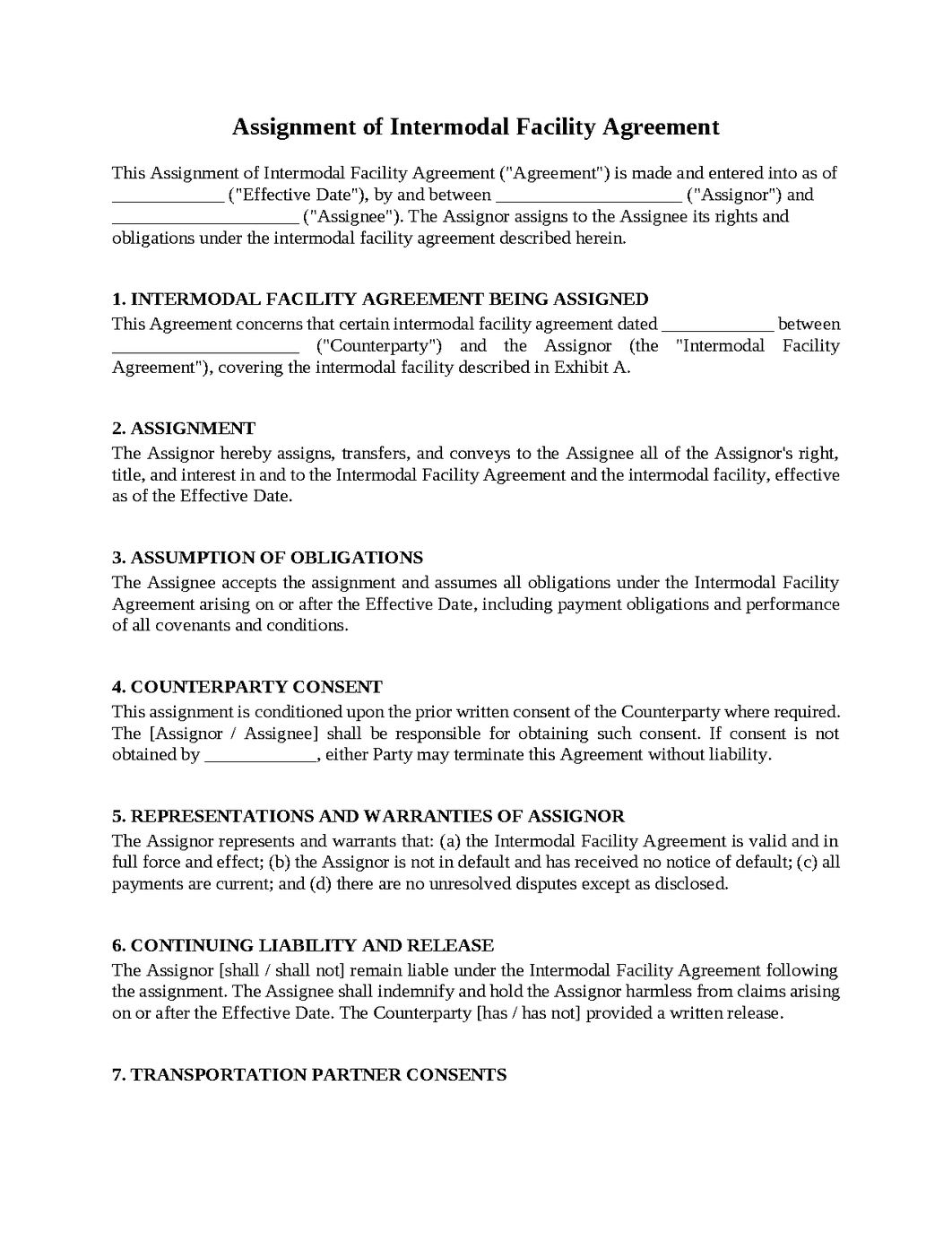
Assignment of Intermodal Facility Agreement
An Assignment of Intermodal Facility Agreement is a legal contract used when a party transfers its rights and obligations under an intermodal facility agreement to another person or business. The party transferring the rights is known as the assignor, while the party receiving those rights is known as the assignee. Intermodal facility agreements are commonly used by rail operators, trucking companies, logistics providers, shipping companies, freight consolidators, and transportation infrastructure operators. These facilities serve as critical transfer points where cargo moves between trucks, trains, ships, and other transportation modes. Because intermodal operations rely on precise coordination, specialized infrastructure, regulatory compliance, customer commitments, and transportation partnerships, disputes can arise when rights are transferred without proper planning. An Assignment of Intermodal Facility Agreement helps establish who assumes responsibility for the facility and how future obligations will be allocated among the parties.
Transportation Partners Refuse to Recognize the Assignment
A logistics company operates an intermodal facility that serves as a key transfer point between regional trucking routes and a major rail network. After a strategic restructuring, the company decides to assign its rights under the facility agreement to another transportation provider.
The assignee views the opportunity as highly attractive because the facility already handles substantial freight volume and has established relationships with rail carriers, trucking companies, and shipping customers. Both parties devote significant effort to planning the operational transition.
Shortly after the assignment closes, problems emerge.
Several rail operators and transportation partners object to the transfer. Their agreements contain provisions requiring notice, consent, or qualification reviews before another operator may assume responsibilities at the facility. Some partners selected the original operator because of its performance history and operational capabilities.
As objections increase, transportation partners begin limiting access, delaying approvals, and redirecting certain freight through alternative facilities.
The assignee quickly realizes that access to the facility alone does not guarantee access to the business relationships necessary for successful operations. Freight volume declines, customer confidence weakens, and projected revenues fall well below expectations.
What initially appeared to be a valuable logistics acquisition becomes a difficult effort to rebuild relationships that the assignee assumed would transfer automatically.
To help avoid this problem, an Assignment of Intermodal Facility Agreement should identify all transportation partner agreements, access rights, operating permissions, and third-party approvals required for continued operations. The agreement should also establish procedures for obtaining consents and allocate responsibility if key relationships cannot be transferred successfully.
The Assignee Inherits Infrastructure That Cannot Support Growth
A rapidly growing transportation company assumes rights under an intermodal facility agreement because the location appears ideal for expanding operations.
The facility includes rail connections, container handling areas, truck staging zones, and cargo transfer equipment. During due diligence, the operation appears busy and productive.
After assuming control, however, the assignee discovers that the facility is operating near maximum capacity.
Rail sidings are too short for anticipated train volumes. Truck staging areas become congested during peak periods. Container handling equipment experiences delays due to aging infrastructure. Utility systems lack the capacity needed to support planned expansion projects.
Internal planning documents reveal that the previous operator was aware of these limitations and had postponed several infrastructure upgrades.
The assignee becomes frustrated because future growth depends on improvements that will require significant capital investment.
Expansion plans must be delayed, customer opportunities are lost, and operating costs increase as management attempts to work around infrastructure constraints.
The facility remains valuable, but its growth potential is far less than originally expected.
To reduce these risks, an Assignment of Intermodal Facility Agreement should require disclosure of capacity limitations, infrastructure assessments, expansion studies, deferred capital projects, and known operational bottlenecks. These disclosures help ensure the assignee understands the facility's true capabilities before completing the transaction.
The Original Operator Remains Responsible for Contractual Obligations
A national transportation company assigns an intermodal facility agreement after exiting a particular geographic market.
The assignee takes over operations successfully and manages the facility for several years. The assignor assumes all obligations ended when the assignment became effective.
Eventually, the assignee experiences financial difficulties and begins failing to satisfy contractual commitments. Maintenance obligations are neglected, access fees remain unpaid, and service agreements are breached.
Facility owners and transportation partners begin reviewing contractual relationships.
To the assignor's surprise, several parties assert that the original operator remains liable under portions of the agreement. Certain contracts were never amended, and required releases were never obtained.
The assignor now faces substantial financial exposure despite having no involvement in daily operations.
Legal expenses begin accumulating as attorneys review years-old agreements and attempt to determine responsibility.
Management becomes frustrated because a transaction believed to be completed long ago continues generating legal and financial risk.
To avoid these problems, an Assignment of Intermodal Facility Agreement should clearly address continuing liability. The agreement should identify all required releases, require the assignee to indemnify the assignor against future claims, and establish procedures for obtaining written acknowledgments from all parties whose rights may be affected by the assignment.
Hidden Service Commitments Create Unexpected Costs
A logistics operator acquires rights under an intermodal facility agreement because historical financial statements indicate strong profitability.
Management focuses on freight volume, facility location, and customer demand. The operation appears highly attractive from a financial perspective.
After closing, however, the assignee learns that the facility is subject to extensive service commitments.
Certain customers require guaranteed transfer times between transportation modes. Rail operators expect minimum throughput volumes. Trucking partners rely on extended operating hours and priority processing arrangements.
Failure to meet these obligations triggers financial penalties, customer credits, and contractual disputes.
The previous operator invested heavily in staffing, technology systems, and equipment redundancy to maintain these performance levels.
The assignee quickly realizes that maintaining contractual service standards is significantly more expensive than anticipated.
Profit margins shrink as additional personnel are hired and operational investments become necessary.
What initially appeared to be a highly profitable operation becomes a much more challenging business.
To help prevent these problems, an Assignment of Intermodal Facility Agreement should require disclosure of service-level commitments, performance guarantees, throughput requirements, penalty provisions, and customer obligations. Understanding these commitments before closing can dramatically affect the value of the transaction.
Freight Tracking Failures Lead to Major Customer Claims
A transportation company assumes operation of an intermodal facility handling thousands of containers and shipments each month.
The transition occurs rapidly because both parties want to avoid disrupting transportation schedules. Freight continues moving through the facility while operational control changes hands.
Several months after the assignment, shipment discrepancies begin appearing.
Containers cannot be located. Transfer records contain inconsistencies. Customers report delays and missing freight. Transportation partners identify gaps in shipment tracking information.
An investigation is launched.
The assignee argues that data quality issues and tracking deficiencies existed before the assignment occurred. The assignor insists that shipment records were accurate when control transferred.
Large customers begin filing claims for delayed deliveries, lost cargo, and business interruption losses.
The financial exposure becomes substantial because the value of the affected shipments is significant and multiple parties are involved in the transportation chain.
What began as a routine operational transition becomes a major dispute involving freight accountability, technology systems, customer claims, and contractual liability.
To reduce these risks, an Assignment of Intermodal Facility Agreement should require detailed audits of freight records, shipment tracking systems, cargo inventories, and transportation data before closing. The agreement should also establish procedures for handling freight already in transit and allocate responsibility for discrepancies discovered after the transfer.
Intermodal facilities play a vital role in modern transportation networks by connecting rail, trucking, maritime, and other transportation systems into a coordinated supply chain. Because these operations involve complex infrastructure, transportation partnerships, customer commitments, regulatory requirements, and significant operational risks, assigning rights under an intermodal facility agreement can create substantial challenges. An Assignment of Intermodal Facility Agreement provides a structured framework for documenting these transfers and clarifying expectations regarding future rights and obligations. When drafted carefully, it can help reduce disputes, preserve transportation relationships, maintain operational continuity, and support a successful transition of intermodal facility operations.

Get started with Upsign today!
Easily send, sign and track your documents