

Assignment of Terminal Operations Agreement
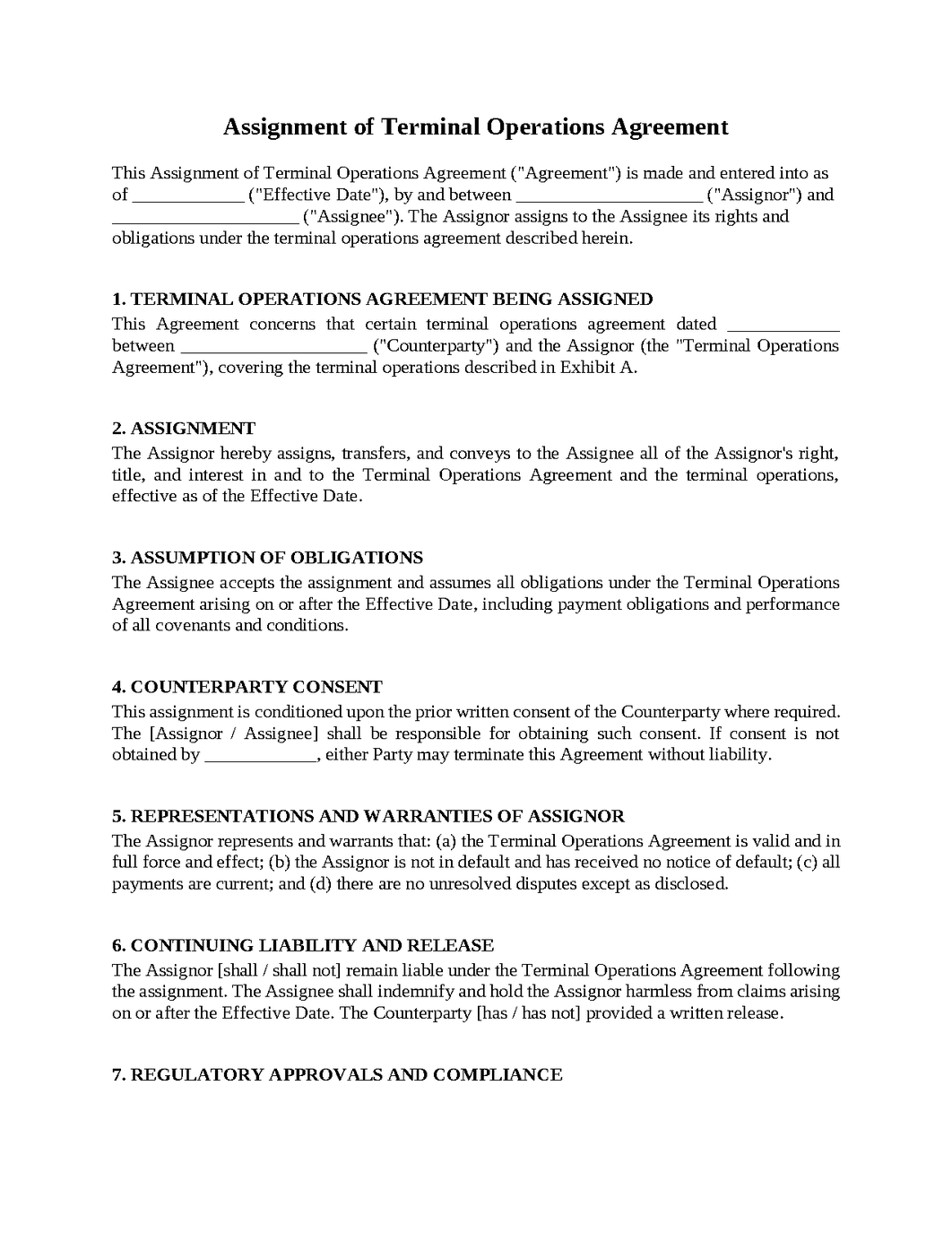
An Assignment of Terminal Operations Agreement is a legal contract used when a party transfers its rights and obligations under a terminal operations agreement to another person or business. The party transferring the rights is known as the assignor, while the party receiving the rights is known as the assignee. Terminal operations agreements are commonly used in ports, airports, freight terminals, intermodal facilities, shipping hubs, logistics centers, and transportation infrastructure projects. These agreements often govern the management of facilities, cargo movement, equipment operations, customer services, safety programs, and regulatory compliance obligations. Because terminal operations are complex, highly regulated, and essential to supply chain performance, transferring operational rights can create significant legal, financial, and operational risks. An Assignment of Terminal Operations Agreement helps establish who assumes responsibility for terminal operations and how future obligations will be allocated between the parties.
The Assignment Triggers a Regulatory Approval Problem
A logistics company operates a large intermodal terminal under a long-term terminal operations agreement. After a strategic shift in corporate priorities, management decides to exit the market and transfer terminal operations to another transportation company.
The assignee has relevant industry experience and appears capable of managing the facility. Both parties focus heavily on employee retention, customer communications, and operational continuity throughout the transition.
The assignment closes successfully, and the new operator begins managing terminal activities immediately. Cargo continues moving through the facility, employees remain on site, and customers initially notice little disruption.
Several weeks later, a government agency responsible for overseeing terminal operations raises concerns. The agency informs the parties that certain operating permits and approvals cannot be transferred automatically and require advance regulatory review.
The assignee suddenly discovers that some activities may not be legally authorized until new approvals are obtained. Customers begin asking questions, operational planning becomes uncertain, and management must devote substantial resources to resolving the issue.
What initially appeared to be a completed transaction now faces potential delays, compliance concerns, and operational restrictions.
To help avoid this problem, an Assignment of Terminal Operations Agreement should identify all regulatory approvals, permits, licenses, and certifications affecting terminal operations. The agreement should require disclosure of approval requirements, establish responsibility for obtaining regulatory consent, and provide remedies if required approvals cannot be secured before closing.
The Assignee Inherits a Terminal with Deferred Maintenance
A transportation services company assumes rights under a terminal operations agreement because the facility occupies a strategic location near major transportation routes.
During due diligence, the terminal appears busy and productive. Cargo handling equipment is functioning, loading areas are active, and facility infrastructure seems adequate.
Several months after the assignment, significant problems begin surfacing.
Pavement deterioration affects vehicle traffic patterns. Drainage systems require extensive repairs. Lighting systems fail regularly. Portions of the terminal's electrical infrastructure no longer meet operational needs.
Further investigation reveals that many maintenance projects were postponed repeatedly by the previous operator. Internal reports document concerns that were never fully addressed.
The assignee becomes frustrated because substantial capital expenditures are now required simply to maintain basic operations.
Instead of investing in growth opportunities, management must allocate resources to repairs and infrastructure improvements that should have been anticipated.
To reduce these risks, an Assignment of Terminal Operations Agreement should require disclosure of maintenance records, capital improvement needs, engineering reports, inspection findings, and deferred maintenance obligations. The agreement should also allocate responsibility for material deficiencies that existed before the transfer occurred.
The Original Operator Remains Responsible for Future Obligations
A terminal management company assigns a terminal operations agreement after selling a business division.
The assignee takes over operations successfully and manages the facility for several years without incident. The assignor assumes all responsibilities ended when the assignment became effective.
Eventually, however, the assignee experiences financial difficulties and begins failing to satisfy contractual obligations. Rent payments become delinquent, maintenance requirements are neglected, and service standards decline.
The terminal owner initiates legal action and contacts the original operator.
Management is surprised.
Although the assignor has not managed the terminal for years, the underlying agreement provides that the original operator remains liable unless formally released. No release was obtained during the assignment process.
The assignor now faces substantial financial exposure involving unpaid obligations, operational deficiencies, and legal expenses.
The situation becomes increasingly frustrating because the assignor has no practical control over terminal operations yet remains exposed to liability.
To avoid these problems, an Assignment of Terminal Operations Agreement should address continuing liability directly. The agreement should require the assignee to indemnify the assignor against future claims and should identify all required releases from terminal owners, landlords, regulators, and contractual counterparties.
Customer Service Commitments Become Difficult to Meet
A logistics company acquires rights under a terminal operations agreement because the facility serves several large transportation customers.
Management focuses heavily on revenue opportunities, customer volume, and terminal capacity. The operation appears attractive based on historical performance.
After taking over the terminal, however, the assignee discovers extensive customer service commitments embedded within the agreement.
Certain customers require guaranteed processing times. Others receive priority access to equipment and terminal resources. Some contracts impose financial penalties when service standards are not met.
The prior operator maintained these service levels through substantial investments in staffing, equipment redundancy, and operational oversight.
The assignee quickly realizes that maintaining contractual performance standards is far more expensive than anticipated.
Additional employees must be hired, operating hours must be expanded, and equipment investments become necessary to satisfy customer expectations.
Profitability declines as operating costs rise.
To help prevent these problems, an Assignment of Terminal Operations Agreement should require disclosure of customer commitments, service-level agreements, performance guarantees, penalty provisions, and staffing requirements. Understanding these obligations before closing can dramatically affect the perceived value of the transaction.
An Operational Accident Creates a Multi-Party Dispute
A transportation company assumes operation of a large terminal facility handling freight from numerous customers.
The transition proceeds smoothly, and terminal operations continue without interruption for many months.
Then a significant accident occurs.
A cargo-handling incident damages equipment, disrupts terminal operations, and results in multiple customer claims. Investigators begin reviewing maintenance records, employee training programs, operational procedures, and safety documentation.
As the investigation progresses, questions emerge regarding whether certain safety deficiencies existed before the assignment occurred.
The assignee argues that maintenance problems and operational weaknesses were inherited from the prior operator. The assignor insists that terminal operations complied with applicable requirements when the assignment became effective.
Customers, insurers, regulators, and attorneys all become involved.
The resulting claims involve property damage, operational delays, customer losses, and substantial legal expenses.
What began as a routine assignment evolves into a complex dispute regarding responsibility for conditions that may have originated before the transfer.
To reduce these risks, an Assignment of Terminal Operations Agreement should require disclosure of safety audits, accident histories, maintenance records, training deficiencies, and operational concerns. The agreement should also allocate responsibility for incidents arising from pre-existing conditions and establish indemnification procedures for future claims.
Terminal operations agreements often govern critical transportation infrastructure that supports the movement of goods throughout regional, national, and international supply chains. Because terminal operations involve extensive customer commitments, regulatory obligations, safety requirements, infrastructure investments, and operational risks, assigning rights under these agreements can create significant challenges. An Assignment of Terminal Operations Agreement provides a structured framework for documenting these transfers and clarifying expectations regarding future rights and responsibilities. When drafted carefully, it can help reduce disputes, preserve operational continuity, protect customer relationships, and support a successful transition of terminal management responsibilities.

Get started with Upsign today!
Easily send, sign and track your documents