

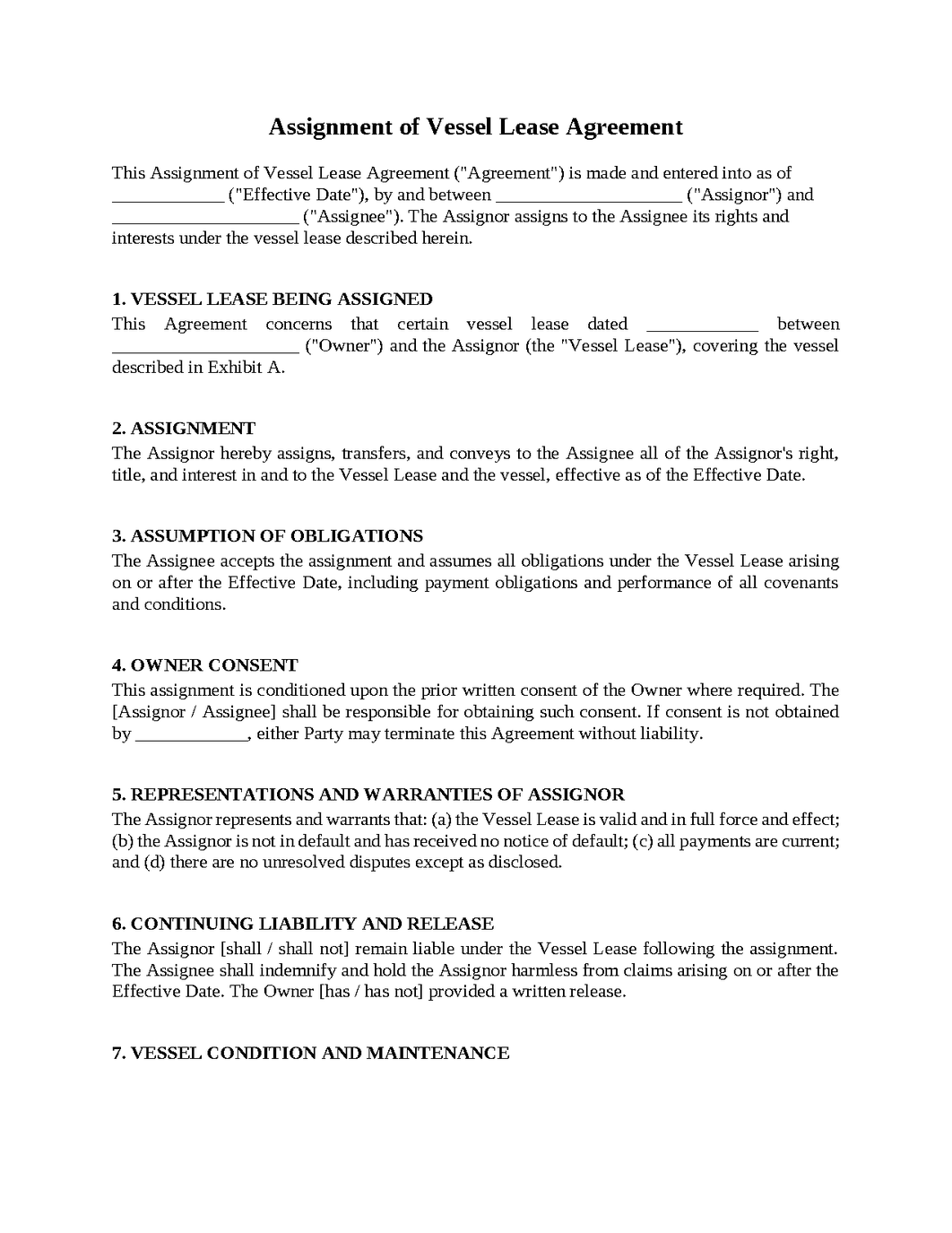
Assignment of Vessel Lease Agreement
An Assignment of Vessel Lease Agreement is a legal contract used when a lessee transfers its rights and obligations under a vessel lease to another person or business. The party transferring the lease is known as the assignor, while the party assuming the lease is known as the assignee. Vessel lease assignments commonly occur in commercial fishing operations, charter businesses, cargo transportation, offshore service operations, tourism ventures, marina businesses, and private boating arrangements. Because vessels are high-value assets subject to maintenance requirements, insurance obligations, regulatory compliance standards, and operational risks, transferring a vessel lease can create significant legal and financial challenges. An Assignment of Vessel Lease Agreement helps establish who assumes responsibility for the leased vessel and how future obligations will be allocated between the parties.
The Lessee Transfers the Vessel Without the Owner's Approval
A charter fishing company leases a large sportfishing vessel used for guided excursions along the coast. After several difficult seasons, the company decides to reduce operations and seeks a way to eliminate the ongoing lease expense.
A competing charter operator expresses interest in taking over the vessel. The boat is well suited to its business, and both parties believe the arrangement will benefit everyone involved.
The companies negotiate quickly and transfer possession of the vessel. The new operator begins scheduling charters immediately and assumes that the transaction is complete.
Several months later, the vessel owner discovers that a different company is operating the boat. A review of the lease reveals that any assignment requires prior written consent from the owner.
No approval was obtained.
The owner raises concerns regarding the assignee's financial condition, operating practices, insurance coverage, and safety procedures. The owner argues that the assignment violates the lease and threatens to terminate the arrangement.
The assignee suddenly faces uncertainty regarding continued access to a vessel that has become central to its business operations. The assignor risks default claims and potential liability for breaching the lease.
To help avoid this problem, an Assignment of Vessel Lease Agreement should identify all approval requirements contained in the lease and make owner consent a condition of the assignment. The agreement should also establish procedures for obtaining approvals and allocating responsibility if consent is denied.
The Assignee Inherits Major Maintenance Problems
A tourism company assumes a lease covering a sightseeing vessel used for harbor cruises. The vessel appears attractive because it is already equipped for passenger operations and comes with favorable lease terms.
During preliminary inspections, the vessel appears functional and reasonably maintained. Because the business is eager to launch operations before the busy season, the transaction moves forward quickly.
Several weeks after taking possession, significant maintenance issues emerge.
Marine surveyors discover corrosion in critical components, deferred engine repairs, and safety equipment requiring replacement. Further review reveals that several maintenance recommendations had been postponed repeatedly by the prior operator.
The assignee is frustrated.
Instead of acquiring a reliable vessel ready for immediate service, the company faces substantial repair costs and operational delays. Cruise schedules must be canceled while repairs are completed.
Revenue projections decline, customer bookings are disrupted, and management begins questioning whether the assignment was economically viable.
To reduce these risks, an Assignment of Vessel Lease Agreement should require disclosure of maintenance records, inspection reports, known defects, repair histories, and upcoming service requirements. The agreement should also allocate responsibility for pre-existing conditions discovered after the transfer.
The Original Lessee Remains Liable After the Assignment
A commercial fishing operation assigns a vessel lease after downsizing its fleet. Management believes the transfer will eliminate future obligations associated with the leased vessel.
The assignee operates the vessel successfully for several years. Lease payments are made on time, and the assignor rarely thinks about the transaction.
Eventually, however, the fishing industry experiences a downturn. The assignee struggles financially and stops making lease payments.
The vessel owner immediately contacts the original lessee.
Management is surprised to learn that the lease still holds the assignor responsible for performance unless the owner expressly releases it from liability. No release was ever obtained during the assignment process.
The assignor now faces potential responsibility for unpaid lease obligations, vessel recovery costs, maintenance deficiencies, and other losses.
The financial exposure is significant because vessel leases often involve substantial monthly payments and expensive assets.
This issue is common because many lessees incorrectly assume that assigning a lease automatically eliminates future responsibility.
To avoid these problems, an Assignment of Vessel Lease Agreement should clearly address continuing liability. The agreement should specify whether the assignor remains responsible after the transfer and require the assignee to indemnify the assignor for future claims. Whenever possible, the assignor should also seek a written release from the vessel owner.
Regulatory Compliance Issues Surface After Closing
An offshore services company assumes a lease covering a support vessel used in energy-related operations.
The vessel appears capable of meeting operational requirements, and management focuses primarily on lease economics and scheduling opportunities.
Several months after the assignment, a regulatory inspection identifies compliance deficiencies.
Documentation regarding safety equipment is incomplete. Certain certifications require renewal. Crew training records contain gaps that may affect compliance with maritime regulations.
The assignee becomes concerned.
Regulatory issues can affect vessel operations immediately. Delays may prevent the vessel from performing contracted work, resulting in lost revenue and damaged customer relationships.
Further investigation suggests that some of the compliance concerns existed before the assignment occurred.
The assignee argues that these issues should have been disclosed. The assignor maintains that the vessel was operating normally when possession transferred.
To reduce these risks, an Assignment of Vessel Lease Agreement should require disclosure of regulatory inspections, compliance deficiencies, safety issues, certification status, and pending enforcement matters. The agreement should also allocate responsibility for regulatory issues originating before the transfer.
A Maritime Accident Leads to a Complex Liability Dispute
A marine transportation company assumes a lease covering a cargo vessel operating along regional shipping routes.
For more than a year, the arrangement works smoothly. The vessel performs regular voyages, maintenance schedules are followed, and lease obligations are satisfied.
Then a serious accident occurs.
The vessel collides with another watercraft during poor weather conditions, causing significant property damage and resulting in multiple insurance claims.
Investigations begin immediately.
Attorneys, insurers, regulators, and vessel owners all become involved. During the investigation, questions arise regarding the vessel's maintenance history, prior repairs, navigational equipment, and operational practices.
The assignee alleges that certain equipment problems may have existed before the assignment occurred. The assignor argues that responsibility transferred when the lease was assigned.
The financial consequences quickly become enormous. Legal costs, insurance disputes, operational interruptions, and potential liability claims affect multiple parties.
What began as a routine lease transfer becomes the focus of years of litigation.
To help avoid these situations, an Assignment of Vessel Lease Agreement should clearly allocate liability for pre-assignment and post-assignment events. The agreement should establish insurance requirements, indemnification obligations, maintenance responsibilities, and procedures for addressing claims arising after the transfer becomes effective.
Vessel leases often involve valuable assets operating in highly regulated and inherently risky environments. Whether the vessel is used for commercial fishing, tourism, transportation, offshore services, or recreational purposes, assigning a vessel lease requires careful attention to approvals, maintenance obligations, regulatory compliance, insurance requirements, and continuing liability risks. An Assignment of Vessel Lease Agreement provides a structured framework for documenting these transfers and clarifying the responsibilities of everyone involved. When drafted carefully, it can help reduce disputes, protect valuable maritime assets, and provide confidence regarding the successful transfer of vessel lease rights and obligations.

Get started with Upsign today!
Easily send, sign and track your documents