

Direct Mail Marketing Agreement
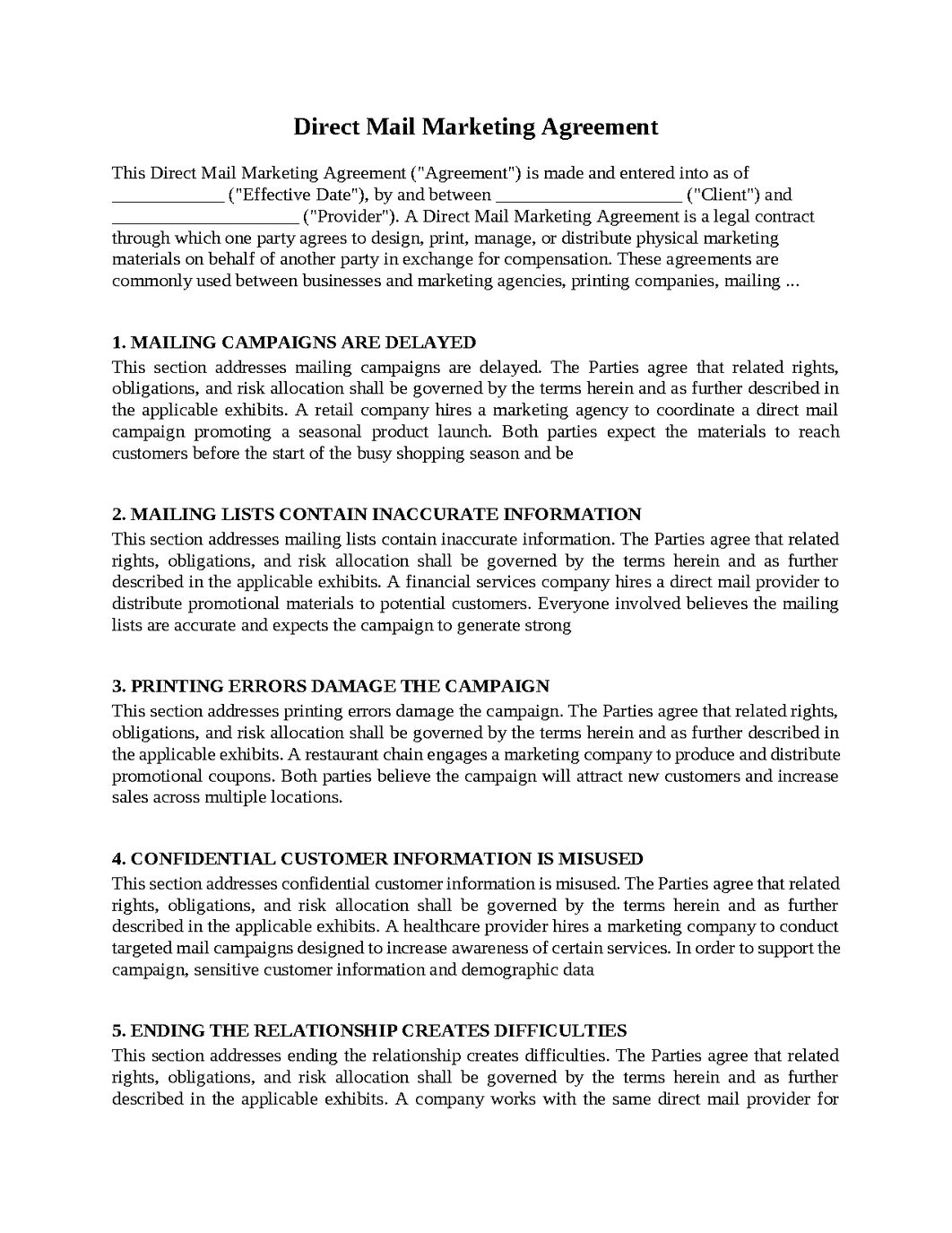
A Direct Mail Marketing Agreement is a legal contract through which one party agrees to design, print, manage, or distribute physical marketing materials on behalf of another party in exchange for compensation. These agreements are commonly used between businesses and marketing agencies, printing companies, mailing services, political campaigns, nonprofit organizations, retailers, and companies seeking to promote products and services through postcards, catalogs, brochures, and targeted mail campaigns. A Direct Mail Marketing Agreement typically addresses the scope of services, mailing lists, budgets, timelines, quality standards, confidentiality obligations, and procedures for handling errors or disputes. Because direct mail campaigns often involve significant costs and time-sensitive promotions, disputes can arise when expectations regarding performance and results are not documented clearly. A carefully drafted Direct Mail Marketing Agreement helps establish certainty and protect the interests of both parties.
Mailing Campaigns Are Delayed
A retail company hires a marketing agency to coordinate a direct mail campaign promoting a seasonal product launch. Both parties expect the materials to reach customers before the start of the busy shopping season and believe the timeline provides sufficient time for printing and distribution.
During the early stages of the project, artwork and mailing lists are finalized without major issues. Unexpected production delays and logistical challenges eventually affect printing schedules, causing the mail pieces to arrive long after the promotional period has begun.
The retailer believes the agency should bear responsibility because the timing of the campaign was essential to its success. The agency argues that supply chain problems and postal delays were outside its control and that reasonable efforts were made to minimize disruptions. As sales projections fall short of expectations, frustrations increase and both sides begin disputing responsibility for the failed campaign.
To help avoid this problem, a Direct Mail Marketing Agreement should clearly establish project timelines and define how delays affecting production and distribution will be handled.
Mailing Lists Contain Inaccurate Information
A financial services company hires a direct mail provider to distribute promotional materials to potential customers. Everyone involved believes the mailing lists are accurate and expects the campaign to generate strong responses.
As the mailings are distributed, a large number of pieces are returned because addresses are outdated or incorrect. Additional complaints arise when materials are delivered to unintended recipients, creating concerns about efficiency and reputation.
The company believes the mailing provider should have verified the accuracy of the data before launching the campaign. The provider argues that the customer supplied the mailing lists and that address verification services were never included within the original scope of work. As expenses increase and response rates decline, both sides begin disagreeing about who should absorb the losses.
To help prevent these issues, a Direct Mail Marketing Agreement should clearly establish responsibility for mailing lists and define the procedures used to verify address information.
Printing Errors Damage the Campaign
A restaurant chain engages a marketing company to produce and distribute promotional coupons. Both parties believe the campaign will attract new customers and increase sales across multiple locations.
After thousands of mailers are printed and distributed, management discovers that important pricing information and expiration dates contain errors. Customers become confused and some attempt to redeem offers that the business never intended to honor.
The restaurant chain believes the marketing company should be responsible because it controlled the printing process and distributed the materials. The marketing company argues that the client approved the final proofs before production began and that the errors should have been detected earlier. As complaints increase and financial losses mount, tensions rise regarding responsibility for the mistakes.
To help avoid these problems, a Direct Mail Marketing Agreement should clearly establish approval procedures and define responsibility for printing errors and production defects.
Confidential Customer Information Is Misused
A healthcare provider hires a marketing company to conduct targeted mail campaigns designed to increase awareness of certain services. In order to support the campaign, sensitive customer information and demographic data are shared with the marketing provider.
Initially, both parties focus on improving outreach and strengthening customer relationships. Over time, concerns arise when information provided for the campaign appears to have been used in unrelated projects or disclosed to additional parties.
The healthcare provider believes the information should only be used for the purposes specifically authorized under the relationship. The marketing company argues that no improper disclosures occurred and that standard industry practices were followed. As trust begins deteriorating, both sides become increasingly concerned about privacy obligations and reputational risks.
To help prevent these issues, a Direct Mail Marketing Agreement should clearly define confidential information and establish restrictions governing its use and disclosure.
Ending the Relationship Creates Difficulties
A company works with the same direct mail provider for many years and gradually integrates campaign processes, customer databases, and marketing strategies into its operations. Both parties assume the relationship will continue indefinitely and make investments based upon that expectation.
Eventually, changing priorities lead the company to bring certain marketing functions in-house and terminate the arrangement. Although both sides initially expect the transition to proceed smoothly, disagreements emerge regarding unfinished campaigns, access to customer lists, and the transfer of marketing materials and records.
The company believes continued cooperation is necessary to preserve momentum and avoid disrupting customer relationships. The provider believes its obligations should conclude promptly so resources can be devoted to other clients. As discussions become more complicated, both parties realize that separating years of cooperation is far more difficult than they originally anticipated.
To help avoid this problem, a Direct Mail Marketing Agreement should clearly establish termination procedures and identify the responsibilities that survive the conclusion of the relationship.
Direct Mail Marketing Agreements are valuable tools that allow businesses to conduct targeted campaigns and reach customers through traditional marketing channels. However, issues involving delays, inaccurate mailing lists, printing errors, confidentiality concerns, and termination responsibilities can become significant sources of conflict when expectations are not documented clearly. A carefully drafted Direct Mail Marketing Agreement provides a structured framework for allocating responsibilities and protecting the interests of both parties. When prepared thoughtfully, it can reduce uncertainty, improve campaign performance, strengthen business relationships, and provide the foundation necessary for successful long-term marketing efforts.

Get started with Upsign today!
Easily send, sign and track your documents