

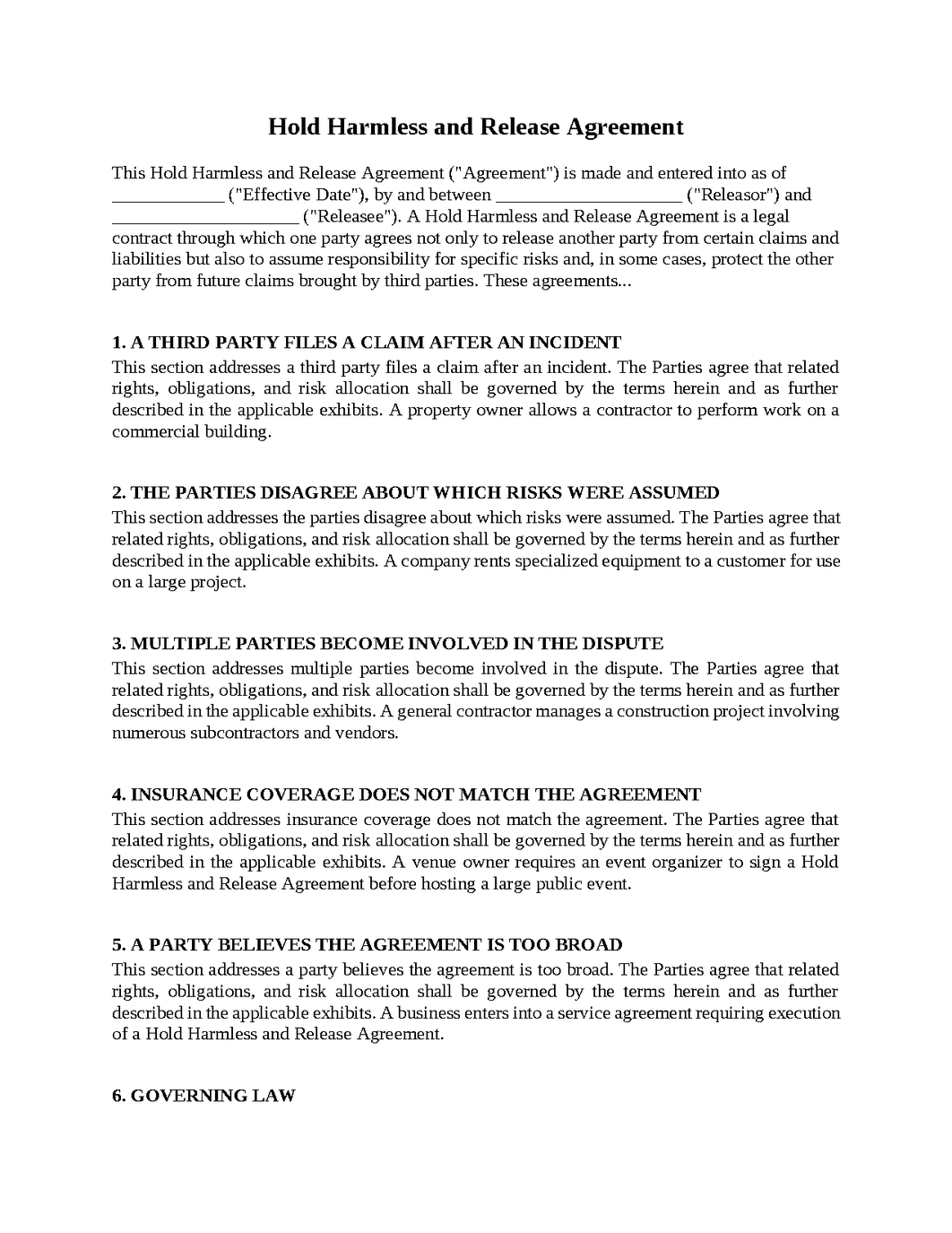
Hold Harmless and Release Agreement
A Hold Harmless and Release Agreement is a legal contract through which one party agrees not only to release another party from certain claims and liabilities but also to assume responsibility for specific risks and, in some cases, protect the other party from future claims brought by third parties. These agreements are commonly used in construction projects, contractor relationships, equipment rentals, event sponsorships, recreational activities, property access arrangements, business transactions, and commercial service agreements. Unlike a simple release, a Hold Harmless and Release Agreement often includes indemnification obligations that require one party to defend or reimburse another if claims arise. Because these agreements shift significant risk from one party to another, disputes frequently arise when the parties have different understandings regarding the scope of the protection being provided. A carefully drafted Hold Harmless and Release Agreement helps allocate risk clearly and reduce uncertainty regarding future liability.
A Third Party Files a Claim After an Incident
A property owner allows a contractor to perform work on a commercial building.
As part of the arrangement, the contractor signs a Hold Harmless and Release Agreement agreeing to assume responsibility for certain risks associated with the project. Both parties believe the agreement provides clear protection against future disputes.
During the project, a visitor to the property suffers an injury and files a claim against the property owner. The owner immediately seeks protection under the hold harmless provisions and expects the contractor to assume responsibility.
The contractor argues that the injury was unrelated to the contractor's work and therefore falls outside the agreement. The property owner believes the incident occurred during the project and should be covered.
The disagreement focuses on whether the third-party claim falls within the scope of the hold harmless obligations.
To help avoid this problem, a Hold Harmless and Release Agreement should clearly define the claims covered by the agreement and explain how third-party claims will be handled.
The Parties Disagree About Which Risks Were Assumed
A company rents specialized equipment to a customer for use on a large project.
As a condition of the rental, the customer signs a Hold Harmless and Release Agreement acknowledging responsibility for risks associated with operating and maintaining the equipment. The rental company believes the agreement provides broad protection.
Several months later, an accident involving the equipment causes property damage and financial losses. The customer argues that the equipment was defective and that responsibility should remain with the rental company.
The rental company believes the customer assumed the risks associated with using the equipment through the agreement. The customer believes certain risks were never intended to be transferred.
The disagreement arises because each side interprets the allocation of risk differently.
To help prevent these issues, a Hold Harmless and Release Agreement should clearly identify the specific risks being assumed and any risks that remain the responsibility of the other party.
Multiple Parties Become Involved in the Dispute
A general contractor manages a construction project involving numerous subcontractors and vendors.
Each subcontractor signs a Hold Harmless and Release Agreement before beginning work. Everyone assumes the agreements will provide clarity if problems arise during the project.
An accident later occurs that allegedly involves actions by several different parties. Claims are asserted against the property owner, general contractor, and multiple subcontractors.
Each party points to various contractual provisions and argues that another participant bears responsibility for defending and paying the claims. The project becomes consumed by disputes over contractual risk allocation.
The original accident becomes secondary to the question of who must indemnify whom.
To help avoid these problems, a Hold Harmless and Release Agreement should clearly identify the parties receiving protection and explain how responsibility will be allocated when multiple parties contribute to a loss.
Insurance Coverage Does Not Match the Agreement
A venue owner requires an event organizer to sign a Hold Harmless and Release Agreement before hosting a large public event.
The organizer agrees to indemnify the venue for certain claims and represents that appropriate insurance coverage is in place. Both parties believe the arrangement adequately protects their interests.
After an incident occurs, a claim is submitted to the organizer's insurer. During the investigation, it becomes apparent that the insurance policy may not provide coverage as broadly as the parties assumed.
The venue owner believes the organizer remains contractually obligated to provide protection regardless of insurance coverage. The organizer argues that the agreement was negotiated with the expectation that insurance would respond.
The disagreement becomes increasingly significant because substantial financial exposure may exist.
To help prevent these issues, a Hold Harmless and Release Agreement should clearly address insurance requirements and explain how contractual obligations interact with available insurance coverage.
A Party Believes the Agreement Is Too Broad
A business enters into a service agreement requiring execution of a Hold Harmless and Release Agreement.
At the time of signing, the parties are focused primarily on launching the project and paying little attention to the detailed risk-allocation provisions. The relationship proceeds successfully for an extended period.
Years later, a dispute arises and one party reviews the agreement more carefully. The party becomes concerned that the hold harmless language appears to transfer far more responsibility than originally understood.
The other party argues that the agreement was negotiated voluntarily and should be enforced according to its terms. The concerned party believes the scope of the obligations extends well beyond what was contemplated when the relationship began.
The disagreement centers on the meaning and breadth of the contractual protections.
To help avoid these problems, a Hold Harmless and Release Agreement should use clear language, define the scope of indemnification obligations, and ensure that all parties understand the responsibilities they are assuming.
Hold Harmless and Release Agreements are powerful risk-management tools that help parties allocate responsibility for future claims and losses. However, issues involving third-party claims, assumed risks, multiple responsible parties, insurance coverage, and the scope of indemnification obligations can become significant sources of conflict when expectations are not documented clearly. A carefully drafted Hold Harmless and Release Agreement provides a structured framework for allocating risk and establishing responsibilities before problems occur. When prepared thoughtfully, it can reduce uncertainty, protect business relationships, support commercial transactions, and provide greater confidence for all parties involved.

Get started with Upsign today!
Easily send, sign and track your documents