

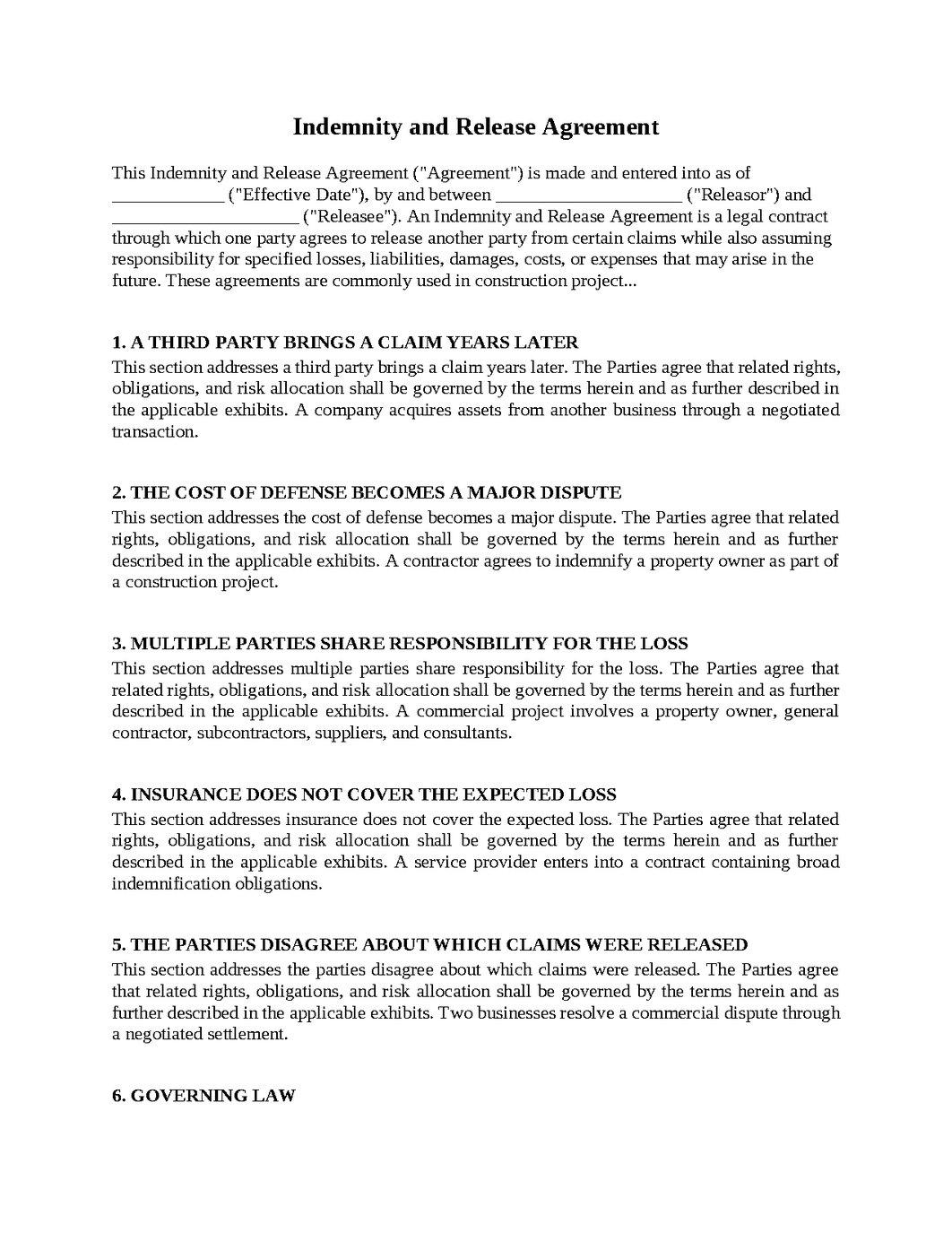
Indemnity and Release Agreement
An Indemnity and Release Agreement is a legal contract through which one party agrees to release another party from certain claims while also assuming responsibility for specified losses, liabilities, damages, costs, or expenses that may arise in the future. These agreements are commonly used in construction projects, business transactions, mergers and acquisitions, contractor relationships, commercial leases, event sponsorships, equipment rentals, settlement agreements, and service arrangements. Unlike a simple release, an Indemnity and Release Agreement often requires one party to reimburse, defend, or protect another party if certain claims are brought by third parties. Because indemnification obligations can create substantial financial exposure long after the underlying transaction has concluded, disputes frequently arise when the parties have different interpretations of their responsibilities. A carefully drafted Indemnity and Release Agreement helps allocate risk clearly and reduce uncertainty regarding future liabilities.
A Third Party Brings a Claim Years Later
A company acquires assets from another business through a negotiated transaction.
As part of the acquisition, the parties execute an Indemnity and Release Agreement addressing known liabilities and allocating responsibility for future claims. Both companies believe the agreement provides a clear framework for handling potential disputes.
Several years after the transaction closes, a third party files a lawsuit relating to events that occurred before the acquisition. The acquiring company seeks indemnification from the seller and expects reimbursement for legal expenses and potential damages.
The seller argues that the claim falls outside the scope of the indemnification provisions. The buyer believes the agreement was specifically designed to address this type of liability.
The disagreement shifts away from the underlying lawsuit and focuses on who must bear the financial burden of defending the claim.
To help avoid this problem, an Indemnity and Release Agreement should clearly define covered claims, identify excluded liabilities, and establish procedures for handling third-party disputes.
The Cost of Defense Becomes a Major Dispute
A contractor agrees to indemnify a property owner as part of a construction project.
The Indemnity and Release Agreement requires the contractor to protect the owner from certain claims arising out of the work. Initially, both parties believe the arrangement is straightforward and unlikely to create problems.
After an accident occurs, a lawsuit is filed against both the contractor and the property owner. The owner immediately demands that the contractor assume responsibility for legal defense costs.
The contractor believes indemnification should apply only if liability is ultimately established. The owner believes the duty to defend arises as soon as the claim is filed.
The legal expenses begin accumulating rapidly while the parties argue over who must pay them.
To help prevent these issues, an Indemnity and Release Agreement should clearly address defense obligations, reimbursement procedures, and the timing of indemnification responsibilities.
Multiple Parties Share Responsibility for the Loss
A commercial project involves a property owner, general contractor, subcontractors, suppliers, and consultants.
Various Indemnity and Release Agreements are executed among the participants before work begins. Everyone assumes the agreements will provide clarity if problems arise.
Following a major incident, claims are asserted against multiple parties. Investigations suggest that several different actions may have contributed to the loss.
Each party argues that another participant bears primary responsibility and should provide indemnification. The parties spend substantial time disputing contractual obligations instead of focusing on resolving the underlying claim.
The complexity increases because responsibility is shared among several entities.
To help avoid these problems, an Indemnity and Release Agreement should clearly address situations involving multiple responsible parties and explain how indemnification obligations will be allocated.
Insurance Does Not Cover the Expected Loss
A service provider enters into a contract containing broad indemnification obligations.
At the time the agreement is signed, both parties assume that insurance coverage will respond to any significant claims. The indemnifying party obtains insurance and believes appropriate protections are in place.
Years later, a claim arises that falls within the indemnification provisions but outside the scope of available insurance coverage. The indemnifying party suddenly faces substantial uninsured financial exposure.
The protected party believes the contractual indemnification obligations remain fully enforceable regardless of insurance limitations. The indemnifying party argues that the agreement was negotiated with the expectation that insurance would provide meaningful protection.
The disagreement becomes increasingly significant because the financial stakes are substantial.
To help prevent these issues, an Indemnity and Release Agreement should clearly address insurance requirements and explain how contractual obligations interact with available coverage.
The Parties Disagree About Which Claims Were Released
Two businesses resolve a commercial dispute through a negotiated settlement.
As part of the settlement, they execute an Indemnity and Release Agreement that includes both releases of existing claims and indemnification obligations relating to future matters. Initially, everyone believes the agreement resolves the conflict completely.
Months later, a new dispute emerges involving conduct that occurred before the settlement but was not specifically discussed during negotiations. One party believes the claim was released permanently.
The other party argues that the indemnification provisions preserve certain rights and obligations despite the release language. Each side points to different sections of the agreement to support its position.
The disagreement becomes a dispute regarding the interaction between the release provisions and the indemnification obligations.
To help avoid these problems, an Indemnity and Release Agreement should clearly distinguish released claims from surviving indemnification obligations and explain how the various provisions work together.
Indemnity and Release Agreements are powerful tools for allocating risk and resolving disputes in business and commercial relationships. However, issues involving third-party claims, defense costs, shared liability, insurance limitations, and the interaction between releases and indemnification obligations can become significant sources of conflict when expectations are not documented clearly. A carefully drafted Indemnity and Release Agreement provides a structured framework for managing future risks and protecting the parties involved. When prepared thoughtfully, it can reduce uncertainty, support complex transactions, preserve business relationships, and provide greater confidence regarding future liabilities.

Get started with Upsign today!
Easily send, sign and track your documents