

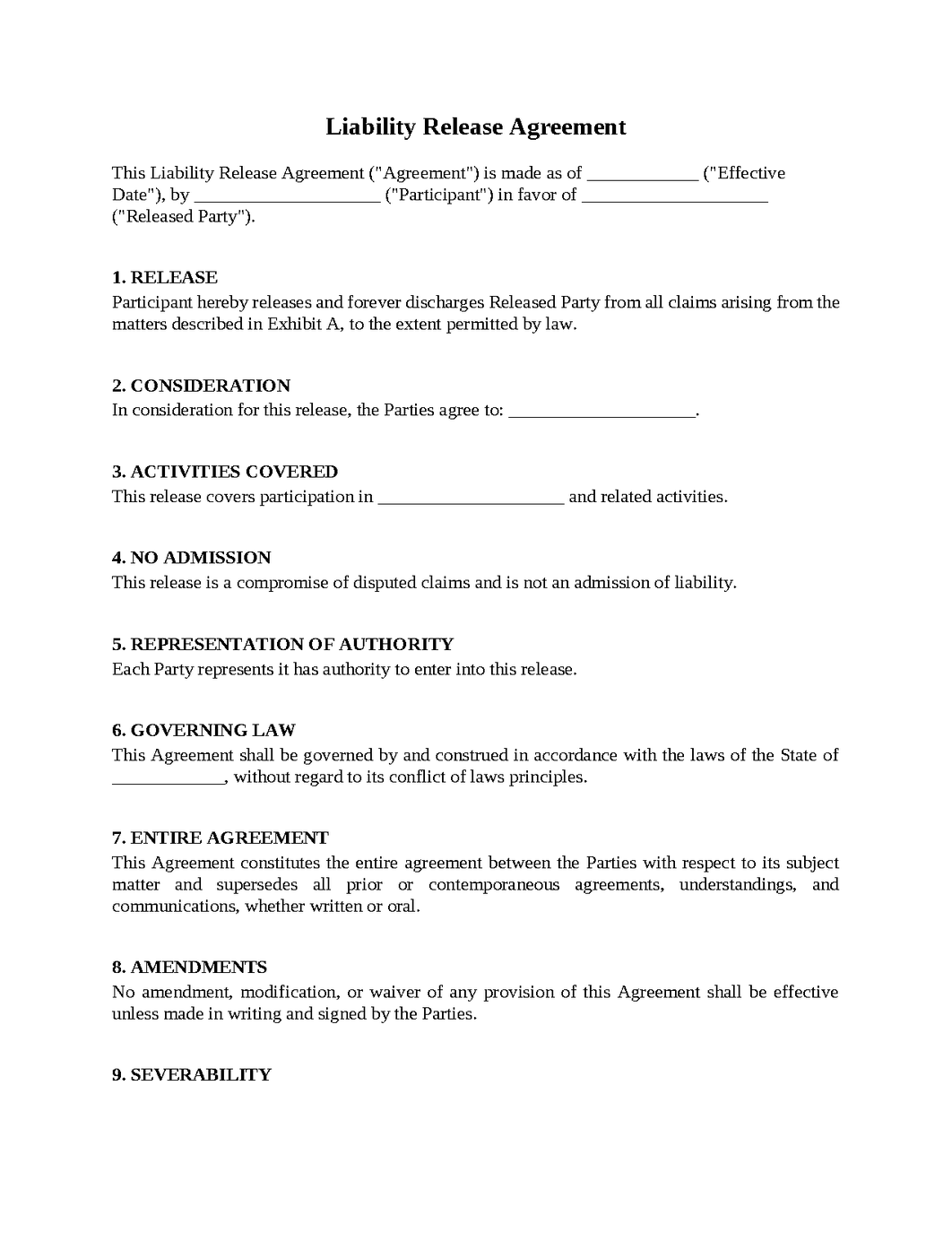
Liability Release Agreement
A Liability Release Agreement is a legal contract through which one party agrees to release another party from liability for certain risks, injuries, damages, losses, or claims that may arise from a specific activity, event, service, or transaction. These agreements are commonly used by fitness centers, recreational facilities, event organizers, sports leagues, tour operators, contractors, educational programs, and businesses that offer activities involving inherent risks. The purpose of a Liability Release Agreement is to allocate risk by ensuring that participants understand and voluntarily accept certain dangers before engaging in the activity. Because accidents and injuries can still occur despite safety precautions, disputes often arise when the parties disagree about the scope and enforceability of the release. A carefully drafted Liability Release Agreement helps establish clear expectations while reducing uncertainty regarding potential claims.
A Participant Is Injured During an Activity
A recreational company offers guided outdoor excursions that attract participants with varying levels of experience.
Before each excursion, participants are required to sign a Liability Release Agreement acknowledging the risks associated with the activity. Most participants review the document briefly and proceed with the event without incident.
During one excursion, a participant suffers a significant injury while navigating difficult terrain. The participant incurs medical expenses, loses time from work, and experiences a lengthy recovery period.
After the accident, the participant argues that the injury resulted from unsafe conditions and inadequate supervision. The company believes the participant voluntarily accepted the known risks of the activity when signing the release.
What began as a recreational experience becomes a dispute regarding whether the injury falls within the scope of the liability waiver.
To help avoid this problem, a Liability Release Agreement should clearly identify the risks associated with the activity and explain the types of claims that are being released.
The Participant Claims the Risks Were Not Explained Properly
A fitness facility introduces a new training program that includes physically demanding exercises and specialized equipment.
As part of the enrollment process, participants sign a Liability Release Agreement before attending classes. The facility believes the agreement adequately informs participants of potential risks.
Several months later, a participant suffers an injury and claims that the specific risks associated with the program were never explained clearly. The participant acknowledges signing the document but argues that the consequences were not fully understood.
The facility maintains that the release was provided before participation and that each participant had an opportunity to review the terms carefully.
The disagreement centers on whether the participant knowingly accepted the risks involved.
To help prevent these issues, a Liability Release Agreement should be written in clear language, describe foreseeable risks, and provide participants with a meaningful opportunity to understand the document before signing.
A Parent Questions a Release Signed for a Minor
A youth sports organization requires parents to sign Liability Release Agreements before children may participate.
The program operates successfully for several seasons and emphasizes safety, training, and supervision. During a competitive event, however, a child suffers an injury that requires medical treatment.
The organization points to the signed release and argues that the risks of participation were disclosed in advance. The parents believe the circumstances surrounding the injury go beyond the ordinary risks associated with the sport.
Questions arise regarding the enforceability of the release, the scope of parental consent, and the responsibilities of the organization.
The disagreement becomes particularly sensitive because it involves the safety and well-being of a minor participant.
To help avoid these problems, a Liability Release Agreement should clearly address participation by minors, identify the role of parental consent, and explain the risks associated with the activity.
Third-Party Conduct Causes an Injury
An event organizer hosts a large recreational event attended by hundreds of participants.
Each participant signs a Liability Release Agreement before attending. The organizer believes the release protects against claims arising from the ordinary risks associated with the event.
During the event, one participant is injured due to the actions of another attendee. The injured participant seeks compensation and argues that the release was not intended to cover injuries caused by third-party conduct.
The organizer maintains that the agreement broadly allocated risk and applies to incidents occurring during participation. The participant believes the situation falls outside the intended scope of the release.
The disagreement focuses on whether liability arising from the actions of others is covered by the agreement.
To help prevent these issues, a Liability Release Agreement should clearly define the claims being released and explain whether injuries involving third parties are included within the scope of the release.
Safety Procedures Are Allegedly Ignored
A company offers an activity that involves specialized equipment and established safety protocols.
Participants sign Liability Release Agreements before taking part and receive safety instructions prior to the activity. The company believes it has taken reasonable steps to protect participants while communicating the inherent risks involved.
Following an accident, a participant alleges that employees failed to follow established safety procedures. The participant argues that a liability release should not excuse conduct that departs from required safety standards.
The company believes the accident resulted from risks inherent in the activity rather than any failure to follow procedures.
The dispute becomes focused on the relationship between assumed risks and the company's own conduct.
To help avoid these problems, a Liability Release Agreement should clearly describe the risks being assumed while remaining consistent with applicable legal standards governing safety and liability.
Liability Release Agreements are widely used to allocate risk and allow individuals to participate in activities that involve inherent dangers. However, issues involving participant injuries, informed consent, parental authorization, third-party conduct, and alleged safety failures can become significant sources of conflict when expectations are not documented clearly. A carefully drafted Liability Release Agreement provides a structured framework for communicating risks and defining responsibilities. When prepared thoughtfully, it can help reduce misunderstandings, support informed decision-making, and provide greater certainty for both participants and organizations.

Get started with Upsign today!
Easily send, sign and track your documents