

Personal Loan Contract
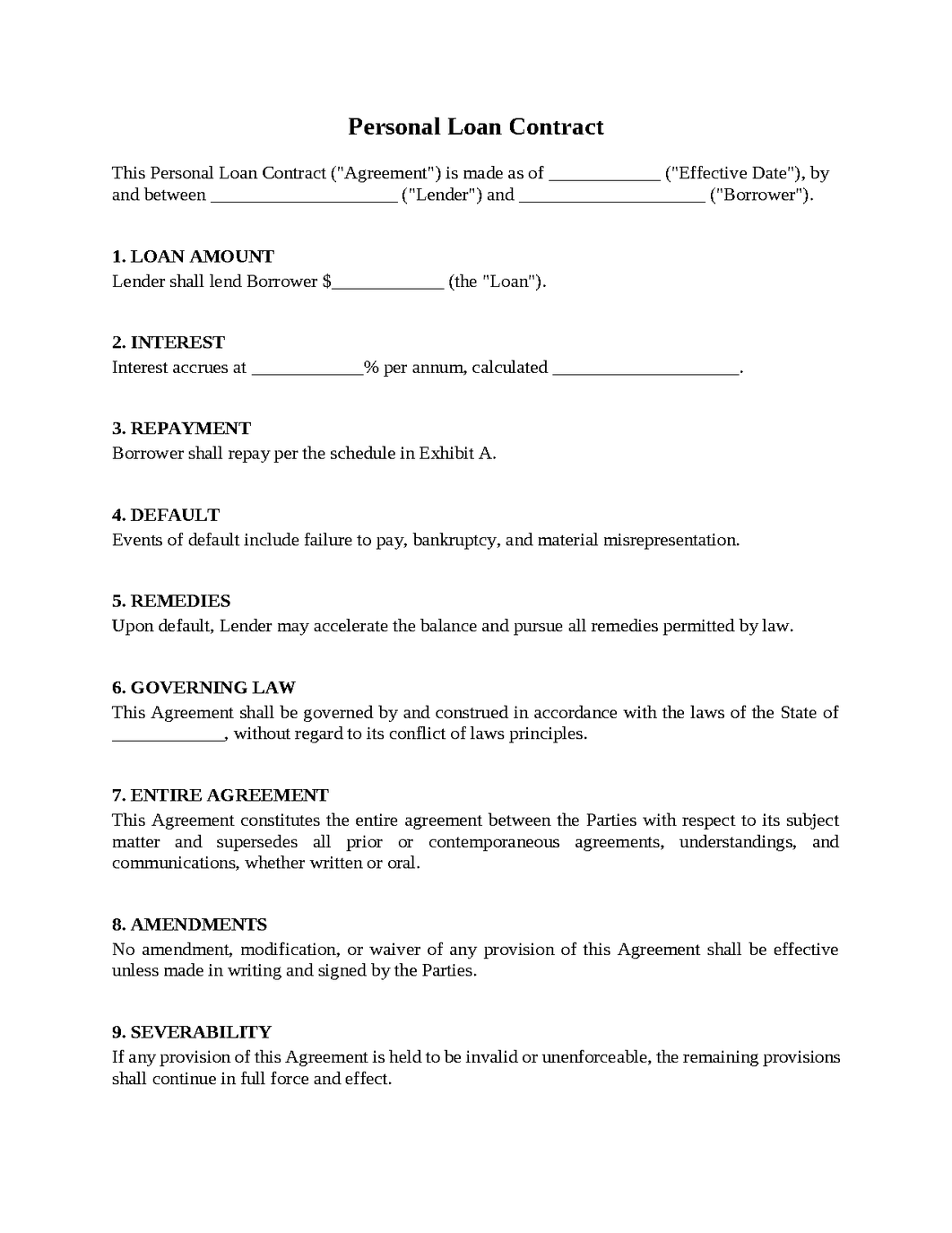
A Personal Loan Contract is a legal agreement that documents the terms under which one individual lends money to another individual. Unlike loans issued by banks or financial institutions, personal loans between friends, family members, business associates, or acquaintances often begin with informal discussions and a high level of trust. While these arrangements may seem straightforward, disagreements frequently arise regarding repayment schedules, interest obligations, late payments, defaults, and misunderstandings about whether the funds were intended as a loan or a gift. A properly drafted Personal Loan Contract helps establish clear expectations and provides a framework for resolving issues before they damage relationships or result in legal disputes.
The Borrower Believes the Loan Was Really a Gift
A father lends his adult son $25,000 to help with the down payment on a first home. The conversation takes place around the family dinner table, and everyone is excited about the purchase. Because the parties trust one another, they never prepare formal documentation.
For the first year, no one discusses repayment. The son assumes his father intended the money as financial support and believes repayment will only be expected if his financial situation improves significantly. The father, however, views the arrangement as a loan and expects repayment once the son becomes established in his new home.
Several years later, financial circumstances change. The father needs additional funds for retirement expenses and asks about repayment. The son is surprised by the request and reminds his father that no payment schedule was ever discussed.
What began as a generous act of support becomes an emotionally charged disagreement. Family members take sides, relationships become strained, and the parties find themselves debating conversations that occurred years earlier.
To help avoid this problem, a Personal Loan Contract should clearly state that the funds are a loan rather than a gift. The agreement should identify the principal amount, repayment obligations, payment schedule, and any circumstances under which repayment may be modified or forgiven. Clear documentation can eliminate uncertainty and preserve important personal relationships.
The Repayment Schedule Is Never Defined
A longtime friend lends another friend $15,000 to help launch a small business. Both parties trust each other completely and view the arrangement as temporary.
The borrower intends to repay the money when the business becomes profitable. The lender assumes monthly payments will begin within a few months. Unfortunately, neither party discusses a specific repayment timeline.
As the business grows, the borrower reinvests profits into expansion rather than making payments. The lender becomes increasingly frustrated and begins asking when repayment will begin. The borrower responds that the business still needs capital and that repayment will happen eventually.
The disagreement escalates because both parties believe their expectations were reasonable. The lender expected predictable payments. The borrower expected flexibility.
To reduce these risks, a Personal Loan Contract should establish a detailed repayment schedule that identifies payment amounts, due dates, payment methods, and maturity dates. Specific repayment terms help eliminate misunderstandings about when money must be returned.
The Parties Never Address Interest
A business associate lends $50,000 to a colleague who needs temporary financing while waiting for a real estate transaction to close.
The loan is expected to last only a few months, so the parties focus primarily on getting the funds transferred quickly. They discuss repayment but never address whether interest will apply.
The real estate transaction is delayed repeatedly. What was expected to be a short-term loan remains outstanding for nearly two years.
When repayment finally occurs, the lender requests interest. The borrower refuses, arguing that interest was never discussed. The lender believes compensation is appropriate because the money was unavailable for other investments during the loan period.
The dispute grows increasingly contentious because the amount at issue is substantial. Both parties feel the other is acting unfairly.
To help prevent these problems, a Personal Loan Contract should clearly state whether interest applies, how it will be calculated, when it accrues, and how it will be paid. Even if the parties agree that no interest will be charged, documenting that decision can prevent future disagreements.
Financial Hardship Makes Repayment Impossible
A woman lends her brother $30,000 to help pay medical expenses during a difficult period.
The brother fully intends to repay the loan and signs a basic agreement requiring monthly payments. Unfortunately, additional health complications arise, causing him to miss work for an extended period.
As months pass, payments become sporadic. Eventually, they stop entirely.
The lender sympathizes with the situation but also needs the money. The borrower feels embarrassed and overwhelmed. Both parties want to preserve their relationship, yet neither knows how to address the growing financial problem.
The original agreement contains no provisions addressing hardship situations, payment modifications, or default procedures. As a result, every conversation becomes awkward and emotionally charged.
What started as a loan between family members now threatens to damage a close personal relationship.
To help avoid these situations, a Personal Loan Contract should address late payments, defaults, hardship accommodations, modification procedures, and available remedies. Having a clear plan for unexpected financial difficulties can reduce tension when challenges arise.
The Borrower Dies Before the Loan Is Repaid
A retired individual lends $40,000 to a longtime friend who plans to repay the money over several years.
For a time, payments are made consistently. Unexpectedly, however, the borrower passes away before the loan is fully repaid.
The lender contacts family members regarding the outstanding balance and discovers that no one is certain what obligations remain. Some relatives were unaware of the loan entirely. Others question whether sufficient evidence exists to prove the debt.
The lender becomes concerned that years of repayments may be lost. The borrower's family becomes frustrated because they are already dealing with estate administration and personal grief.
A situation that could have been handled routinely becomes complicated because the loan documentation lacks detail regarding estate obligations and supporting records.
To help prevent these issues, a Personal Loan Contract should address what happens if either party dies before the loan is repaid. The agreement should specify whether the obligation survives death, how claims may be asserted against an estate, and what documentation will be maintained to verify the outstanding balance.
Personal loans are often made between people who trust one another and may not anticipate future disagreements. Unfortunately, misunderstandings regarding repayment, interest, timing, hardship situations, and estate issues can quickly transform a simple loan into a serious dispute. A Personal Loan Contract provides a structured framework for documenting expectations and protecting both parties. When drafted carefully, it can help preserve relationships, reduce uncertainty, and provide clear guidance regarding repayment obligations throughout the life of the loan.

Get started with Upsign today!
Easily send, sign and track your documents