

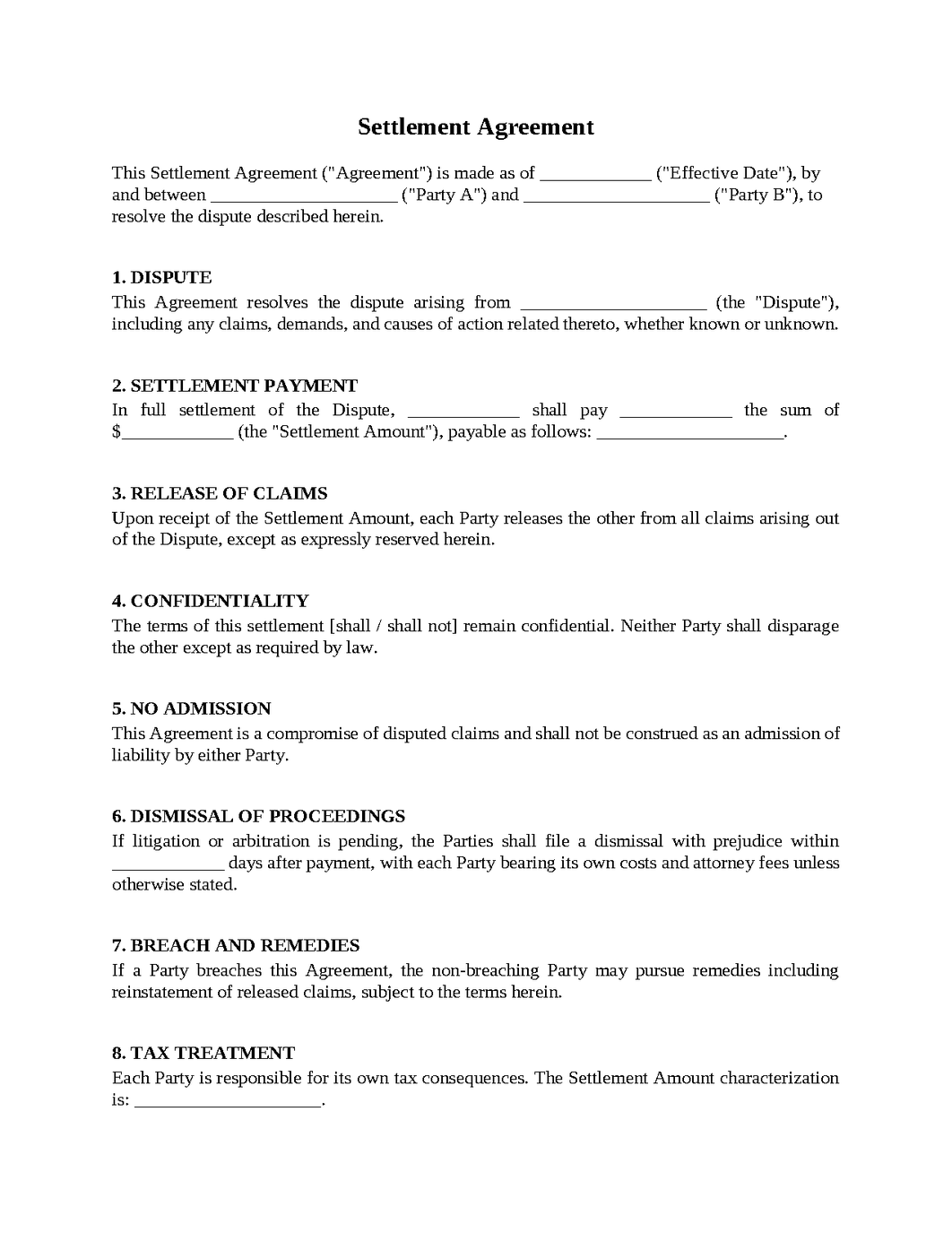
Settlement Agreement
A Settlement Agreement is a legal contract used to resolve an existing dispute or prevent a potential dispute from escalating into litigation. Settlement Agreements are commonly used in business disputes, employment matters, contract disagreements, personal injury claims, partnership conflicts, real estate disputes, intellectual property matters, and countless other legal situations. The agreement typically outlines the obligations each party will undertake in exchange for resolving the matter, such as making payments, releasing claims, maintaining confidentiality, or performing certain actions. Because settlement agreements are intended to bring finality to disputes, disagreements can arise when the scope of the settlement or future obligations are not documented clearly. A well-drafted Settlement Agreement helps provide certainty, reduce legal risk, and avoid future conflict.
The Parties Disagree About Which Claims Were Settled
Two businesses become involved in a dispute arising from a failed commercial transaction.
After months of negotiations, the parties agree to resolve the matter and sign a Settlement Agreement. Both sides are relieved to avoid the expense and uncertainty of litigation.
Several months later, one party raises additional complaints related to the same business relationship. The other party argues that those issues were resolved as part of the settlement and should no longer be pursued.
The disagreement centers on whether the settlement covered only specific claims or all potential claims arising from the relationship.
Neither side intended future conflict, yet the scope of the release was never defined clearly.
To help avoid this problem, a Settlement Agreement should clearly identify the claims being resolved, define the scope of released matters, and specify whether unknown or future claims are included within the settlement.
A Settlement Payment Is Not Made on Time
A company agrees to pay a former business partner a substantial sum of money in exchange for resolving a dispute.
The Settlement Agreement establishes payment deadlines and outlines the consequences of nonpayment. Initially, both parties expect the payment process to proceed smoothly.
As the due date approaches, financial challenges arise and the company is unable to make the payment as scheduled.
The recipient believes the agreement has been breached and considers pursuing legal remedies. The company requests additional time and argues that the delay is temporary.
The disagreement quickly revives tensions that the settlement was intended to resolve.
To reduce these risks, a Settlement Agreement should clearly establish payment schedules, identify default remedies, define grace periods when appropriate, and explain the consequences of missed payments.
Confidential Settlement Terms Are Disclosed
Two parties settle a dispute and agree that the terms of the resolution will remain confidential.
Both sides believe confidentiality is important because public disclosure could affect reputations, business relationships, or future negotiations.
Months later, information regarding the settlement appears in conversations, public statements, or industry discussions. One party believes the other improperly disclosed confidential details.
The accused party argues that no intentional disclosure occurred or that the information became known through other sources.
Trust deteriorates because confidentiality was one of the key reasons the settlement was reached.
To help prevent these issues, a Settlement Agreement should clearly define confidential information, identify permitted disclosures, establish confidentiality obligations, and specify remedies for violations.
One Party Believes Additional Obligations Were Promised
During settlement negotiations, the parties discuss a variety of possible business arrangements, future cooperation opportunities, and operational changes.
Ultimately, a written Settlement Agreement is signed and the dispute appears resolved. Later, one party claims that verbal promises made during negotiations should still be honored even though they do not appear in the final written agreement.
The other party argues that only the written agreement controls and that prior discussions were part of the negotiation process.
The disagreement arises because expectations developed during negotiations were not reflected in the final document.
What should have been a complete resolution becomes a new dispute.
To help avoid these problems, a Settlement Agreement should clearly identify all obligations being undertaken, contain a comprehensive integration clause, and state that the written agreement represents the complete understanding of the parties.
The Parties Disagree About Future Business Relationships
Two companies resolve a dispute through a Settlement Agreement while continuing to operate in the same industry.
One company assumes the settlement allows the parties to move forward independently without further obligations. The other believes certain restrictions, cooperation requirements, or ongoing commitments continue after the settlement.
Questions arise regarding future communications, competitive activities, customer relationships, and business conduct.
The disagreement creates uncertainty because the parties have different interpretations of what the settlement was intended to accomplish.
A dispute that seemed resolved begins resurfacing in new forms.
To reduce these risks, a Settlement Agreement should clearly address any ongoing obligations, define post-settlement rights and restrictions, and establish expectations regarding future interactions between the parties.
Settlement Agreements play a vital role in resolving disputes efficiently and avoiding the costs and uncertainty of prolonged litigation. However, issues involving claim releases, payment obligations, confidentiality provisions, negotiation expectations, and future business relationships can become significant sources of conflict when terms are not documented clearly. A carefully drafted Settlement Agreement provides a structured framework for achieving finality and protecting all parties involved. When prepared thoughtfully, it can help reduce legal risk, preserve valuable relationships, minimize future disputes, and create a clear path forward after a conflict has been resolved.

Get started with Upsign today!
Easily send, sign and track your documents