

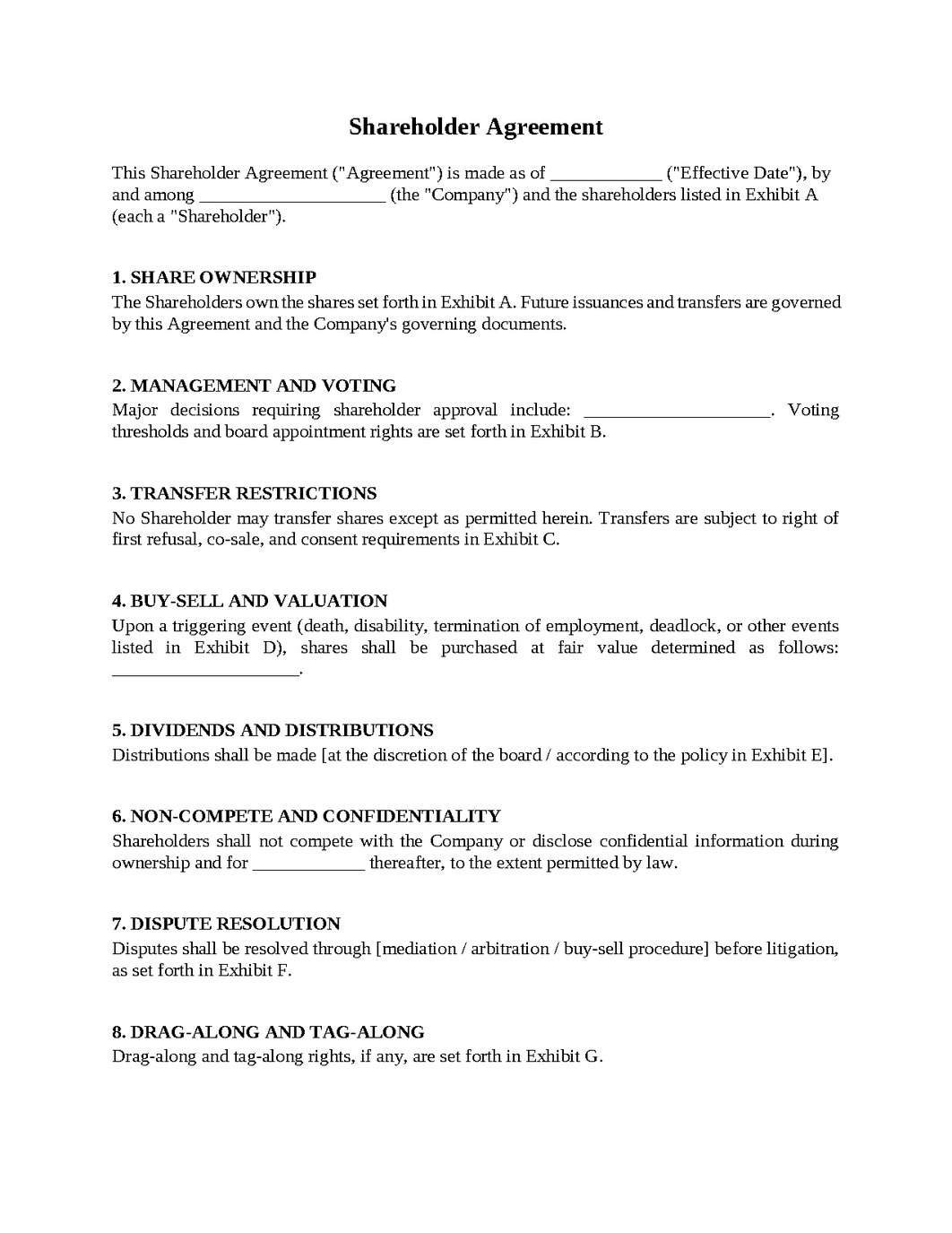
Shareholder Agreement
A Shareholder Agreement is a legal contract among the owners of a corporation that establishes the rights, responsibilities, and expectations governing ownership of the company. While corporate bylaws and governing documents address many operational matters, a Shareholder Agreement focuses specifically on the relationship between shareholders and provides rules for ownership transfers, voting rights, management authority, dispute resolution, capital contributions, and business succession. Shareholder Agreements are commonly used by closely held businesses, family-owned companies, startups, professional practices, and private corporations where a small group of individuals controls ownership. Because ownership interests often represent significant financial and personal investments, disputes can arise when expectations are not documented clearly. A well-drafted Shareholder Agreement helps protect both the company and its owners while reducing uncertainty during periods of growth and change.
A Shareholder Wants to Sell to an Outside Party
Three business partners form a successful company and each owns a substantial percentage of the corporation.
For many years, the shareholders work together effectively and focus primarily on growing the business. Eventually, one shareholder decides to retire and receives an attractive offer from an outside investor interested in purchasing the ownership interest.
The departing shareholder wants the freedom to complete the transaction and realize the value of the investment. The remaining shareholders become concerned about introducing a new owner with different goals, management styles, and expectations.
The disagreement centers on whether the shareholder can freely transfer ownership or whether the other owners should have the opportunity to purchase the shares first.
What began as a personal financial decision becomes a significant governance issue.
To help avoid this problem, a Shareholder Agreement should establish transfer restrictions, define rights of first refusal, identify approval requirements, and create procedures for handling proposed ownership transfers.
The Owners Disagree About Major Business Decisions
A privately held corporation experiences rapid growth and begins facing increasingly important strategic decisions.
Some shareholders want to reinvest profits, expand operations, and pursue aggressive growth opportunities. Others prefer a more conservative approach focused on preserving profitability and distributing earnings.
As the company's success increases, the financial consequences of major decisions become more significant.
The shareholders disagree regarding expansion plans, financing arrangements, executive compensation, and long-term business strategy.
Although everyone wants the company to succeed, they have different visions for its future.
To reduce these risks, a Shareholder Agreement should clearly define voting rights, establish approval thresholds for major decisions, identify reserved matters requiring special consent, and create procedures for resolving governance disputes.
A Shareholder Dies Unexpectedly
A corporation operates successfully for many years under the ownership of several active shareholders.
One shareholder unexpectedly passes away, creating uncertainty regarding what will happen to the ownership interest.
The deceased shareholder's family expects to inherit the shares and participate in the company's value. The surviving shareholders become concerned about working with individuals who have never been involved in the business.
Questions arise regarding valuation, purchase rights, funding sources, and ownership succession.
A situation that is already emotionally difficult becomes even more complicated because no clear plan exists.
To help prevent these issues, a Shareholder Agreement should address death and disability scenarios, establish buy-sell provisions, define valuation procedures, and identify funding mechanisms for ownership transitions.
One Shareholder Stops Contributing to the Business
A corporation is owned by several individuals who each play active roles in management and operations.
Over time, one shareholder becomes less involved in the business. Attendance at meetings declines, responsibilities are neglected, and contributions become minimal.
The remaining shareholders continue investing significant time and effort into the company's success and begin questioning whether ownership interests remain aligned with actual contributions.
The inactive shareholder believes ownership rights should remain unchanged regardless of participation levels. The active shareholders believe adjustments may be appropriate.
The disagreement affects morale and creates resentment among the owners.
To help avoid these problems, a Shareholder Agreement should address employment expectations, define consequences for reduced participation, establish buyout rights when appropriate, and clarify the distinction between ownership rights and operational responsibilities.
The Business Relationship Reaches a Deadlock
Two shareholders each own fifty percent of a corporation and share management authority equally.
For years, decisions are made collaboratively and the arrangement works well. Eventually, however, the shareholders develop fundamentally different views regarding the company's future.
Neither shareholder has sufficient voting power to override the other. Important decisions remain unresolved, growth opportunities are missed, and operations become increasingly difficult.
The company finds itself trapped in a governance deadlock.
Both owners believe they are acting in the corporation's best interests, yet neither can move the business forward without cooperation from the other.
To reduce these risks, a Shareholder Agreement should establish deadlock-resolution procedures, identify mediation or arbitration mechanisms, provide buyout options when appropriate, and create pathways for resolving major disputes before they threaten the business.
Shareholder Agreements are among the most important documents governing privately held corporations because they define how owners will interact during both ordinary operations and extraordinary events. However, issues involving ownership transfers, major business decisions, succession planning, shareholder participation, and governance deadlocks can become significant sources of conflict when expectations are not documented clearly. A carefully drafted Shareholder Agreement provides a structured framework for managing these relationships and protecting both the corporation and its owners. When prepared thoughtfully, it can help preserve business continuity, reduce disputes, facilitate ownership transitions, and support long-term corporate success.

Get started with Upsign today!
Easily send, sign and track your documents