

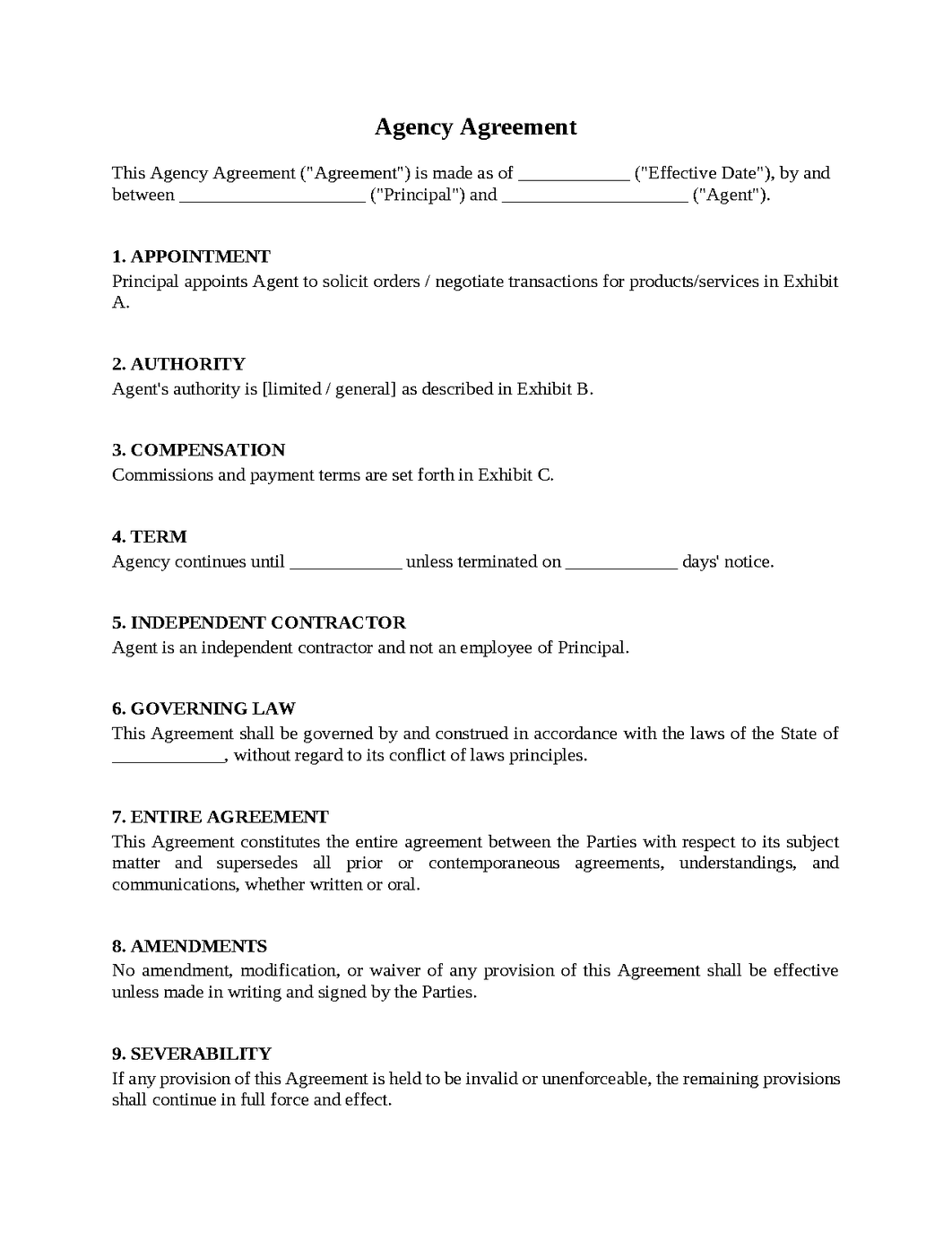
Agency Agreement
An Agency Agreement is a contract that establishes a legal relationship in which one party, known as the principal, authorizes another party, known as the agent, to act on the principal's behalf. Businesses, individuals, real estate professionals, manufacturers, distributors, entertainers, athletes, investors, and service providers frequently use agency agreements to delegate authority for specific tasks or transactions. Depending on the arrangement, an agent may have authority to negotiate contracts, sell products, manage relationships, purchase goods, represent the principal in business dealings, or perform other activities. Because the agent's actions can legally bind the principal in many situations, agency relationships involve significant trust and responsibility. When expectations are clearly documented, agency agreements can create valuable business opportunities. When misunderstandings occur, however, disputes regarding authority, compensation, conflicts of interest, and performance can arise quickly.
The Agent Exceeds Their Authority
A manufacturing company hires an independent sales representative to market its products throughout several western states. The parties sign an Agency Agreement that authorizes the representative to solicit customers and negotiate pricing within specific guidelines.
Several months later, the company discovers that the agent promised a major customer delivery guarantees and discount terms that were never authorized. The customer believes those promises are binding because they were made by the company's representative.
The manufacturer disagrees. Company leadership argues that the agent exceeded the authority granted under the agreement and had no right to make those commitments.
Situations like this are among the most common disputes involving agency relationships. Customers often assume that an agent has broad authority to act on behalf of the principal. The principal may view the agent's authority much more narrowly.
The consequences can be substantial. Customers may demand that promises be honored. Business relationships may suffer. Legal disputes may emerge regarding whether the principal is responsible for the agent's actions.
An Agency Agreement helps reduce these risks by clearly defining what authority the agent possesses and what actions require additional approval. The more specific the agreement, the less likely it is that misunderstandings will occur regarding the agent's role.
The Agent Claims They Were Underpaid
A software company enters into an Agency Agreement with a business development consultant who is responsible for generating new enterprise customers. The agreement provides for commissions based on revenue generated from accounts the consultant brings to the company.
At first, the relationship works well. Several new clients sign contracts and revenue grows. Over time, however, disagreements emerge regarding commission calculations.
The consultant believes commissions should be paid on all revenue generated by the customers they introduced. The company believes commissions should apply only to the initial contracts and not to later expansions or renewals.
Both parties review the agreement and realize that the compensation language is not as clear as they originally believed.
Compensation disputes frequently arise in agency relationships because success often depends on future transactions, recurring revenue, renewals, referrals, or long-term customer relationships.
Even relatively small differences in interpretation can become significant when large accounts or long-term business relationships are involved.
An Agency Agreement helps address these concerns by clearly defining how compensation is calculated, when payments are earned, when commissions become payable, and what happens if the relationship ends. Detailed compensation provisions often prevent costly disputes later.
The Agent Represents a Competitor
A medical equipment manufacturer appoints an agent to market products to hospitals and healthcare systems. The company assumes the agent will focus primarily on promoting its products.
Months later, the manufacturer learns that the same agent also represents a competing company offering similar equipment. During sales presentations, the agent frequently discusses both product lines and allows customers to compare options.
The manufacturer becomes concerned that confidential information may be shared and that the agent's loyalty may be divided.
Conflicts of interest are common in agency relationships, particularly when agents represent multiple clients within the same industry. While some principals are comfortable with these arrangements, others expect exclusivity.
The issue becomes especially sensitive when confidential pricing information, customer lists, strategic plans, or proprietary business information are involved.
If expectations regarding exclusivity are not documented clearly, disagreements can emerge even when both parties acted in good faith.
An Agency Agreement helps establish whether the agent may represent competing businesses and what restrictions apply. By addressing conflicts of interest upfront, the agreement can help preserve trust and avoid future disputes.
The Principal Terminates the Relationship Unexpectedly
A regional distributor spends two years developing customer relationships on behalf of a product manufacturer. The distributor invests substantial time and money building the market.
Without warning, the manufacturer terminates the Agency Agreement and appoints a different representative. The original agent believes they should continue receiving compensation for customers they developed.
The manufacturer disagrees and argues that the agreement allows termination at any time.
Termination disputes frequently arise because agency relationships often involve long-term investments of time, money, and effort. Agents may expect to benefit from relationships they spent years building. Principals may want flexibility to change business strategies.
Questions quickly emerge regarding notice requirements, post-termination commissions, customer ownership, and ongoing obligations.
Without clear contractual guidance, both sides may feel treated unfairly.
An Agency Agreement helps address these concerns by establishing termination procedures, notice periods, post-termination compensation rights, and obligations that survive the relationship. These provisions can significantly reduce uncertainty when the relationship ends.
A Customer Sues Both the Agent and the Principal
An agent negotiates a large commercial transaction on behalf of a company. After the deal closes, the customer alleges that important information was misrepresented during negotiations.
The customer files a lawsuit naming both the agent and the principal as defendants. Each party immediately begins evaluating who bears responsibility for the alleged statements.
The principal argues that the agent acted independently and exceeded instructions. The agent argues that they were acting on behalf of the principal and relied on information provided by the company.
These disputes can become complex because agency law often allows principals to be held responsible for actions taken by authorized agents. At the same time, agents may face personal liability under certain circumstances.
The financial consequences can be significant. Litigation costs, settlement demands, reputational harm, and lost business opportunities may all result.
An Agency Agreement helps clarify responsibilities, establish standards of conduct, define authority limits, and allocate risk between the parties. While the agreement cannot prevent every dispute, it provides an important framework for resolving issues when claims arise.
Agency relationships allow businesses and individuals to expand opportunities by delegating authority to trusted representatives. However, because agents frequently interact with customers, negotiate transactions, and make decisions on behalf of principals, misunderstandings regarding authority, compensation, conflicts of interest, termination rights, and liability can create significant challenges. An Agency Agreement provides a practical method for defining expectations and documenting the rights and responsibilities of both parties. When drafted carefully and supported by clear communication, the agreement can help reduce disputes, strengthen business relationships, and provide greater confidence to everyone involved.
:::

Get started with Upsign today!
Easily send, sign and track your documents