

Assignment of Client List Agreement
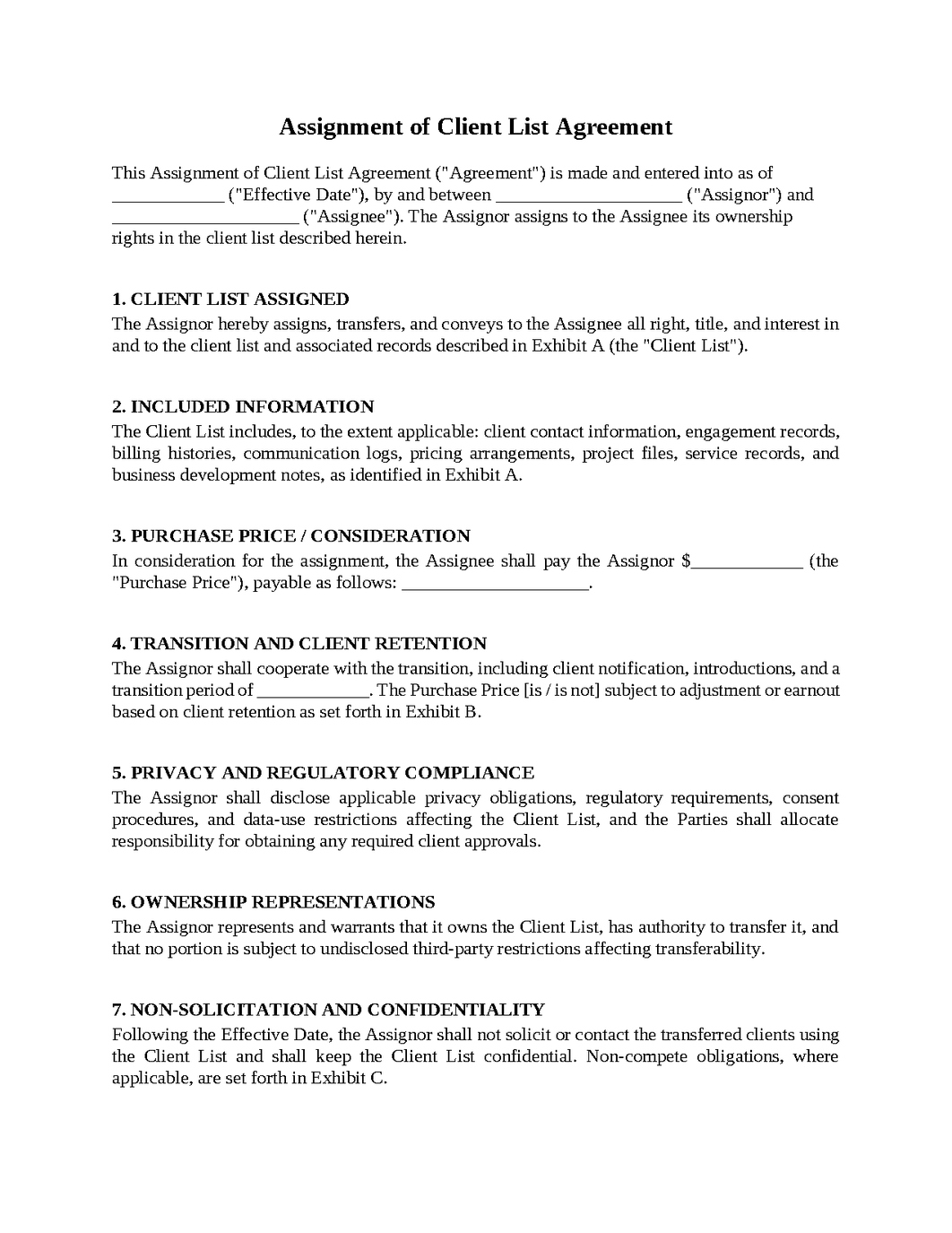
An Assignment of Client List Agreement is a legal contract used when a business transfers ownership rights in a client list to another person or organization. The party transferring the client list is known as the assignor, while the recipient is known as the assignee. Client list assignments commonly occur during business acquisitions, professional practice sales, mergers, succession planning, consulting firm transactions, agency sales, and asset transfers. Unlike a general customer list, a client list often includes ongoing professional relationships, confidential business information, account histories, service records, pricing arrangements, and sensitive personal or business data. Because these relationships are frequently built over many years, disputes can arise regarding ownership, confidentiality, client communications, privacy obligations, and post-closing solicitation activities. An Assignment of Client List Agreement helps establish who owns the client information and what rights are transferred as part of the transaction.
Clients Refuse to Work with the New Owner
A successful accounting firm is acquired by a larger regional practice. One of the primary assets involved in the transaction is the firm's long-standing client base.
The buyer values the acquisition largely because of these relationships.
After closing, however, several key clients object to the transition.
Many clients selected the original firm because of personal relationships with specific accountants. Some express concerns about changes in service quality. Others simply prefer working with individuals they have known for years.
Within months, several major clients terminate their engagements.
The buyer becomes frustrated because the purchase price assumed a much higher client retention rate.
The seller argues that ownership of the client list was transferred successfully and that client decisions remain beyond anyone's control.
The disagreement centers on expectations.
Professional relationships are often more personal than ordinary customer relationships, making retention less predictable after ownership changes.
To help avoid this problem, an Assignment of Client List Agreement should clearly address transition responsibilities, client notification procedures, introduction periods, and post-closing cooperation obligations. The agreement may also include earnout provisions or purchase price adjustments tied to client retention performance.
The Buyer Learns Privacy Restrictions Limit Use of the Data
A wealth management firm sells a portion of its practice to another advisory business.
The client list contains valuable information regarding investment preferences, financial goals, account histories, and personal contact details.
The buyer assumes it can immediately begin marketing additional services to the acquired clients.
Before doing so, compliance personnel review privacy obligations and discover several concerns.
Certain client disclosures never contemplated a transfer of information to another firm. Regulatory requirements impose restrictions on how client data may be used. Additional notices and consents may be required before certain information can be shared or utilized.
The buyer becomes concerned.
One of the most valuable assets acquired may not be usable in the manner originally anticipated.
Financial, legal, healthcare, and professional service industries frequently encounter these issues because client information is often subject to heightened privacy protections.
To reduce these risks, an Assignment of Client List Agreement should require disclosure of applicable privacy obligations, regulatory requirements, consent procedures, and data-use restrictions. The agreement should also allocate responsibility for obtaining any required client approvals.
The Seller Continues Soliciting Former Clients
A marketing agency sells its business, including its client list, to a larger competitor.
The buyer pays a substantial amount based on recurring client relationships and future revenue opportunities.
Several months after closing, the former owner launches a new consulting practice.
Soon afterward, former clients begin receiving emails, phone calls, and promotional materials from the seller.
Some clients move their business back to the former owner.
Others reduce spending with the buyer after being approached by someone they trust and know personally.
The buyer becomes increasingly frustrated.
From its perspective, the client relationships were purchased as part of the transaction. The seller argues that personal relationships cannot simply be sold and forgotten.
The dispute quickly becomes contentious.
Situations like this are common when client-based businesses change ownership and post-closing restrictions are not clearly addressed.
To avoid these problems, an Assignment of Client List Agreement should contain confidentiality provisions, non-solicitation obligations, and, where appropriate, carefully drafted non-compete provisions. The agreement should clearly prohibit unauthorized use of transferred client information after closing.
The Parties Disagree About What Information Was Included
A consulting company acquires a smaller competitor and receives an assignment of its client list.
The buyer assumes the transfer includes client contact information, engagement histories, billing records, pricing agreements, project files, communications, support records, and business development notes.
After closing, the buyer discovers that only basic contact information was transferred.
Detailed project histories remain stored in systems controlled by the seller. Important pricing information is missing. Historical communications and client preferences cannot be located.
The buyer becomes disappointed.
The practical value of the client list is significantly lower than expected because much of the supporting information was never delivered.
The disagreement centers on scope.
A client list may consist of much more than names and phone numbers. The underlying records often provide the context necessary to maintain successful client relationships.
To prevent misunderstandings, an Assignment of Client List Agreement should specifically identify all information being transferred, including contact information, engagement records, billing histories, communication logs, pricing arrangements, project files, and other supporting documentation relevant to client service.
A Security Incident Creates Unexpected Liability
A technology consulting firm sells its client list as part of a larger asset sale.
The database contains confidential client information accumulated over many years.
Several months after closing, the buyer learns that the seller experienced a cybersecurity incident before the transaction occurred.
Although no public disclosure was made at the time, internal investigations suggested that portions of the client database may have been exposed.
The buyer becomes alarmed.
Regulatory reporting requirements may apply. Client trust could be affected. Potential liability may exist for issues that originated before the assignment occurred.
The value of the acquired asset suddenly becomes less certain.
Data-related liabilities frequently surface after client list transfers because security incidents, privacy concerns, and compliance issues are not always obvious during due diligence.
To reduce these risks, an Assignment of Client List Agreement should require disclosure of known security incidents, regulatory investigations, privacy complaints, and compliance concerns. The agreement should also allocate responsibility for liabilities arising before and after the transfer date.
Client lists often represent one of the most valuable assets within professional service businesses because they embody trust, recurring revenue, and long-term relationships. However, transferring ownership of client information creates unique challenges involving privacy obligations, relationship management, confidentiality, retention risks, and post-closing competition. An Assignment of Client List Agreement provides a structured framework for documenting these transfers and clarifying expectations regarding ownership and use of client information. When drafted carefully, it can help reduce disputes, preserve valuable relationships, protect confidential information, and support a successful transition of business operations.

Get started with Upsign today!
Easily send, sign and track your documents