

Assignment of Contract Rights Agreement
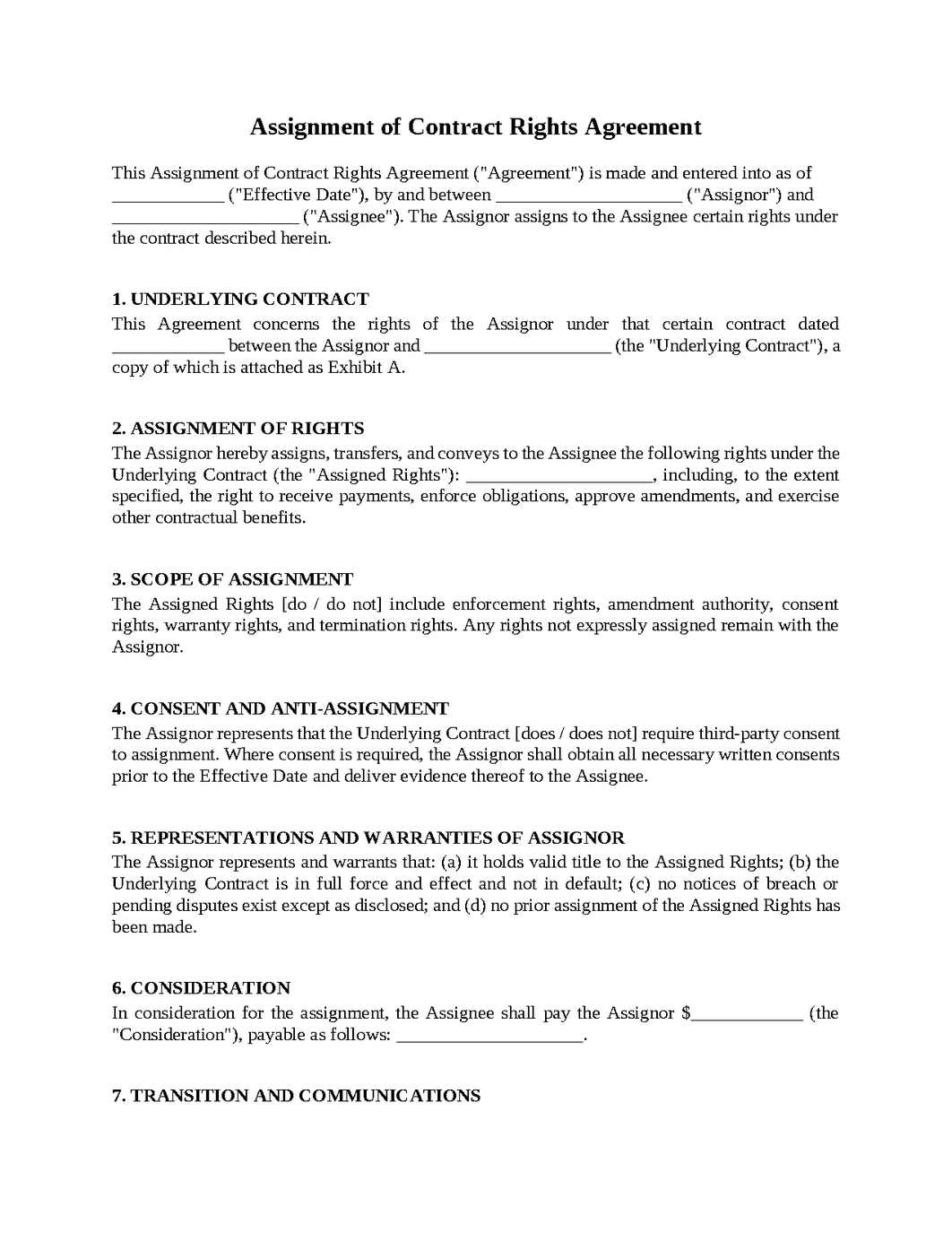
An Assignment of Contract Rights Agreement is a legal contract used when one party transfers some or all of its rights under an existing contract to another person or entity. The party transferring the rights is known as the assignor, while the recipient is known as the assignee. Assignment of Contract Rights Agreements are common in commercial transactions, financing arrangements, business acquisitions, construction projects, service agreements, licensing relationships, government contracts, and corporate restructurings. Contract rights may include the right to receive payments, enforce obligations, receive goods or services, benefit from warranties, or exercise other contractual rights. Because contracts often involve ongoing obligations, restrictions, and relationships between multiple parties, disputes can arise regarding what rights were transferred, whether consent was required, and who has authority to enforce the agreement. An Assignment of Contract Rights Agreement helps establish exactly what rights are being assigned and how the transfer affects the parties involved.
The Contract Prohibits Assignment
A software company enters into a long-term licensing agreement with a major corporate customer. Several years later, the software company sells a division of its business and assigns the associated contract rights to the buyer.
Management assumes the transfer is routine.
The buyer begins communicating with the customer and expects to receive future payments under the agreement.
The customer responds with an unexpected objection.
According to the licensing agreement, neither party may assign its rights without prior written consent. No consent was ever requested, and none was granted.
The customer argues that the assignment is invalid.
The buyer is stunned.
From its perspective, it purchased valuable contract rights as part of the acquisition. Instead, it discovers that the transfer may not be enforceable at all.
The transaction becomes significantly more complicated.
Anti-assignment provisions are common in commercial contracts, yet they are frequently overlooked during acquisitions and asset sales.
To reduce this risk, an Assignment of Contract Rights Agreement should identify any assignment restrictions contained in the underlying contract, require necessary third-party consents before closing, and clearly allocate responsibility if required approvals cannot be obtained.
The Assignee Learns the Contract Is Already in Default
A financing company purchases contract rights arising from a long-term service agreement between a contractor and a commercial customer.
The contractor assigns the right to receive future payments in exchange for immediate funding.
The financing company reviews payment history and believes the arrangement is secure.
Shortly after closing, however, the customer refuses to make additional payments.
The customer explains that the contractor has failed to meet performance standards under the agreement. Service levels declined months earlier, deadlines were missed, and formal notices of default were already issued.
The financing company was never informed.
What appeared to be a reliable payment stream suddenly becomes highly uncertain.
The contractor argues that the issues are temporary and can be resolved. The financing company believes material contract problems should have been disclosed before the assignment.
This situation occurs frequently because the value of contract rights depends heavily on the underlying contract's condition.
To avoid these disputes, an Assignment of Contract Rights Agreement should contain representations regarding contract status, defaults, notices of breach, pending disputes, and other material issues affecting performance. The agreement should also establish remedies if material information was withheld.
The Parties Disagree About Which Rights Were Assigned
A manufacturer assigns rights under a supply agreement to a strategic partner.
The manufacturer believes it assigned only the right to receive payments under the contract.
The strategic partner believes it acquired broader rights, including authority to enforce performance obligations, approve modifications, and negotiate future amendments.
The disagreement remains unnoticed initially.
Months later, the customer requests a contract amendment.
Both parties claim authority to negotiate.
The customer becomes confused and delays decision-making until ownership issues are resolved.
Attorneys are brought into the discussion.
The dispute centers on a simple but critical question: What exactly was assigned?
Assignment agreements frequently create problems when parties use broad language without clearly defining the rights being transferred.
To help prevent these issues, an Assignment of Contract Rights Agreement should precisely identify the assigned rights. The agreement should specify whether the transfer includes payment rights, enforcement rights, amendment authority, consent rights, warranty rights, termination rights, or other contractual benefits.
The Assignor Continues Acting as if It Still Owns the Contract
A consulting company assigns its rights under a valuable service agreement to another business as part of a restructuring transaction.
The assignee expects to manage the relationship going forward.
Several weeks later, however, the assignor continues communicating with the customer.
The assignor approves project changes, discusses pricing issues, and participates in contract-related decisions.
The customer assumes nothing has changed.
The assignee becomes frustrated.
From its perspective, ownership of the contract rights transferred at closing. The assignor argues that it is simply helping maintain the relationship during the transition.
The overlapping communications create confusion and increase the risk of conflicting decisions.
This issue is particularly common when long-standing customer relationships are involved.
To reduce these risks, an Assignment of Contract Rights Agreement should establish clear transition procedures, define communication responsibilities, and prohibit the assignor from exercising assigned rights after the transfer becomes effective unless specifically authorized.
A Lawsuit Reveals Missing Assignment Documentation
A business acquires a portfolio of commercial contracts through a larger acquisition transaction.
Several years later, a dispute arises involving one of the contracts.
The assignee files a lawsuit seeking to enforce its rights under the agreement.
The opposing party challenges standing.
According to the defendant, the assignee cannot prove it owns the contract rights because assignment records are incomplete.
Attorneys begin reviewing historical transaction documents.
Certain schedules are missing. Assignment records are inconsistent. Supporting documentation is difficult to locate.
The litigation becomes focused on ownership rather than the underlying dispute.
Months of delay and substantial legal fees follow.
Ownership challenges frequently arise when contract rights are transferred multiple times over many years.
To avoid these issues, an Assignment of Contract Rights Agreement should clearly identify the contract being assigned, establish a documented chain of ownership, require delivery of supporting records, and obligate the assignor to assist if ownership questions arise in the future.

Get started with Upsign today!
Easily send, sign and track your documents