

Travel Agency Agreement
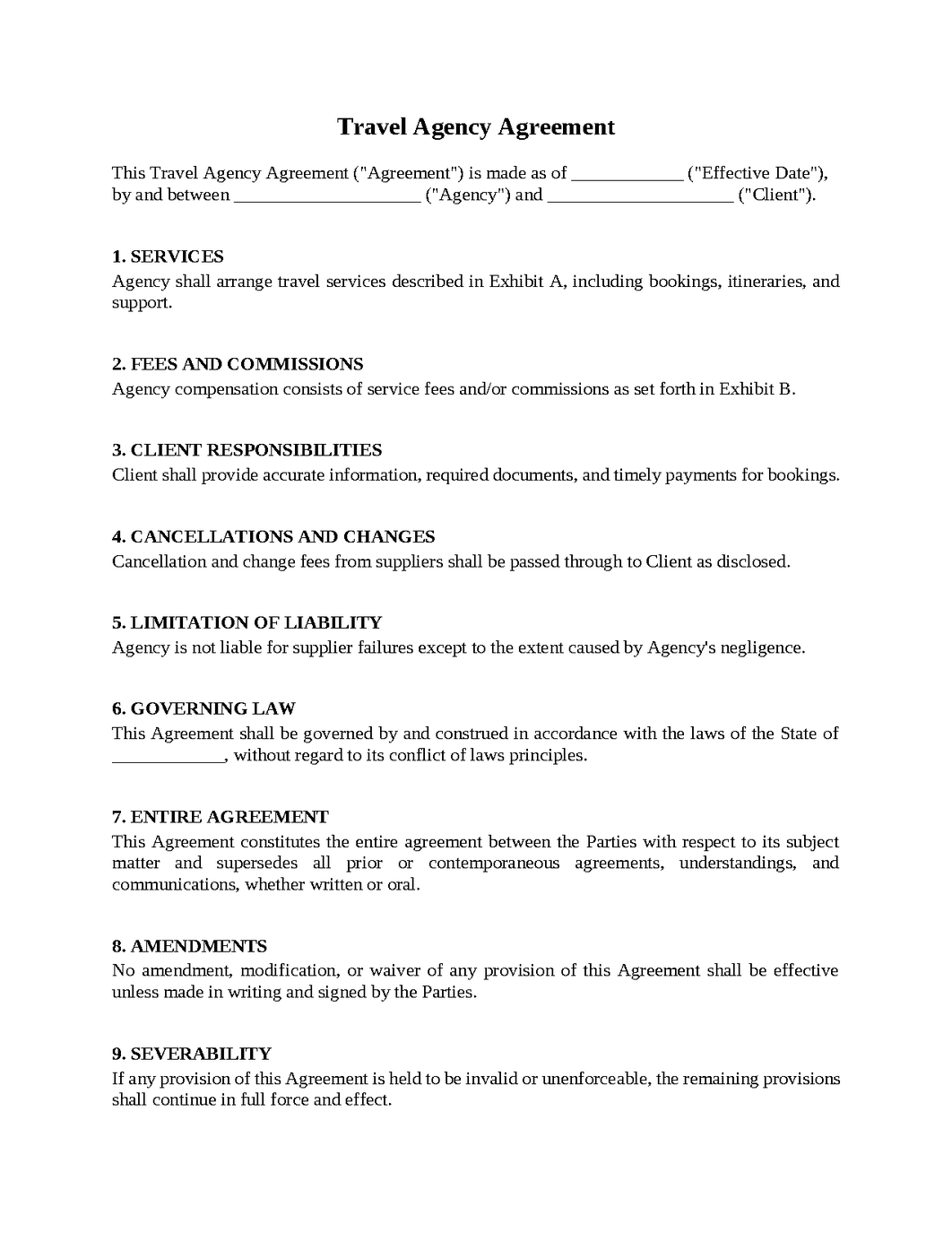
A Travel Agency Agreement is a legal contract that establishes the terms under which a travel agency markets, arranges, books, coordinates, or sells travel-related services on behalf of clients, suppliers, tour operators, airlines, hotels, cruise lines, or other travel providers. These agreements are commonly used in leisure travel, corporate travel management, group tours, destination weddings, educational travel programs, cruise bookings, and vacation planning services. A Travel Agency Agreement typically addresses booking authority, commissions, customer responsibilities, cancellation policies, supplier relationships, liability limitations, and payment obligations. Because travel arrangements often involve multiple providers, changing schedules, and significant customer expectations, disputes can arise when responsibilities are not documented clearly. A well-drafted Travel Agency Agreement helps protect both the travel agency and its clients while promoting successful travel experiences.
A Trip Is Canceled and Everyone Expects a Refund
A family works with a travel agency to arrange a vacation involving flights, hotel accommodations, transportation, and activities.
The agency successfully coordinates the various reservations and collects payment according to the agreed itinerary. Shortly before departure, however, circumstances force the travelers to cancel the trip.
The travelers expect substantial refunds because many services will no longer be used. The travel agency explains that airlines, hotels, tour operators, and other suppliers each maintain their own cancellation policies.
Some portions of the trip may be refundable, while others are subject to penalties or nonrefundable terms.
The travelers become frustrated because they believed the agency controlled all aspects of the booking process.
To help avoid this problem, a Travel Agency Agreement should clearly explain cancellation policies, identify supplier-imposed restrictions, define refund procedures, and clarify the agency's role in processing cancellations.
A Supplier Fails to Deliver Promised Services
A travel agency organizes a complex international itinerary involving multiple hotels, transportation providers, and guided tours.
Upon arrival, travelers discover that one supplier has failed to honor a reservation. Alternative accommodations must be arranged quickly, causing inconvenience and unexpected expenses.
The travelers believe the travel agency should be responsible because the booking was made through the agency. The agency argues that it acted as an intermediary and did not directly control the supplier's performance.
The situation becomes stressful because vacation plans are disrupted.
Neither side anticipated the supplier's failure when the arrangements were made.
To reduce these risks, a Travel Agency Agreement should clearly define the agency's role, identify third-party supplier responsibilities, and explain liability limitations relating to services provided by independent travel vendors.
Travelers Expect Services Beyond the Original Booking
A corporate client hires a travel agency to coordinate transportation and lodging for a large business conference.
The agency completes the requested arrangements and provides detailed itineraries. As the event approaches, however, the client requests additional services, including restaurant reservations, local transportation changes, meeting coordination, and last-minute itinerary revisions.
The client believes these requests are naturally part of the agency relationship. The agency believes the additional work falls outside the original scope of services.
The disagreement develops because expectations evolve after the initial booking process is complete.
What began as a straightforward travel assignment becomes a broader service dispute.
To help prevent these issues, a Travel Agency Agreement should clearly define the scope of services, establish procedures for additional requests, and identify any fees associated with expanded support.
Travel Disruptions Create Confusion About Responsibility
A group of travelers books an international vacation through a travel agency months in advance.
Everything proceeds smoothly until unexpected weather conditions, transportation strikes, or operational disruptions affect the itinerary. Flights are delayed, connections are missed, and portions of the trip must be rescheduled.
The travelers expect the agency to solve every problem immediately and absorb related costs. The agency works diligently to assist but cannot control the actions of airlines, transportation providers, or government authorities.
The disagreement centers on what level of responsibility the agency assumed when arranging the travel.
The situation becomes more difficult because multiple parties are involved.
To help avoid these problems, a Travel Agency Agreement should clearly define the agency's responsibilities during travel disruptions, identify limitations on agency control, and explain the role of travel insurance and supplier policies.
Commission and Compensation Disputes Arise
A travel agency develops a long-term relationship with a tour operator and regularly books travel packages for clients.
Over time, questions arise regarding commission calculations, bonus incentives, promotional credits, and supplier payments.
The travel agency believes commissions should be calculated based on total booking value. The supplier believes certain deductions and exclusions should apply.
As booking volume increases, the financial impact of the disagreement becomes substantial.
Neither party disputes that compensation is owed, but both interpret the arrangement differently.
To reduce these risks, a Travel Agency Agreement should clearly define commission structures, establish payment schedules, identify allowable deductions, and provide procedures for resolving compensation disputes.
Travel Agency Agreements are important tools for managing relationships between agencies, travelers, and travel suppliers. However, issues involving cancellations, supplier performance, expanded service requests, travel disruptions, and compensation arrangements can become significant sources of conflict when expectations are not documented clearly. A carefully drafted Travel Agency Agreement provides a structured framework for managing these relationships and protecting all parties involved. When prepared thoughtfully, it can help reduce misunderstandings, improve customer experiences, strengthen supplier relationships, and support successful travel planning outcomes.

Get started with Upsign today!
Easily send, sign and track your documents