

Trust Amendment
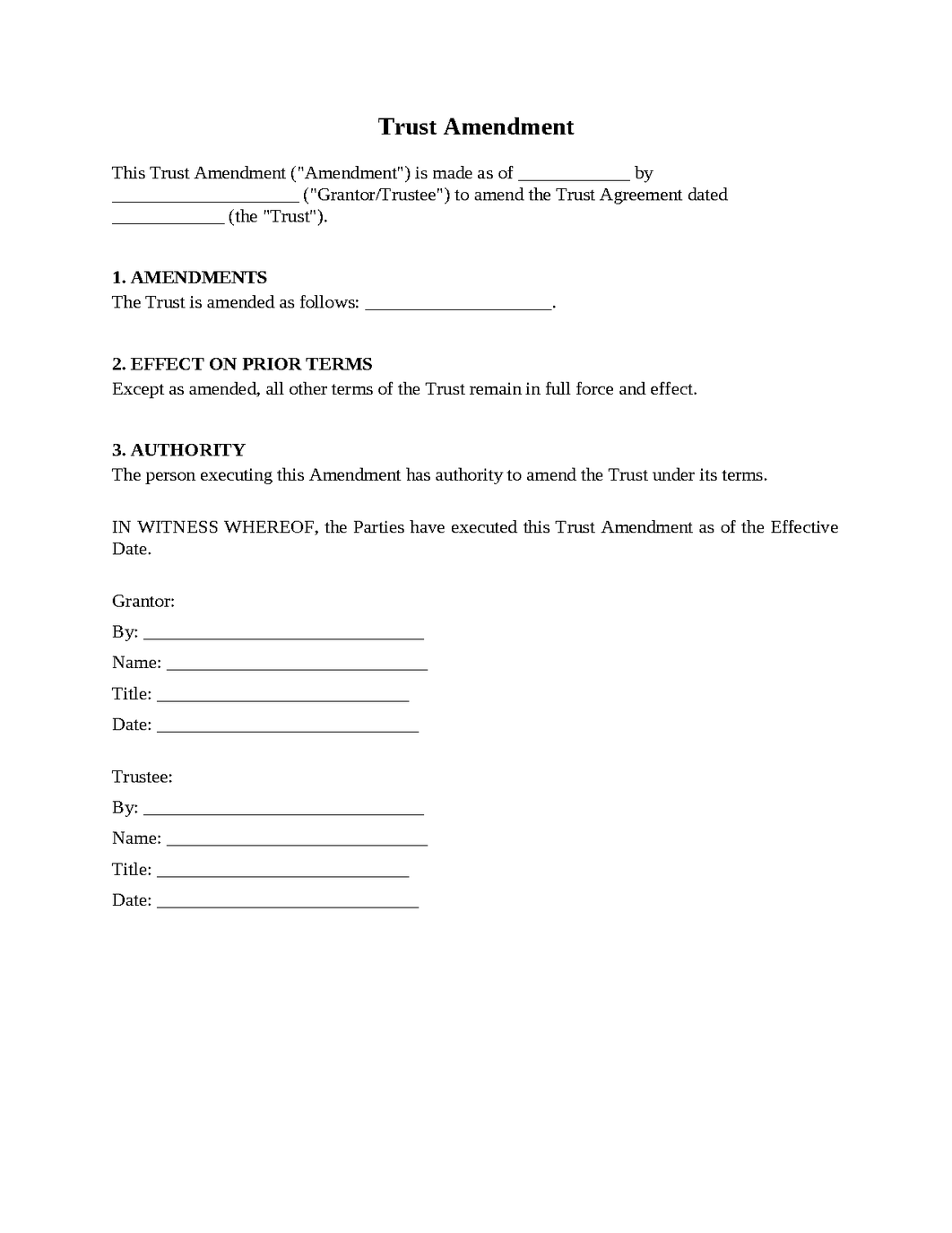
A Trust Amendment is a legal document used to modify specific provisions of an existing revocable trust without creating an entirely new trust agreement. Trust Amendments are commonly used when a grantor wishes to change beneficiaries, update trustees, revise distribution instructions, add or remove assets, respond to changes in family circumstances, or adjust estate planning objectives. Because trusts often remain in effect for many years, amendments allow a trust to evolve as circumstances change while preserving the underlying structure of the original agreement. However, disputes can arise when amendments are prepared improperly, communicated poorly, or conflict with prior provisions. A carefully drafted Trust Amendment helps ensure that the grantor's updated intentions are documented clearly and carried out effectively.
Family Members Dispute Whether the Amendment Was Intended
A grantor creates a revocable trust and manages it successfully for many years.
As family circumstances evolve, the grantor decides to amend the trust to reflect changing relationships and priorities. The amendment modifies certain distribution provisions and adjusts how trust assets will ultimately be divided among beneficiaries.
Following the grantor's death, several family members review the amendment and express surprise regarding the changes. Some beneficiaries believe the amendment accurately reflects the grantor's final wishes, while others believe it is inconsistent with years of prior discussions and expectations.
The beneficiaries begin debating whether the grantor truly intended to make the revisions. Different family members recall conversations and events that support conflicting interpretations of the grantor's intentions.
What began as a routine estate planning update becomes a significant dispute among family members regarding the validity and purpose of the amendment.
To help avoid this problem, a Trust Amendment should clearly describe the changes being made, identify the provisions being modified, and express the grantor's intentions in language that minimizes uncertainty and conflicting interpretations.
Multiple Amendments Create Confusion
A trust remains in effect for more than twenty years.
During that period, the grantor executes several amendments in response to births, deaths, marriages, financial changes, and evolving estate planning goals. Each amendment modifies certain provisions while leaving other portions of the trust unchanged.
As time passes, the relationship between the various amendments becomes increasingly difficult to follow. Some provisions appear to overlap, while others seem inconsistent with language contained in earlier documents.
After the grantor's death, the trustee must determine which provisions control and how the various amendments interact with one another.
Beneficiaries disagree regarding the proper interpretation of the trust because different documents appear to support different outcomes.
To help prevent these issues, a Trust Amendment should clearly identify the provisions being modified, specify whether prior language is being replaced or supplemented, and maintain consistency with the overall structure of the trust.
The Trustee Is Changed Unexpectedly
A grantor establishes a trust and appoints a trusted family member as the original trustee.
Years later, the grantor decides that another individual may be better suited to manage the trust in the future. An amendment is prepared to replace the originally named trustee with a new successor.
The amendment is signed, but the change is not discussed widely among family members. When the original trustee later becomes unable to serve, beneficiaries are surprised to learn that someone else has been designated to assume control.
Some beneficiaries support the change, while others question why the amendment was made and whether the new trustee was the appropriate choice.
The disagreement creates tension during a period when the trust requires stable administration and effective leadership.
To help avoid this problem, a Trust Amendment should clearly identify trustee changes, specify when the changes become effective, and ensure that trustee succession provisions are easy to understand and administer.
A Beneficiary Is Added or Removed
A trust initially provides for distributions among several beneficiaries.
Over time, family relationships change. New grandchildren are born, marriages occur, divorces take place, and personal circumstances evolve. The grantor decides to amend the trust to add certain beneficiaries and remove others.
The amendment reflects the grantor's current wishes, but not everyone affected understands the reasons for the changes.
Following the grantor's death, disappointed beneficiaries challenge the amendment and argue that prior trust provisions should control. Other beneficiaries maintain that the amendment represents the grantor's final and most important expression of intent.
The disagreement becomes emotionally charged because it involves family relationships as well as financial interests.
To help prevent these issues, a Trust Amendment should clearly identify affected beneficiaries, describe revised distribution provisions, and eliminate ambiguity regarding who is entitled to receive trust assets.
The Amendment Is Challenged on Procedural Grounds
A grantor decides to update a trust after experiencing significant life changes.
The desired revisions are prepared and signed, and everyone assumes the amendment will become part of the trust. Years later, however, questions arise regarding whether the amendment was executed properly.
Certain beneficiaries argue that required formalities were not followed, signatures were incomplete, or the grantor lacked the necessary capacity at the time the amendment was signed. Others believe the amendment is fully valid and should be enforced.
The dispute shifts away from the substance of the changes and focuses instead on the amendment process itself.
A document intended to simplify estate planning now becomes the center of a legal challenge.
To help avoid these problems, a Trust Amendment should be executed in accordance with applicable legal requirements, clearly identify the trust being amended, and document the grantor's intent to modify the trust provisions.
Trust Amendments are valuable tools that allow trust documents to evolve as family, financial, and personal circumstances change over time. However, issues involving beneficiary changes, trustee appointments, multiple amendments, procedural requirements, and competing interpretations can become significant sources of conflict when modifications are not documented clearly. A carefully drafted Trust Amendment provides a structured framework for updating trust provisions while preserving the integrity of the overall estate plan. When prepared thoughtfully, it can help reduce uncertainty, prevent disputes, support effective trust administration, and ensure that the grantor's current wishes are carried out successfully.

Get started with Upsign today!
Easily send, sign and track your documents