

Trust Restatement
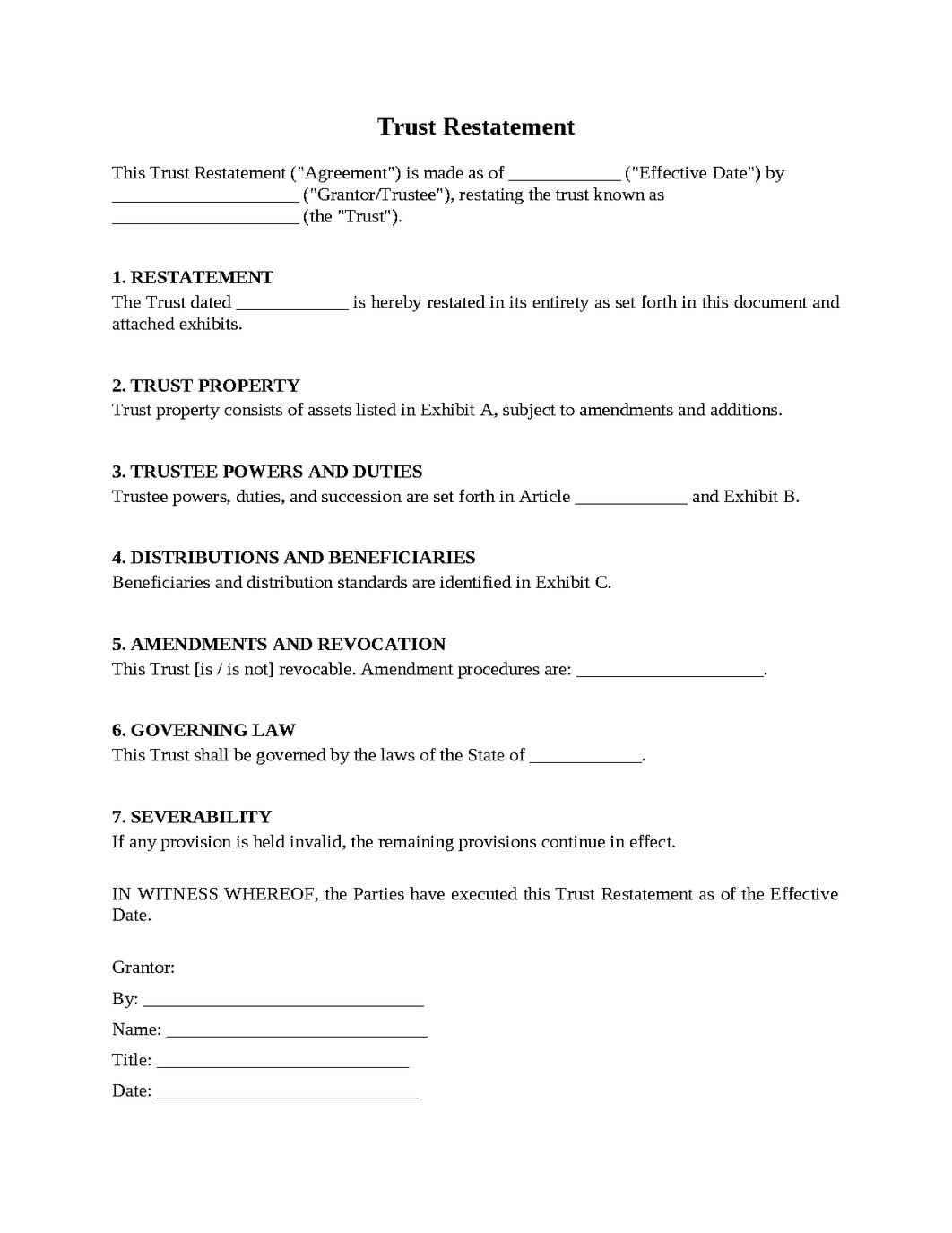
A Trust Restatement is a legal document that completely revises and replaces the operative provisions of an existing trust while preserving the original trust's identity and creation date. Rather than preparing multiple amendments over time, a trust restatement allows a grantor to reorganize, update, and modernize the trust through a single comprehensive document. Trust Restatements are commonly used when family circumstances change, estate planning goals evolve, tax laws are updated, trustees need to be replaced, or numerous amendments have made the trust difficult to administer. Because a Trust Restatement can significantly alter the rights and expectations of beneficiaries and trustees, disputes can arise when the restatement is not prepared or communicated clearly. A carefully drafted Trust Restatement helps ensure that the grantor's current intentions are reflected accurately while maintaining continuity with the original trust structure.
Family Members Disagree About Why the Trust Was Restated
A grantor creates a revocable trust and manages it successfully for many years.
Over time, the trust is amended several times to reflect changing family circumstances, financial goals, and estate planning priorities. Eventually, the grantor decides that the trust has become too complicated and chooses to execute a complete Trust Restatement.
The restatement reorganizes the trust and updates numerous provisions affecting distributions, trustees, and beneficiary rights. While the grantor views the changes as a practical effort to simplify administration, some family members become concerned after learning that significant revisions were made.
Following the grantor's death, beneficiaries begin comparing the original trust with the restated version. Certain individuals believe the restatement accurately reflects the grantor's final wishes, while others believe the changes were unexpected and inconsistent with long-standing family expectations.
The disagreement grows because different beneficiaries focus on different versions of the trust and reach different conclusions regarding the grantor's true intentions.
To help avoid this problem, a Trust Restatement should clearly identify the purpose of the restatement, preserve continuity with the original trust where appropriate, and express the grantor's intentions in a manner that minimizes confusion and conflicting interpretations.
The Restatement Changes Beneficiary Rights Significantly
A trust originally provides for equal distributions among several family members.
As the years pass, relationships, financial circumstances, and personal needs evolve. The grantor decides to restate the trust and modify how assets will ultimately be distributed.
The revised provisions increase benefits for some beneficiaries while reducing or eliminating benefits for others. Although the grantor believes the changes are justified based on current circumstances, not everyone affected shares that view.
After the grantor's death, disappointed beneficiaries challenge the restatement and argue that prior versions of the trust should carry greater weight. Other beneficiaries maintain that the restated trust represents the grantor's final and most deliberate expression of intent.
The dispute becomes emotionally charged because the changes affect both family relationships and financial interests.
To help prevent these issues, a Trust Restatement should clearly identify revised beneficiary provisions and leave no uncertainty regarding the grantor's intended distribution plan.
Trustee Changes Create Administrative Challenges
A trust originally names a close friend as trustee and several family members as successor trustees.
Years later, the grantor determines that different individuals may be better suited to administer the trust in the future. As part of a comprehensive restatement, the grantor revises the trustee succession structure entirely.
The restated trust appoints new trustees and modifies certain administrative powers. While the grantor views these changes as beneficial, family members who expected to serve in trustee roles are surprised by the revisions.
Following the grantor's death, questions arise regarding who has authority to act and whether the newly appointed trustees possess the experience necessary to manage the trust effectively.
The disagreement complicates administration during a period when stability and clear leadership are especially important.
To help avoid these problems, a Trust Restatement should clearly identify trustee appointments, define trustee authority, and establish unambiguous succession procedures.
Outdated Provisions Are Removed but New Questions Emerge
A trust drafted many years earlier contains provisions based on circumstances that no longer exist.
Children who were once minors are now adults, certain assets have been sold, and family priorities have changed significantly. The grantor executes a Trust Restatement to modernize the document and eliminate outdated provisions.
The restated trust successfully removes obsolete language, but beneficiaries later question whether certain protections and safeguards contained in the original trust were intentionally removed or simply overlooked.
Some family members believe the grantor intended major policy changes. Others believe the revisions were primarily administrative and should not alter the trust's overall objectives.
The differing interpretations create uncertainty regarding how the trust should be administered.
To help prevent these issues, a Trust Restatement should clearly articulate substantive changes and distinguish them from organizational or administrative revisions.
Questions Arise Regarding Which Document Controls
A trust remains in existence for decades and accumulates multiple amendments.
Eventually, the grantor executes a complete Trust Restatement intended to replace the prior provisions. Years later, beneficiaries discover copies of earlier trust documents and amendments among the grantor's records.
Some family members begin relying on language from older documents to support their interpretation of the grantor's wishes. Others argue that the restated trust supersedes all prior versions and should control exclusively.
The trustee becomes caught between competing interpretations and must determine which provisions govern the administration of the trust.
What should be a straightforward estate administration becomes more complicated because multiple documents continue to circulate among interested parties.
To help avoid these problems, a Trust Restatement should clearly state that it replaces the operative provisions of the prior trust, identify the trust being restated, and eliminate uncertainty regarding which document controls moving forward.
Trust Restatements are powerful estate-planning tools that allow grantors to modernize and reorganize existing trusts without creating entirely new trust structures. However, issues involving beneficiary changes, trustee appointments, evolving family circumstances, document interpretation, and competing versions of trust provisions can become significant sources of conflict when a restatement is not prepared clearly. A carefully drafted Trust Restatement provides a comprehensive framework for updating trust terms while preserving continuity and administrative efficiency. When prepared thoughtfully, it can help reduce confusion, prevent disputes, simplify trust administration, and ensure that the grantor's most current wishes are carried out effectively.

Get started with Upsign today!
Easily send, sign and track your documents