

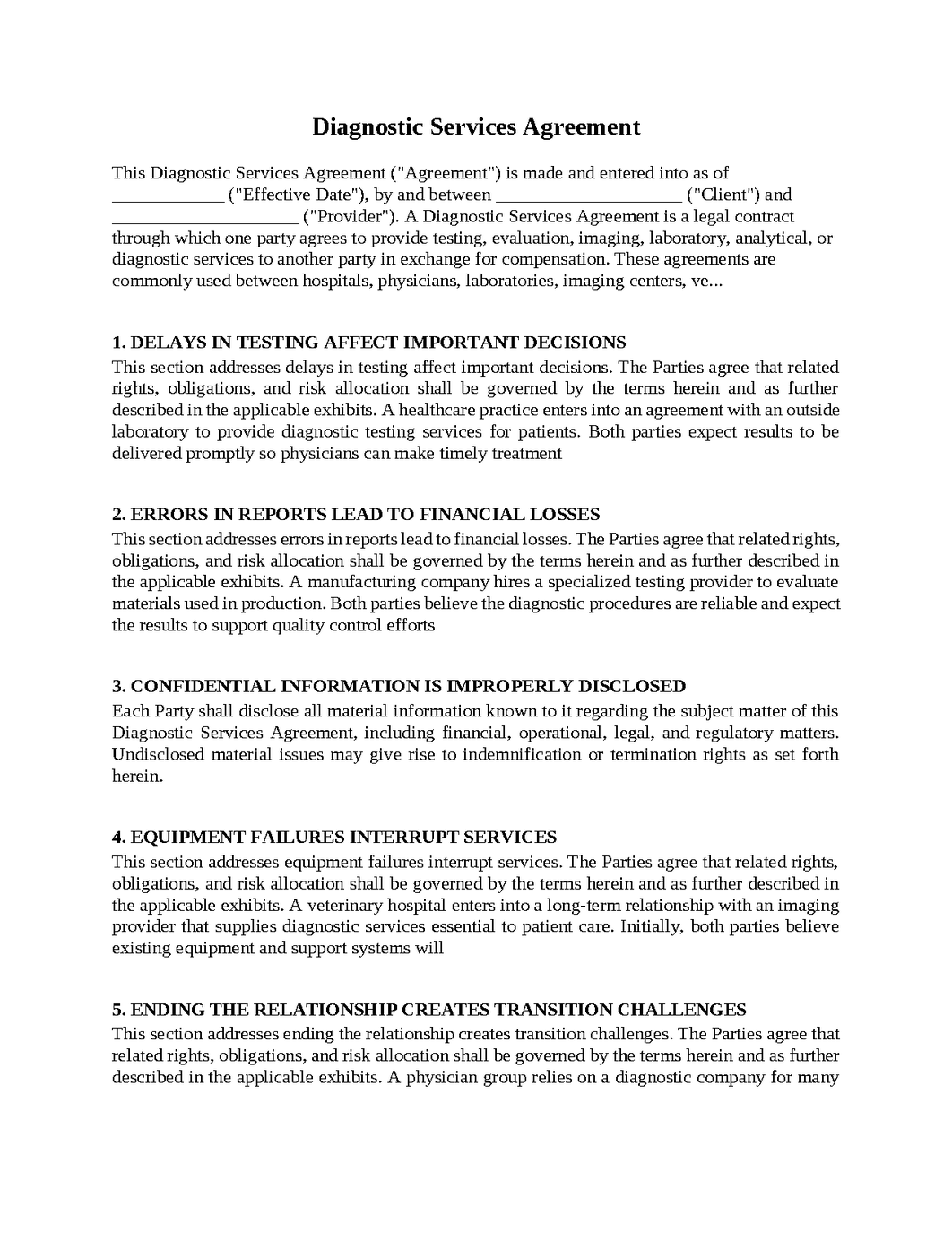
Diagnostic Services Agreement
A Diagnostic Services Agreement is a legal contract through which one party agrees to provide testing, evaluation, imaging, laboratory, analytical, or diagnostic services to another party in exchange for compensation. These agreements are commonly used between hospitals, physicians, laboratories, imaging centers, veterinary clinics, manufacturers, software companies, and businesses that rely upon specialized testing or evaluation services. A Diagnostic Services Agreement typically addresses the scope of services, turnaround times, reporting obligations, confidentiality requirements, quality standards, and procedures for handling errors or disputes. Because important decisions often depend upon the accuracy and timeliness of diagnostic information, disputes can arise when expectations regarding performance and responsibility are not documented clearly. A carefully drafted Diagnostic Services Agreement helps establish certainty and protect the interests of both service providers and their customers.
Delays in Testing Affect Important Decisions
A healthcare practice enters into an agreement with an outside laboratory to provide diagnostic testing services for patients. Both parties expect results to be delivered promptly so physicians can make timely treatment decisions and maintain a high standard of care.
For several years, the relationship functions smoothly and patients receive results without significant delays. Eventually, staffing shortages and increasing testing volumes begin affecting turnaround times, causing reports to arrive much later than originally anticipated.
The healthcare practice believes the laboratory should be responsible because timely results are essential to patient care. The laboratory argues that unexpected demand and industry-wide shortages created circumstances beyond its control and that reasonable efforts were made to minimize disruptions. As patient complaints increase and scheduling difficulties become more severe, tensions develop regarding responsibility for the delays.
To help avoid this problem, a Diagnostic Services Agreement should clearly establish turnaround expectations and define how delays and service interruptions will be addressed.
Errors in Reports Lead to Financial Losses
A manufacturing company hires a specialized testing provider to evaluate materials used in production. Both parties believe the diagnostic procedures are reliable and expect the results to support quality control efforts.
After relying on several reports, the manufacturer discovers that certain test results contained inaccuracies that affected production decisions. Defective products reach customers, leading to warranty claims and damage to the company's reputation.
The manufacturer believes the testing company should be responsible because important decisions were made based upon the reports provided. The diagnostic provider argues that no testing process is completely free from error and maintains that its procedures met industry standards. As losses increase, both sides begin disputing the extent of liability and the expectations associated with the services.
To help prevent these issues, a Diagnostic Services Agreement should clearly establish quality standards and define the responsibilities associated with inaccurate or incomplete results.
Confidential Information Is Improperly Disclosed
A medical clinic relies upon an outside diagnostic company to process sensitive patient information and test results. At the outset of the relationship, both parties recognize the importance of privacy and expect confidential information to remain protected.
Over time, concerns emerge when records appear to have been accessed or disclosed outside the group originally authorized to receive them. Questions arise regarding internal controls and whether sufficient safeguards existed to protect sensitive information.
The clinic believes the diagnostic provider should be responsible for maintaining strict confidentiality because the information was shared solely for testing purposes. The provider argues that appropriate procedures were followed and denies any intentional disclosures. As regulatory concerns and reputational risks increase, both parties become increasingly focused on their legal obligations.
To help avoid these problems, a Diagnostic Services Agreement should clearly define confidential information and establish procedures governing its protection and use.
Equipment Failures Interrupt Services
A veterinary hospital enters into a long-term relationship with an imaging provider that supplies diagnostic services essential to patient care. Initially, both parties believe existing equipment and support systems will provide reliable performance.
Unexpected equipment failures eventually interrupt operations and prevent timely testing. Patients experience delays, and the veterinary hospital struggles to maintain normal scheduling and treatment plans.
The hospital believes the provider should have maintained backup systems and preventative maintenance programs. The provider argues that mechanical failures occasionally occur despite reasonable precautions and that repairs were completed as quickly as possible. As interruptions continue affecting operations, disagreements emerge regarding preparedness and service expectations.
To help prevent these issues, a Diagnostic Services Agreement should clearly establish maintenance obligations and define how service interruptions will be handled.
Ending the Relationship Creates Transition Challenges
A physician group relies on a diagnostic company for many years and gradually integrates reporting systems and workflows into daily operations. Both parties assume the relationship will continue indefinitely and make investments based on that expectation.
Eventually, changing business strategies lead the physician group to transition to another provider. Although both sides initially expect the process to be straightforward, disagreements arise regarding unfinished testing, access to historical records, and the amount of assistance required during the transition.
The physician group believes continued cooperation is necessary to avoid disruptions and protect patient care. The diagnostic company believes its obligations should end promptly so resources can be redirected toward other clients. As discussions become more difficult, both sides realize that separating years of integrated systems is far more complicated than either originally expected.
To help avoid this problem, a Diagnostic Services Agreement should clearly establish termination procedures and identify the responsibilities that survive the conclusion of the relationship.
Diagnostic Services Agreements are valuable tools that allow organizations to obtain specialized testing and analytical expertise without developing those capabilities internally. However, issues involving delays, inaccurate reports, confidentiality concerns, equipment failures, and transition responsibilities can become significant sources of conflict when expectations are not documented clearly. A carefully drafted Diagnostic Services Agreement provides a structured framework for allocating responsibilities and protecting the interests of both parties. When prepared thoughtfully, it can reduce uncertainty, improve service quality, preserve important relationships, and provide the foundation necessary for reliable and effective diagnostic services.

Get started with Upsign today!
Easily send, sign and track your documents