

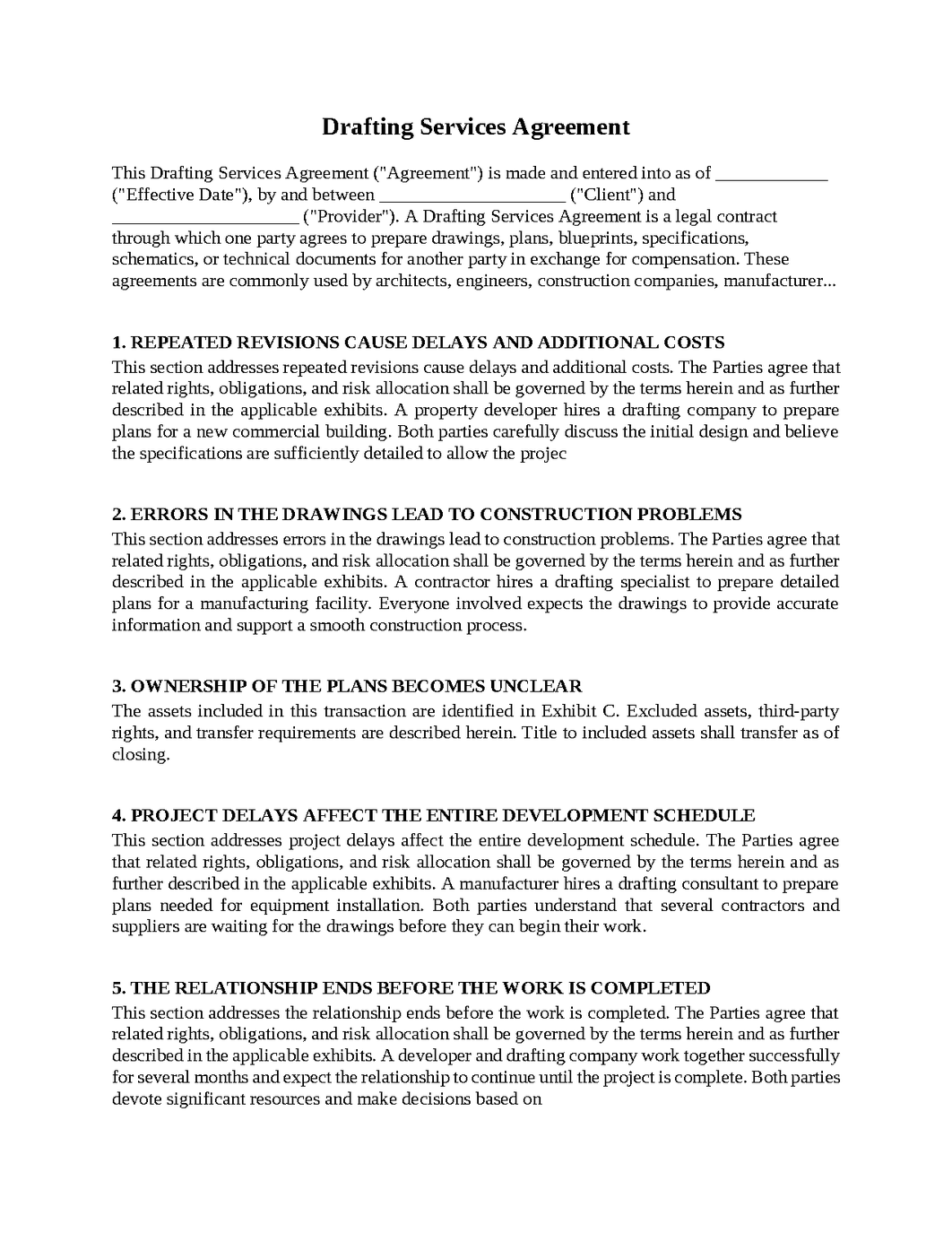
Drafting Services Agreement
A Drafting Services Agreement is a legal contract through which one party agrees to prepare drawings, plans, blueprints, specifications, schematics, or technical documents for another party in exchange for compensation. These agreements are commonly used by architects, engineers, construction companies, manufacturers, product designers, and businesses that require specialized drafting or design services. A Drafting Services Agreement typically addresses the scope of work, timelines, revisions, ownership of work product, payment terms, and the responsibilities of each party throughout the engagement. Because drafting projects often evolve over time and influence larger projects, disputes can arise when expectations regarding deliverables and responsibilities are not documented clearly. A carefully drafted Drafting Services Agreement helps establish certainty and protect the interests of both parties.
Repeated Revisions Cause Delays and Additional Costs
A property developer hires a drafting company to prepare plans for a new commercial building. Both parties carefully discuss the initial design and believe the specifications are sufficiently detailed to allow the project to proceed efficiently.
As the project develops, the owner requests modifications intended to improve the appearance and functionality of the building. What initially appear to be minor changes gradually evolve into numerous revisions affecting layouts, dimensions, and structural details.
The developer believes the revisions simply refine the original vision and should be included within the agreed price. The drafting company believes the repeated changes represent additional work that increases costs and delays completion. As deadlines become difficult to satisfy, frustrations increase and both sides begin disagreeing about what services were originally contemplated.
To help avoid this problem, a Drafting Services Agreement should clearly define the scope of work and establish procedures for approving revisions and adjusting fees and schedules.
Errors in the Drawings Lead to Construction Problems
A contractor hires a drafting specialist to prepare detailed plans for a manufacturing facility. Everyone involved expects the drawings to provide accurate information and support a smooth construction process.
After construction begins, discrepancies are discovered between the plans and the actual requirements of the project. Materials must be reordered and portions of the work require costly modifications to correct the errors.
The contractor believes the drafting company should be responsible because construction decisions relied heavily on the plans that were provided. The drafting company argues that it relied upon information supplied by others and that the errors resulted from incomplete instructions. As delays and expenses continue increasing, both parties begin disputing responsibility for the consequences.
To help prevent these issues, a Drafting Services Agreement should clearly establish performance expectations and define the responsibilities associated with inaccurate drawings or specifications.
Ownership of the Plans Becomes Unclear
A business hires a drafting firm to create detailed plans for a new product line. Throughout the engagement, both parties collaborate closely and contribute ideas intended to improve the final design.
As the relationship progresses, the plans become increasingly valuable and additional opportunities arise to use the drawings in future projects. Questions emerge regarding who owns the completed work and whether the drafting firm may reuse portions of the materials for other clients.
The customer believes the plans belong exclusively to the company because it paid for the services. The drafting firm believes certain templates and methodologies reflect years of experience and should remain available for future use. As commercial opportunities expand, disagreements emerge regarding intellectual property rights.
To help avoid these problems, a Drafting Services Agreement should clearly establish ownership rights and distinguish preexisting materials from work created during the engagement.
Project Delays Affect the Entire Development Schedule
A manufacturer hires a drafting consultant to prepare plans needed for equipment installation. Both parties understand that several contractors and suppliers are waiting for the drawings before they can begin their work.
Unexpected staffing issues and competing priorities delay completion of the plans. As a result, other aspects of the project are postponed and overall costs begin increasing.
The manufacturer believes timely performance was essential and expects the drafting consultant to bear responsibility for the resulting delays. The consultant argues that unforeseen circumstances and changing project requirements made the original schedule unrealistic. As additional parties become affected, tensions rise regarding who should absorb the losses.
To help prevent these issues, a Drafting Services Agreement should clearly establish milestones and define how delays and schedule modifications will be addressed.
The Relationship Ends Before the Work Is Completed
A developer and drafting company work together successfully for several months and expect the relationship to continue until the project is complete. Both parties devote significant resources and make decisions based on that assumption.
Unexpected financial pressures eventually cause the developer to suspend the project. Questions arise regarding unfinished work, outstanding invoices, and access to partially completed drawings.
The developer believes all materials prepared to date should be delivered because substantial payments have already been made. The drafting company believes additional compensation is necessary before releasing unfinished documents and terminating the engagement. As discussions become more difficult, both parties realize that ending the relationship is more complicated than either originally expected.
To help avoid this problem, a Drafting Services Agreement should clearly establish termination procedures and identify the rights and obligations that survive the conclusion of the relationship.
Drafting Services Agreements are valuable tools that allow businesses and professionals to obtain specialized design and documentation services while creating clear expectations for both parties. However, issues involving repeated revisions, drawing errors, ownership rights, project delays, and early termination can become significant sources of conflict when expectations are not documented clearly. A carefully drafted Drafting Services Agreement provides a structured framework for allocating responsibilities and protecting the interests of everyone involved. When prepared thoughtfully, it can reduce uncertainty, improve project efficiency, preserve working relationships, and provide the foundation necessary for successful design and construction projects.

Get started with Upsign today!
Easily send, sign and track your documents