

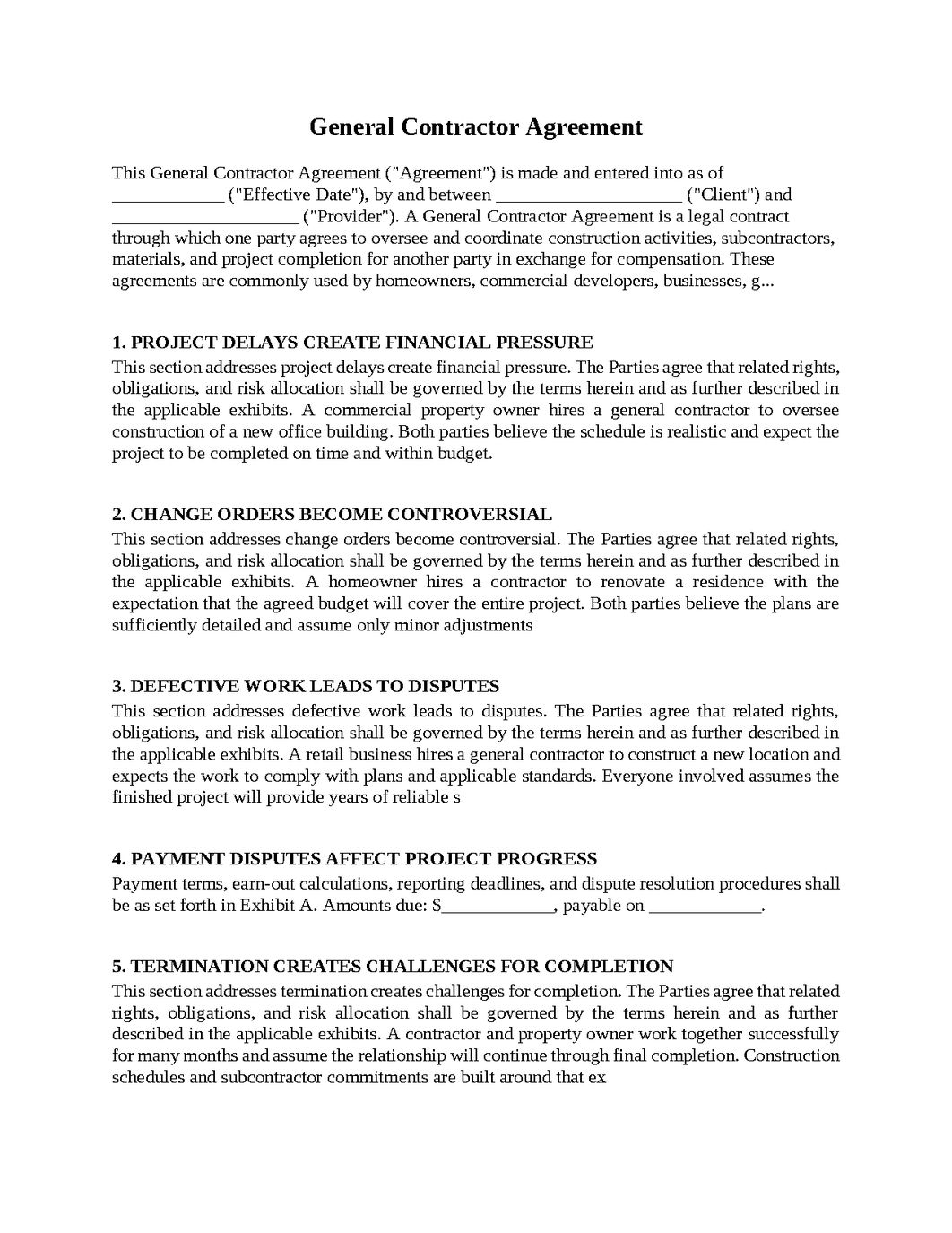
General Contractor Agreement
A General Contractor Agreement is a legal contract through which one party agrees to oversee and coordinate construction activities, subcontractors, materials, and project completion for another party in exchange for compensation. These agreements are commonly used by homeowners, commercial developers, businesses, government entities, and property owners undertaking renovation or construction projects. A General Contractor Agreement typically addresses the scope of work, project schedules, payment terms, change orders, insurance requirements, and procedures governing delays and disputes. Because construction projects involve multiple participants and significant financial commitments, disputes can arise when expectations regarding responsibilities and performance are not documented clearly. A carefully drafted General Contractor Agreement helps establish certainty and protect the interests of both owners and contractors.
Project Delays Create Financial Pressure
A commercial property owner hires a general contractor to oversee construction of a new office building. Both parties believe the schedule is realistic and expect the project to be completed on time and within budget.
Initially, work progresses according to plan and subcontractors perform efficiently. Over time, labor shortages, weather conditions, and material delays begin affecting progress. Completion dates are repeatedly postponed, disrupting tenant plans and increasing carrying costs.
The property owner believes the contractor should have anticipated potential delays and coordinated resources more effectively because timely completion was essential. The contractor believes unforeseen circumstances affected the entire industry and argues that reasonable efforts were made to maintain progress. As additional expenses accumulate, tensions emerge regarding responsibility for the delays.
To help avoid this problem, a General Contractor Agreement should clearly establish project schedules and define the procedures governing delays and extensions of time.
Change Orders Become Controversial
A homeowner hires a contractor to renovate a residence with the expectation that the agreed budget will cover the entire project. Both parties believe the plans are sufficiently detailed and assume only minor adjustments will be necessary.
As construction progresses, additional requests involving upgraded materials and design changes increase costs beyond the original estimate. Questions arise regarding whether certain modifications should be included within the existing price.
The homeowner believes many changes are minor and should not result in substantial additional charges. The contractor believes the revised work requires more labor and materials and argues that compensation should reflect the expanded scope. As invoices increase, disagreements emerge regarding pricing and approvals.
To help prevent these issues, a General Contractor Agreement should clearly establish change order procedures and define how additional work and costs will be approved.
Defective Work Leads to Disputes
A retail business hires a general contractor to construct a new location and expects the work to comply with plans and applicable standards. Everyone involved assumes the finished project will provide years of reliable service.
Several months after completion, problems involving flooring, plumbing, and electrical systems begin appearing. Repairs become necessary and questions arise regarding whether the defects resulted from poor workmanship or design issues.
The owner believes the contractor should be responsible because the deficiencies appeared shortly after completion. The contractor believes subcontractors and design professionals contributed to the problems and argues that some conditions are outside its control. As repair costs increase, tensions develop regarding warranties and liability.
To help avoid these problems, a General Contractor Agreement should clearly establish workmanship standards and define warranty obligations and procedures for correcting defects.
Payment Disputes Affect Project Progress
A developer enters into a construction agreement and expects progress payments to support ongoing work. Both parties believe the payment schedule provides fairness and promotes efficiency.
As construction advances, disagreements arise regarding completed milestones and the value of work performed. Certain payments are delayed while disputes concerning inspections and punch lists remain unresolved.
The contractor believes timely payments are essential because subcontractors and suppliers depend on steady cash flow. The owner believes withholding funds is appropriate until all concerns are addressed and the work satisfies expectations. As tensions increase, project progress slows and relationships become strained.
To help prevent these issues, a General Contractor Agreement should clearly establish payment schedules and define the procedures governing inspections and progress approvals.
Termination Creates Challenges for Completion
A contractor and property owner work together successfully for many months and assume the relationship will continue through final completion. Construction schedules and subcontractor commitments are built around that expectation.
Unexpected financial difficulties and disagreements eventually cause one party to terminate the relationship. Questions arise regarding unfinished work, materials on site, outstanding invoices, and responsibilities involving subcontractors.
The owner believes an orderly transition is necessary to minimize disruptions and complete the project efficiently. The contractor believes compensation should be provided for work already performed and expects contractual rights to be respected. As completion becomes uncertain, disagreements emerge regarding the obligations that survive termination.
To help avoid this problem, a General Contractor Agreement should clearly establish termination procedures and identify the rights and responsibilities that continue after the relationship ends.
General Contractor Agreements are valuable tools that provide structure and accountability throughout construction projects. However, issues involving delays, change orders, defective work, payment disputes, and termination can become significant sources of conflict when expectations are not documented clearly. A carefully drafted General Contractor Agreement provides a structured framework for allocating responsibilities and protecting the interests of both owners and contractors. When prepared thoughtfully, it can reduce uncertainty, strengthen working relationships, encourage successful project completion, and provide the foundation necessary for effective construction management.

Get started with Upsign today!
Easily send, sign and track your documents