

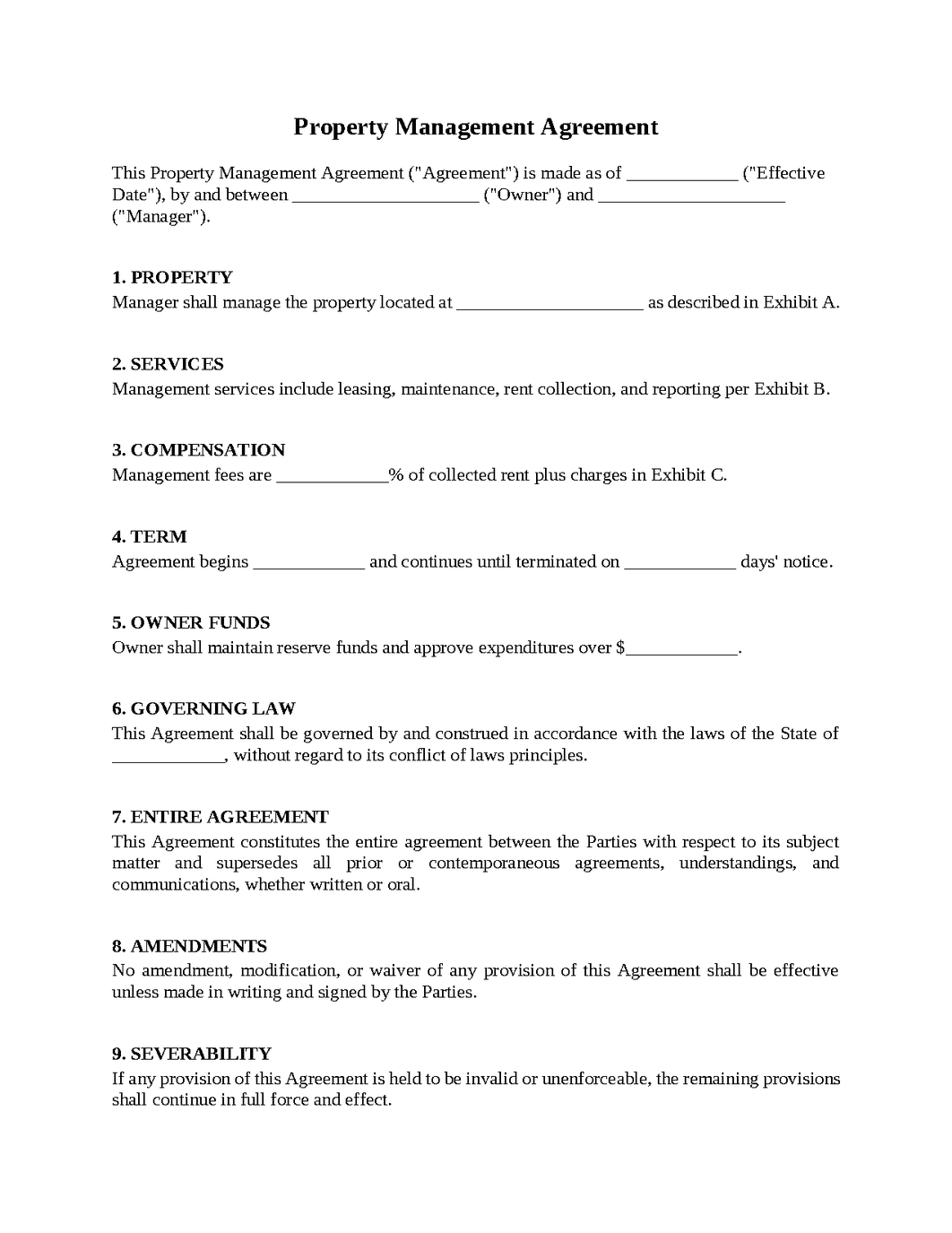
Property Management Agreement
A Property Management Agreement is a legal contract that establishes the terms under which a property manager or management company operates, maintains, leases, and administers real estate on behalf of a property owner. These agreements are commonly used for residential rental properties, apartment complexes, commercial buildings, office properties, retail centers, industrial facilities, vacation rentals, and mixed-use developments. A Property Management Agreement typically addresses leasing authority, rent collection, maintenance responsibilities, vendor management, financial reporting, tenant relations, compensation, and termination rights. Because property managers often make day-to-day decisions involving valuable real estate assets, disputes can arise when expectations and authority are not clearly documented. A well-drafted Property Management Agreement helps protect both owners and managers while promoting efficient property operations.
The Manager Spends More Than the Owner Expected
A real estate investor hires a property management company to oversee several rental properties. The owner wants professional management and trusts the company to handle maintenance, tenant issues, and routine operations.
For the first year, the relationship works smoothly. As maintenance needs increase, however, the management company begins authorizing repairs, upgrades, and vendor services without consulting the owner on every decision.
The manager believes the expenditures are necessary to protect the properties and maintain tenant satisfaction. The owner becomes concerned after reviewing financial statements showing costs that were significantly higher than anticipated.
Neither party disputes that repairs were needed, but they disagree regarding the manager's spending authority and when owner approval should have been obtained.
What began as routine maintenance becomes a financial dispute because authority limits were never defined clearly.
To help avoid this problem, a Property Management Agreement should establish spending limits, identify expenditures requiring owner approval, define emergency repair authority, and establish reporting requirements for significant expenses.
Vacancies Last Longer Than Expected
A property owner hires a management company with the expectation that vacant units will be leased quickly and efficiently.
When several tenants move out unexpectedly, the manager begins marketing the available units. Weeks pass, then months, and vacancies remain unfilled despite ongoing efforts.
The owner becomes frustrated because rental income declines significantly. The management company explains that market conditions have weakened, competition has increased, and rental rates may need adjustment.
The owner believes more aggressive marketing should be occurring. The manager believes pricing expectations are unrealistic for current market conditions.
The disagreement grows because neither party established measurable leasing expectations at the beginning of the relationship.
To reduce these risks, a Property Management Agreement should address marketing responsibilities, leasing authority, vacancy reporting, rental pricing procedures, and performance expectations related to occupancy levels.
Tenant Complaints Escalate Into Larger Problems
A management company oversees an apartment complex and serves as the primary point of contact for tenants.
Over time, tenants begin submitting complaints regarding maintenance delays, communication issues, parking disputes, and property conditions. Some tenants contact the property owner directly after becoming dissatisfied with management's response.
The owner becomes concerned that tenant relationships are deteriorating and that renewals may decline. The manager argues that tenant complaints are common and that reasonable efforts are being made to address issues.
As occupancy rates begin to suffer, both parties disagree regarding whether management performance is contributing to the problem.
What began as isolated tenant concerns evolves into a dispute about overall management effectiveness.
To help prevent these issues, a Property Management Agreement should establish tenant communication standards, maintenance response expectations, complaint-resolution procedures, and performance reporting requirements.
Financial Reporting Creates Mistrust
A property owner relies on a management company to collect rents, pay expenses, manage security deposits, and provide financial reports.
For several years, the arrangement functions without major issues. Eventually, the owner begins asking questions regarding certain expenses, reserve balances, vendor payments, and account reconciliations.
The management company believes the records are accurate and complete. The owner wants greater transparency and more detailed explanations regarding financial activity.
Neither side accuses the other of misconduct, but confidence begins eroding because financial information is not being presented in a way that satisfies both parties.
The disagreement consumes time and damages the working relationship.
To help avoid these problems, a Property Management Agreement should establish accounting procedures, reporting requirements, audit rights, record retention standards, and timelines for delivering financial information.
The Relationship Ends and Property Operations Are Disrupted
After several years, a property owner decides to terminate the management relationship and hire a different management company.
Although the decision is a business matter, the transition proves more complicated than expected. Tenant records, lease agreements, maintenance histories, vendor contracts, keys, security deposits, and financial information must all be transferred to the new manager.
The outgoing management company wants sufficient time to organize the transition properly. The owner wants immediate access to all information necessary to continue operations without interruption.
Questions arise regarding record ownership, transition costs, vendor relationships, and responsibility for unresolved tenant issues.
What should have been a routine management change becomes an operational challenge.
To reduce these risks, a Property Management Agreement should establish termination procedures, define transition obligations, identify record-transfer requirements, and require cooperation during management changes.
Property Management Agreements play a critical role in protecting real estate investments and ensuring efficient property operations. However, issues involving spending authority, leasing performance, tenant relations, financial reporting, and management transitions can become significant sources of conflict when expectations are not documented clearly. A carefully drafted Property Management Agreement provides a structured framework for managing these relationships and protecting both owners and managers. When prepared thoughtfully, it can help improve property performance, reduce misunderstandings, strengthen accountability, and support long-term investment success.

Get started with Upsign today!
Easily send, sign and track your documents