

Retainer Agreement
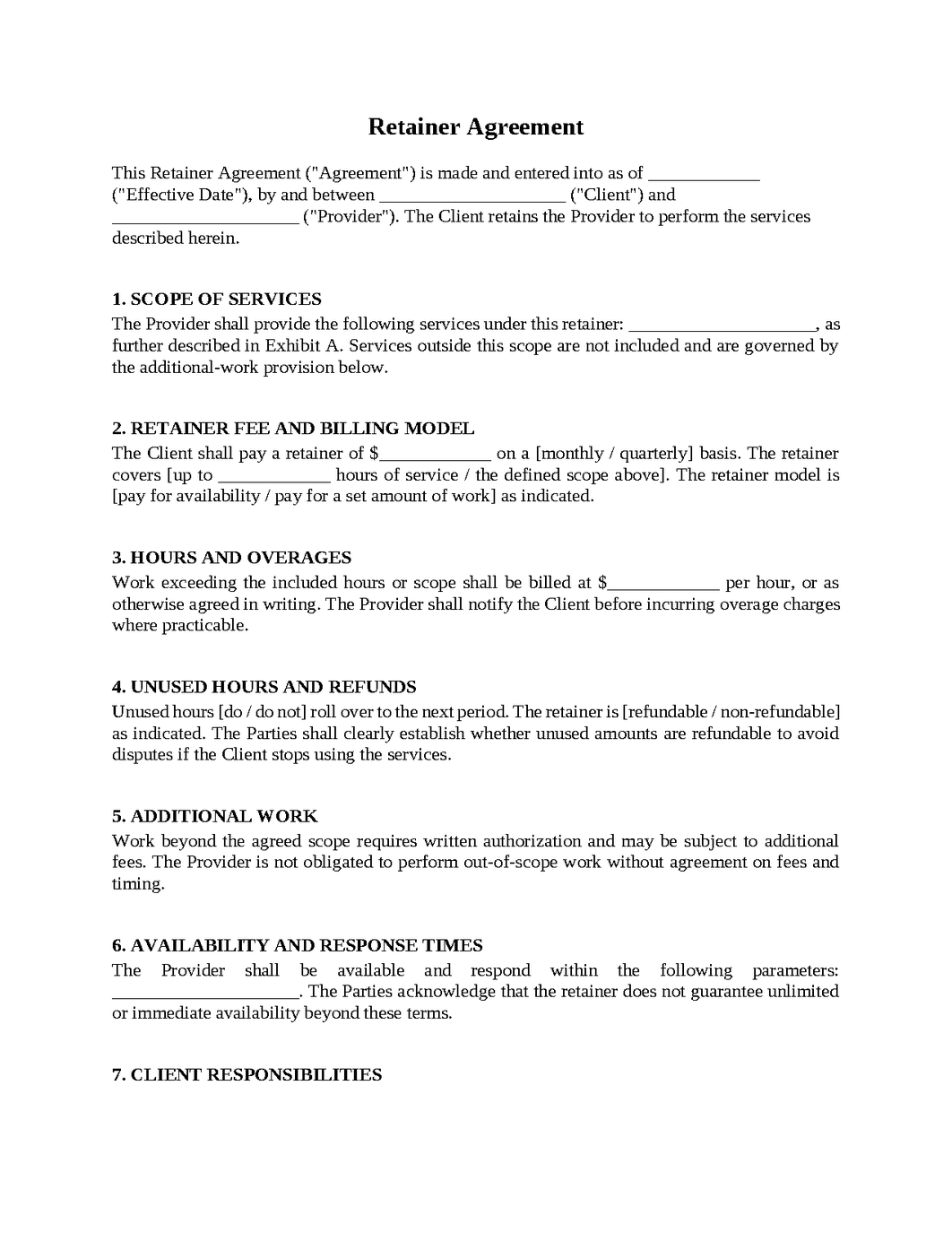
A Retainer Agreement is a legal contract under which a client pays a professional, consultant, attorney, agency, or service provider an upfront fee or recurring payment in exchange for ongoing access to services, availability, or a defined scope of work. Retainer Agreements are commonly used by law firms, marketing agencies, accountants, consultants, public relations firms, technology providers, and other professionals who provide continuing services over time. Because retainers often involve advance payments, evolving work requirements, and long-term relationships, disputes can arise when expectations regarding services and compensation are not documented clearly. A well-drafted Retainer Agreement helps establish clear expectations and protect both parties throughout the engagement.
The Client Expects Unlimited Services
A business hires a consultant under a monthly retainer arrangement to provide strategic advice and ongoing support.
At the beginning of the relationship, both parties are enthusiastic and communicate frequently. The consultant attends meetings, answers questions, reviews documents, and provides recommendations as needed.
As months pass, the client's requests increase significantly. New projects emerge, urgent questions become frequent, and the consultant spends substantially more time supporting the business than originally anticipated.
The client believes the retainer covers all requested assistance. The consultant believes the agreement contemplated a reasonable amount of work rather than unlimited services.
The disagreement develops gradually because neither party clearly defined the expected scope of ongoing support.
What began as a productive relationship becomes strained due to differing expectations regarding workload.
To help avoid this problem, a Retainer Agreement should clearly define included services, identify any limitations on time or availability, establish procedures for handling additional work, and explain when supplemental fees may apply.
The Client Stops Using the Services but Wants a Refund
A company enters into a retainer arrangement with a professional services firm and pays several months of fees in advance.
Shortly after the engagement begins, internal priorities change and the company uses very little of the firm's time. Management concludes that the services are no longer needed and requests a refund of the unused portion of the retainer.
The firm argues that the retainer was paid in exchange for availability and reserved capacity, regardless of how much work was ultimately requested.
The client believes payment should correspond to actual services used. The firm believes it fulfilled its obligations by remaining available and ready to perform.
The disagreement centers on the purpose of the retainer itself.
To reduce these risks, a Retainer Agreement should clearly define whether fees are earned upon receipt, refundable, non-refundable, or subject to periodic reconciliation based on actual services provided.
The Professional Performs Work Beyond the Original Scope
A marketing agency is retained to provide ongoing support for a growing company's advertising efforts.
Initially, the agency focuses on campaign management, reporting, and routine consulting services. Over time, the client requests website revisions, content creation, branding projects, and strategic planning assistance.
The agency performs the additional work in an effort to maintain a positive relationship. Months later, the agency submits invoices for services it believes fall outside the retainer.
The client is surprised because it assumed all requested work was covered by the monthly payment.
Neither side intended conflict, but expectations regarding the scope of services were never revisited as the relationship evolved.
To help prevent these issues, a Retainer Agreement should clearly distinguish covered services from project-based work and establish approval procedures for services outside the original scope.
Availability Expectations Become Unrealistic
A business executive retains a professional advisor to provide guidance on an ongoing basis.
The executive values quick access to advice and frequently contacts the advisor during evenings, weekends, and holidays. Initially, the advisor responds whenever possible.
As demands increase, the advisor struggles to maintain the expected level of responsiveness while serving other clients. The executive becomes frustrated when responses are not immediate.
The advisor believes reasonable response times are being provided. The client believes the retainer guarantees priority access at all times.
The disagreement develops because availability expectations were never clearly defined.
To help avoid these problems, a Retainer Agreement should establish communication protocols, response-time expectations, availability limitations, and procedures for handling urgent matters.
The Relationship Ends Unexpectedly
After working together successfully for several years, a client decides to terminate a retainer arrangement and bring services in-house.
Although the decision is business-related, questions immediately arise regarding outstanding work, prepaid fees, ownership of work product, file transfers, and post-termination responsibilities.
The client expects a smooth transition and immediate access to all materials. The service provider wants sufficient time to complete open matters and reconcile financial obligations.
Without a clear transition process, the relationship becomes more difficult than either party expected.
What should have been a routine termination turns into a dispute regarding obligations that survive the engagement.
To reduce these risks, a Retainer Agreement should establish termination procedures, define ownership rights, address treatment of prepaid fees, and identify responsibilities that continue after the relationship ends.
Retainer Agreements are widely used because they provide clients with ongoing access to professional expertise while creating predictable compensation for service providers. However, issues involving service scope, refund rights, additional work, availability expectations, and termination procedures can become significant sources of conflict when expectations are not documented clearly. A carefully drafted Retainer Agreement provides a structured framework for managing these relationships and protecting both parties involved. When prepared thoughtfully, it can help reduce misunderstandings, improve communication, support long-term professional relationships, and ensure that services are delivered according to clearly defined expectations.

Get started with Upsign today!
Easily send, sign and track your documents