

Software Maintenance Agreement
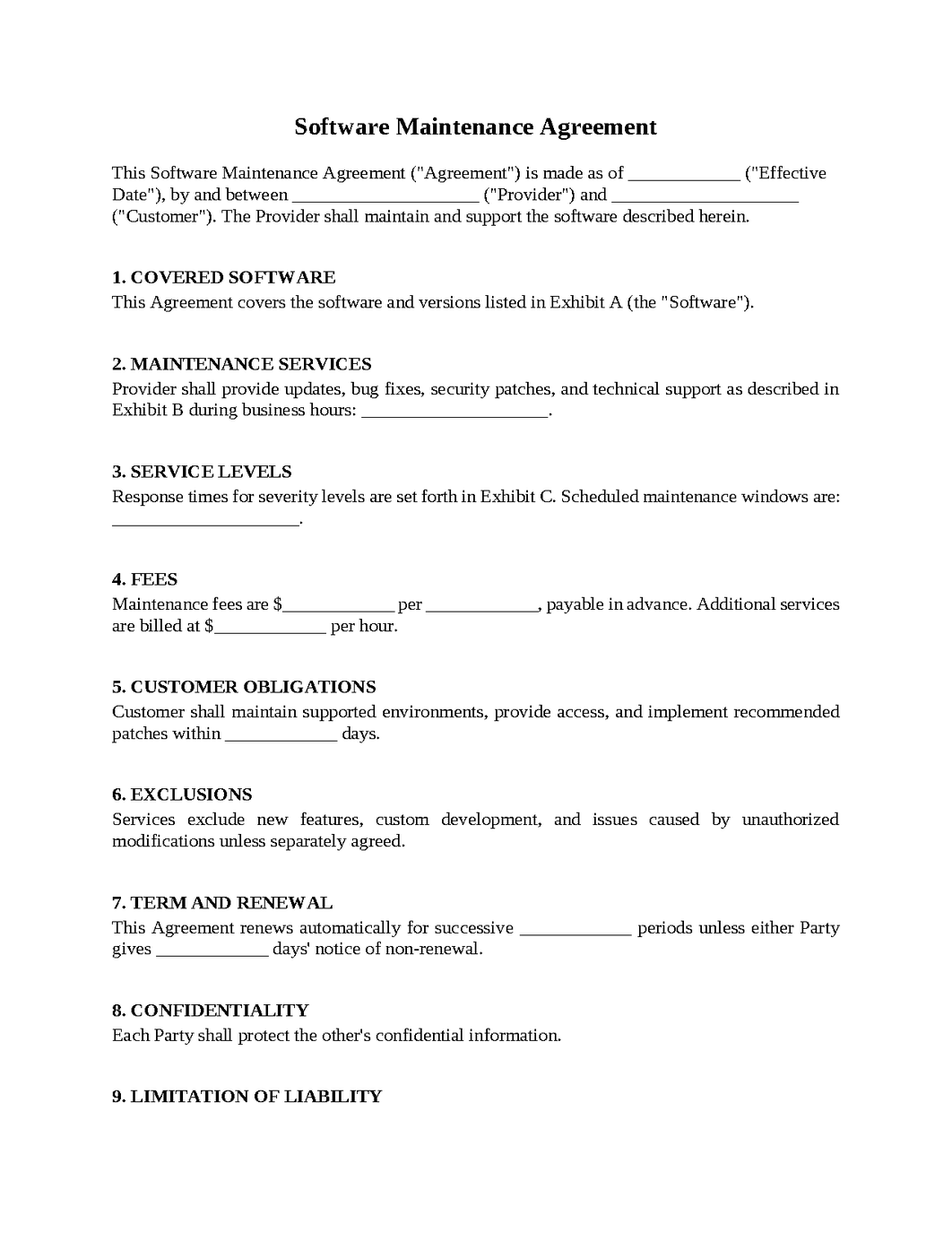
A Software Maintenance Agreement is a legal contract that establishes the terms under which a software developer, vendor, or technology provider delivers ongoing support, maintenance, updates, bug fixes, monitoring, and technical assistance for software after initial deployment. These agreements are commonly used for SaaS platforms, enterprise applications, custom software, mobile apps, business systems, APIs, and mission-critical technology infrastructure. A Software Maintenance Agreement typically addresses support levels, response times, update schedules, maintenance windows, service availability, fees, and termination rights. Because businesses often depend heavily on software to operate effectively, disputes can arise when expectations regarding support and system performance are not documented clearly. A well-drafted Software Maintenance Agreement helps protect both software providers and customers while promoting reliable long-term software operation.
The Customer Expects Immediate Support for Every Issue
A company licenses a business-critical software platform and enters into a maintenance agreement for ongoing support.
Initially, the software performs well and only occasional assistance is required. As the business grows, however, employees begin contacting support for a wide range of issues, including technical problems, training questions, customization requests, and operational guidance.
The customer expects rapid responses regardless of the nature of the request because the software is important to daily operations. The provider believes support resources should be prioritized according to the severity of each issue.
Tension develops when certain requests are not addressed as quickly as the customer expects.
Neither party intends conflict, but their expectations regarding support availability differ significantly.
To help avoid this problem, a Software Maintenance Agreement should clearly define support categories, establish response-time commitments, identify priority levels, and explain how support requests will be handled.
Software Problems Are Discovered After Updates
A software provider regularly releases updates to improve functionality, security, and performance.
Most updates are implemented successfully and benefit customers. During a major release, however, a software change introduces compatibility issues affecting certain customer workflows.
The customer experiences operational disruptions and believes the provider should bear responsibility for resulting losses. The provider explains that extensive testing was performed and that unforeseen issues can occur in complex technology environments.
The disagreement centers on responsibility for problems arising from software changes.
Both parties want stable systems, yet software updates inherently involve some level of risk.
To reduce these risks, a Software Maintenance Agreement should establish update procedures, define testing responsibilities, identify maintenance windows, and address how software defects will be corrected if issues arise.
The Customer Requests Enhancements That Are Not Included
A business enters into a maintenance agreement expecting ongoing software improvements over time.
As operations evolve, the customer requests new features, integrations, reports, and workflow enhancements. The customer believes the requests fall naturally within the maintenance relationship.
The provider views the requested functionality as custom development work rather than maintenance services.
The disagreement grows because both parties use the term "enhancement" differently.
The customer focuses on business needs. The provider focuses on the distinction between maintaining existing functionality and building new capabilities.
To help prevent these issues, a Software Maintenance Agreement should clearly distinguish maintenance services from new development work, define enhancement requests, and establish procedures for pricing and approving additional features.
System Downtime Creates Business Losses
A company relies on software covered by a maintenance agreement to support customer service, operations, and revenue generation.
Unexpected system downtime occurs, making the software unavailable for several hours. The outage affects employee productivity and customer interactions.
The customer believes maintenance services should have prevented the disruption and seeks compensation for business losses. The provider explains that no software system can guarantee uninterrupted operation and that reasonable efforts were made to restore service promptly.
The disagreement becomes significant because the outage affects important business activities.
Questions arise regarding service levels, uptime commitments, and available remedies.
To help avoid these problems, a Software Maintenance Agreement should establish service-level expectations, define uptime commitments when applicable, address scheduled maintenance periods, and clarify remedies available for service interruptions.
The Maintenance Relationship Ends Unexpectedly
A software provider supports a customer's systems for many years under a maintenance agreement.
Eventually, one party decides to terminate the relationship. The customer may wish to transition support to another provider, or the software vendor may discontinue support services.
As the relationship winds down, questions arise regarding documentation, source code access, system knowledge transfer, outstanding support requests, and future software updates.
The customer wants a smooth transition with minimal disruption. The provider wants a clear end to ongoing obligations.
What should be a manageable transition becomes difficult because exit procedures were never defined clearly.
To reduce these risks, a Software Maintenance Agreement should establish termination procedures, identify transition obligations, define access rights to documentation and materials, and clarify support responsibilities following termination.
Software Maintenance Agreements play a critical role in ensuring that software remains secure, functional, and reliable after deployment. However, issues involving support expectations, software updates, enhancement requests, system downtime, and termination procedures can become significant sources of conflict when responsibilities are not documented clearly. A carefully drafted Software Maintenance Agreement provides a structured framework for managing these relationships and protecting both providers and customers. When prepared thoughtfully, it can help reduce misunderstandings, improve system reliability, support business continuity, and promote successful long-term technology partnerships.

Get started with Upsign today!
Easily send, sign and track your documents