

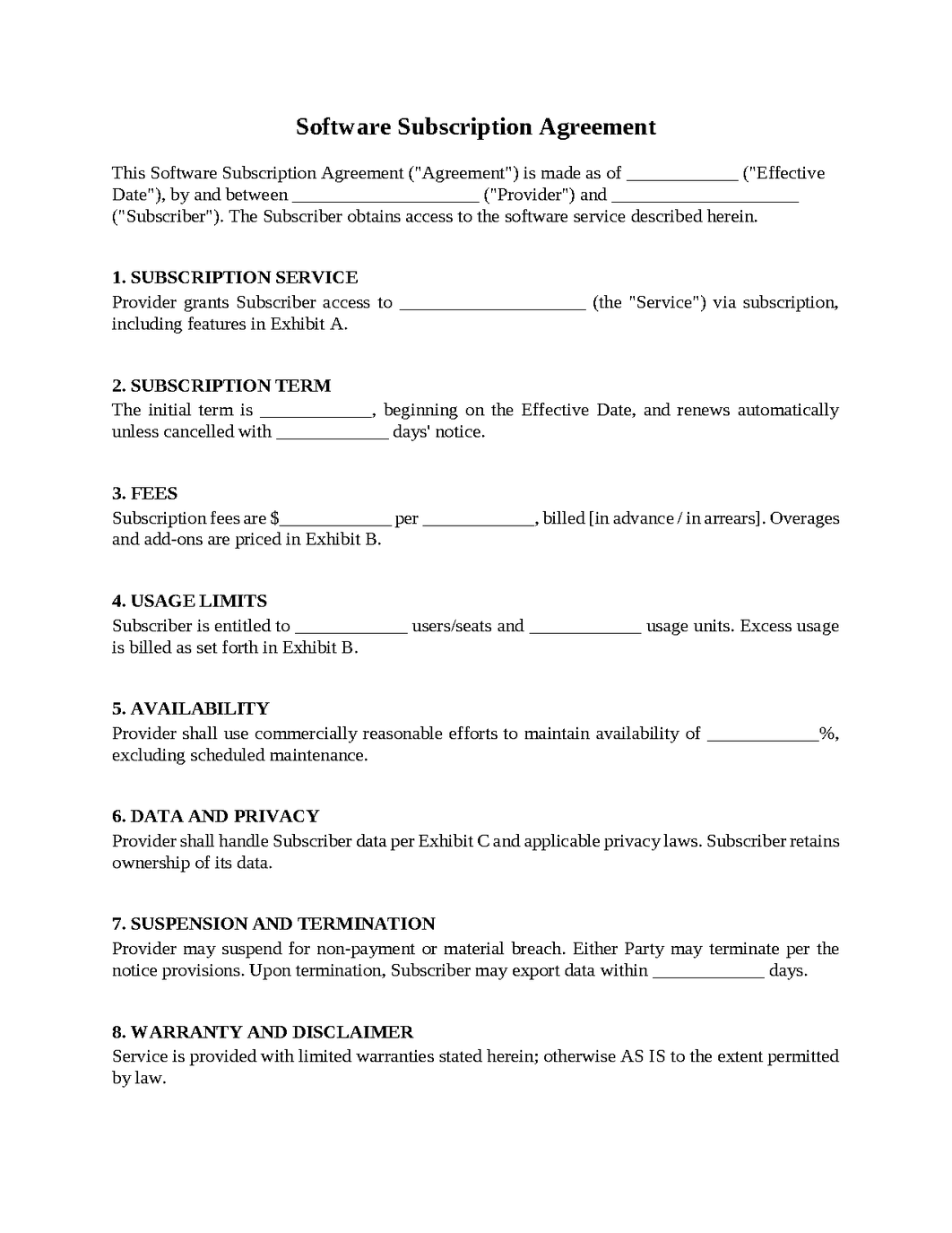
Software Subscription Agreement
A Software Subscription Agreement is a legal contract that establishes the terms under which a customer gains access to software on a subscription basis rather than purchasing perpetual ownership rights. These agreements are commonly used for Software-as-a-Service (SaaS) platforms, cloud applications, enterprise software, productivity tools, financial systems, healthcare platforms, and business management solutions. A Software Subscription Agreement typically addresses subscription fees, user access rights, service availability, renewals, data ownership, support obligations, security requirements, and termination rights. Because businesses often rely heavily on subscription software for daily operations, disputes can arise when expectations regarding access, pricing, performance, and data management are not documented clearly. A well-drafted Software Subscription Agreement helps protect both software providers and customers while promoting long-term business relationships.
Subscription Fees Increase Unexpectedly
A company subscribes to a cloud-based software platform that becomes deeply integrated into its daily operations.
Initially, the subscription pricing is affordable and aligns with the company's budget. Over time, the business grows and becomes increasingly dependent on the software.
At renewal, the provider announces significant pricing increases. The customer believes the increase is unreasonable because switching platforms would require substantial time, expense, and operational disruption.
The provider argues that product improvements, increased support costs, and expanded functionality justify the new pricing structure.
The disagreement becomes more significant because the customer's dependence on the software limits available alternatives.
To help avoid this problem, a Software Subscription Agreement should clearly address pricing adjustments, renewal procedures, notice requirements, and the circumstances under which subscription fees may change.
Service Outages Disrupt Business Operations
A business relies on subscription software to manage customer relationships, internal workflows, and operational reporting.
For several years, the platform performs reliably. Eventually, however, a significant outage prevents users from accessing critical functions for an extended period.
The customer experiences lost productivity, delayed transactions, and customer-service challenges. Management believes the provider should compensate the business for the disruption.
The provider explains that complex cloud systems occasionally experience interruptions despite significant investments in infrastructure and monitoring.
Both parties recognize the importance of reliability but disagree regarding responsibility for the consequences of downtime.
To reduce these risks, a Software Subscription Agreement should establish service-level commitments, define uptime expectations, identify maintenance windows, and specify remedies available if service interruptions occur.
The Customer Wants Access to Data After Termination
A company uses a subscription platform for many years and stores substantial amounts of operational and customer information within the system.
Eventually, the company decides to migrate to another provider and terminates the subscription. After termination, questions arise regarding access to historical records and the process for retrieving stored data.
The customer believes all information should remain accessible for a reasonable period. The provider believes certain access restrictions apply once the subscription ends.
The disagreement becomes increasingly important because the data is necessary for ongoing business operations and regulatory compliance.
What initially seemed like a routine transition becomes a critical operational issue.
To help avoid these problems, a Software Subscription Agreement should clearly address data ownership, export rights, retention periods, transition assistance, and procedures for retrieving information after termination.
User Access Exceeds Subscription Limits
A growing organization subscribes to software under a pricing model based on the number of authorized users.
Initially, usage remains within the agreed limits. As the company expands, however, additional employees begin accessing the system without corresponding subscription upgrades.
The customer views the increased usage as temporary and operationally necessary. The provider believes the customer is exceeding the scope of the subscription and owes additional fees.
An audit reveals the discrepancy, and both parties disagree regarding how the situation should be resolved.
Neither side intended conflict, but growth outpaced the original subscription structure.
To help prevent these issues, a Software Subscription Agreement should clearly define user limitations, establish reporting obligations, identify audit rights, and explain the consequences of exceeding authorized usage levels.
Security Concerns Affect Customer Confidence
A business subscribes to a platform that stores sensitive customer information, financial records, and proprietary business data.
As cybersecurity threats become more prominent, the customer seeks assurance regarding data protection practices and system security.
Following a security incident or publicized vulnerability, questions arise regarding how information is protected and what responsibilities each party has for maintaining security.
The customer expects strong safeguards and rapid communication. The provider believes reasonable security measures are in place but recognizes that no system can eliminate all risk.
The disagreement centers on expectations regarding security obligations and liability.
To reduce these risks, a Software Subscription Agreement should clearly define security responsibilities, establish incident-notification procedures, identify data protection commitments, and allocate risk appropriately between the parties.
Software Subscription Agreements form the foundation of modern cloud software relationships by defining access rights, financial obligations, service expectations, and data responsibilities. However, issues involving pricing changes, service availability, data access, user limitations, and cybersecurity concerns can become significant sources of conflict when expectations are not documented clearly. A carefully drafted Software Subscription Agreement provides a structured framework for managing these relationships and protecting both providers and customers. When prepared thoughtfully, it can help reduce misunderstandings, support business continuity, safeguard valuable information, and promote successful long-term software partnerships.

Get started with Upsign today!
Easily send, sign and track your documents