

Assignment of Beneficial Interest Agreement
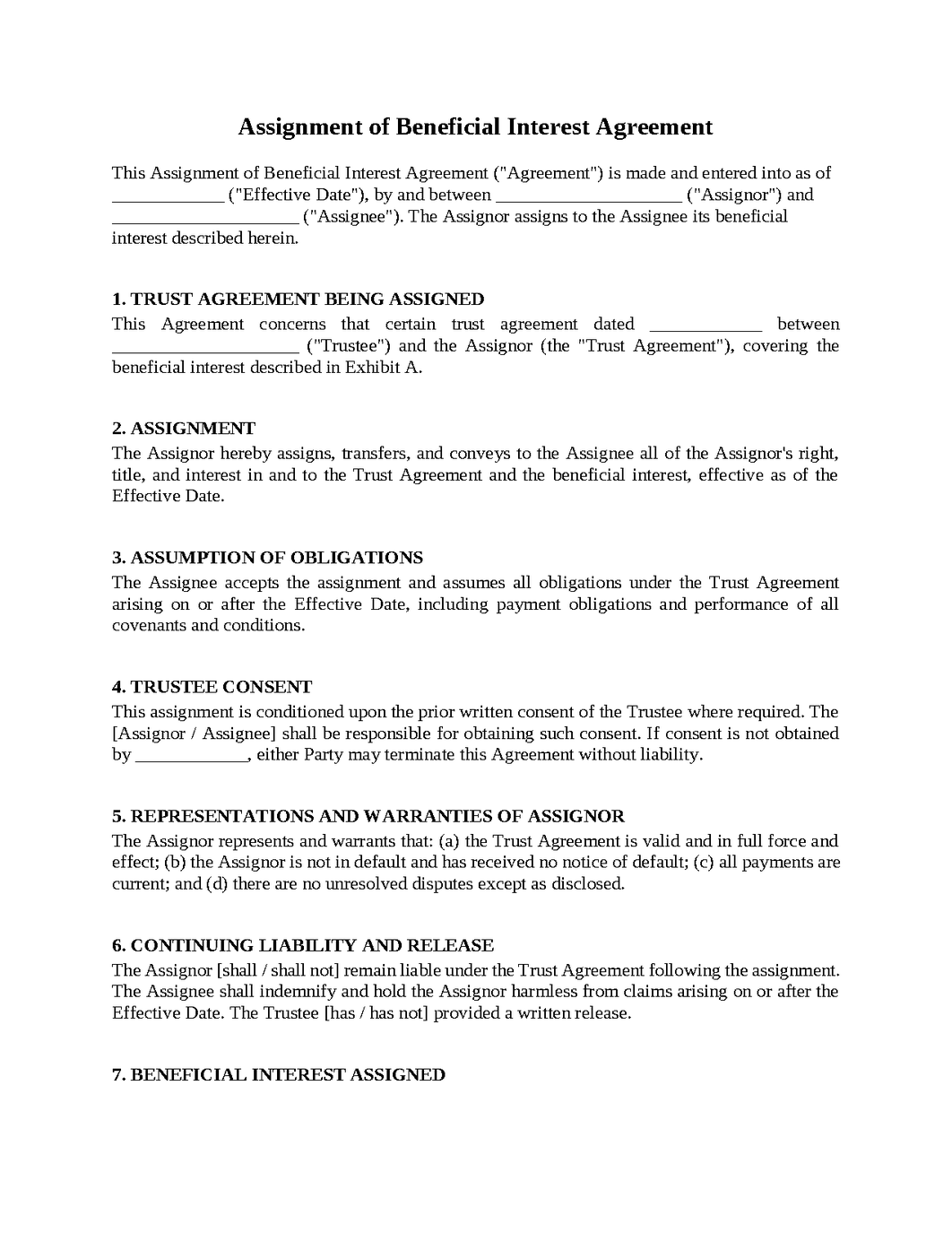
An Assignment of Beneficial Interest Agreement is a legal contract used when a person or entity transfers its beneficial interest in a trust, land trust, investment arrangement, estate, or other asset-holding structure to another party. The person transferring the interest is known as the assignor, while the recipient is known as the assignee. Unlike legal ownership, which may remain in the name of a trustee or other titleholder, a beneficial interest represents the right to receive economic benefits associated with the asset. Beneficial interests are commonly transferred as part of estate planning, business transactions, real estate investments, divorce settlements, succession planning, financing arrangements, and family wealth transfers. Because beneficial ownership can be separated from legal title, assignments often create unique legal and practical issues that are not present in ordinary asset transfers. An Assignment of Beneficial Interest Agreement helps document the transfer and clarify exactly what rights are changing hands.
A Beneficiary Attempts to Transfer an Interest That Cannot Be Assigned
A real estate investor owns a beneficial interest in a land trust that holds several valuable commercial properties. After receiving an attractive offer from another investor, the beneficiary decides to sell a portion of the beneficial interest.
The transaction appears straightforward.
The buyer agrees on a price, the parties begin preparing documents, and everyone expects the transfer to occur quickly.
During the review process, however, the trustee discovers a restriction in the trust agreement prohibiting assignments without prior consent. The assignor assumed the interest could be transferred freely. The buyer assumed the same thing.
The trustee refuses to approve the transfer until additional requirements are satisfied.
What began as a simple investment transaction becomes a lengthy negotiation involving the trustee, the assignor, and the prospective buyer. The parties incur additional legal fees, and the buyer begins considering other investment opportunities.
To help avoid this type of problem, an Assignment of Beneficial Interest Agreement should specifically address any restrictions contained in the governing trust or ownership documents. The agreement should identify required approvals, make the transfer contingent upon obtaining those approvals, and establish what happens if consent is denied.
The Assignee Assumes They Receive More Rights Than Intended
A family trust owns a portfolio of income-producing properties. One of the beneficiaries decides to assign a portion of their beneficial interest to an adult child as part of a long-term estate planning strategy.
The child is pleased to receive the interest and assumes that ownership includes the right to participate in trust decisions, direct investment activity, and communicate directly with the trustee regarding management matters.
The trustee disagrees.
The trustee explains that while the child may now have a right to receive certain economic benefits associated with the assigned interest, control over trust administration remains governed by the trust agreement.
The child feels confused. From their perspective, receiving an ownership interest should include a meaningful role in decision-making.
The misunderstanding creates tension among family members and leads to disagreements regarding expectations.
Situations like this occur frequently because beneficial interests often involve economic rights without corresponding management authority. Beneficiaries may have rights to distributions, but they do not necessarily gain the ability to direct trust operations or make investment decisions.
To reduce confusion, an Assignment of Beneficial Interest Agreement should clearly define the rights being transferred. The agreement should distinguish between economic rights, distribution rights, voting rights, management authority, information rights, and any limitations imposed by the governing documents.
The Parties Cannot Agree on the Value of the Beneficial Interest
A business trust owns several income-producing assets, including commercial real estate, investment accounts, and private business interests. One beneficiary wishes to sell their beneficial interest to another investor.
The challenge becomes determining what the interest is actually worth.
The seller focuses on future appreciation, projected income growth, and the long-term value of the underlying assets. The buyer emphasizes market uncertainty, potential liabilities, and restrictions affecting transferability.
Each side hires valuation professionals.
The seller's expert concludes the beneficial interest is worth nearly $4 million. The buyer's expert arrives at a value closer to $2.7 million.
The large gap surprises everyone involved.
Negotiations become difficult. The seller feels the buyer is undervaluing the interest. The buyer believes the seller is ignoring important risks.
Valuation disputes are particularly common with beneficial interests because the underlying assets may not be publicly traded and the rights associated with the interest may be subject to significant restrictions.
Questions regarding liquidity, future distributions, management control, tax consequences, and transfer limitations can all affect value.
To help avoid these disputes, an Assignment of Beneficial Interest Agreement should reference a clearly defined valuation methodology whenever possible. The agreement may incorporate appraisal procedures, valuation formulas, or predetermined pricing mechanisms to reduce uncertainty.
A Divorce Creates Unexpected Ownership Complications
A beneficiary of a substantial family trust becomes involved in a contentious divorce. During settlement discussions, attorneys identify the beneficial interest as one of the most valuable assets involved in the marital estate.
The spouse argues that a portion of the beneficial interest should be transferred as part of the property division.
Other family members become concerned.
The trust was originally established to benefit specific descendants, and relatives worry that ownership rights may be transferred outside the family.
Questions arise regarding whether the trust permits such transfers, whether consent is required, and what rights the former spouse would actually receive.
The uncertainty creates stress not only for the divorcing parties but also for other beneficiaries who have no involvement in the marriage.
Family trusts frequently encounter these issues because beneficial interests can represent substantial wealth while also being subject to unique restrictions and family objectives.
Without careful planning, a personal dispute can create uncertainty throughout an entire trust structure.
To reduce these risks, an Assignment of Beneficial Interest Agreement should coordinate closely with trust provisions addressing divorce-related transfers. The agreement should clearly define the rights being transferred, identify applicable restrictions, and address whether buyout rights or family approval provisions apply.
A Beneficiary Assigns an Interest but Remains Involved in Future Disputes
A beneficiary sells their interest in a trust that owns several commercial properties. The transaction closes successfully, and the beneficiary assumes their relationship with the trust has ended.
Several years later, litigation arises regarding decisions made while the individual was still a beneficiary.
The dispute involves allegations that certain transactions were approved improperly and that trust assets were managed negligently.
Although the former beneficiary no longer owns any interest in the trust, attorneys request documents and testimony relating to historical events.
The former beneficiary becomes frustrated.
From their perspective, they sold the interest years ago and should have no continuing involvement in trust matters.
Unfortunately, ownership transfers do not necessarily eliminate exposure relating to prior actions or events. Depending on the circumstances, former beneficiaries may still become involved in litigation concerning matters that occurred before the assignment.
The legal costs and inconvenience can be substantial.
To help protect both parties, an Assignment of Beneficial Interest Agreement should address indemnification obligations, cooperation requirements, document retention responsibilities, and the allocation of costs associated with future disputes relating to events occurring before the transfer.
Beneficial interests are unique assets because they often separate economic ownership from legal title and management authority. Whether the transfer occurs as part of estate planning, investment activity, divorce proceedings, business transactions, or succession planning, significant issues can arise if the rights being transferred are not documented carefully. An Assignment of Beneficial Interest Agreement provides a structured framework for documenting these transfers and clarifying expectations for assignors, assignees, trustees, beneficiaries, and other interested parties. When drafted properly, it can help reduce disputes, facilitate ownership transitions, and provide greater certainty regarding the rights and obligations associated with the beneficial interest.
:::

Get started with Upsign today!
Easily send, sign and track your documents