

Assignment of Cause of Action Agreement
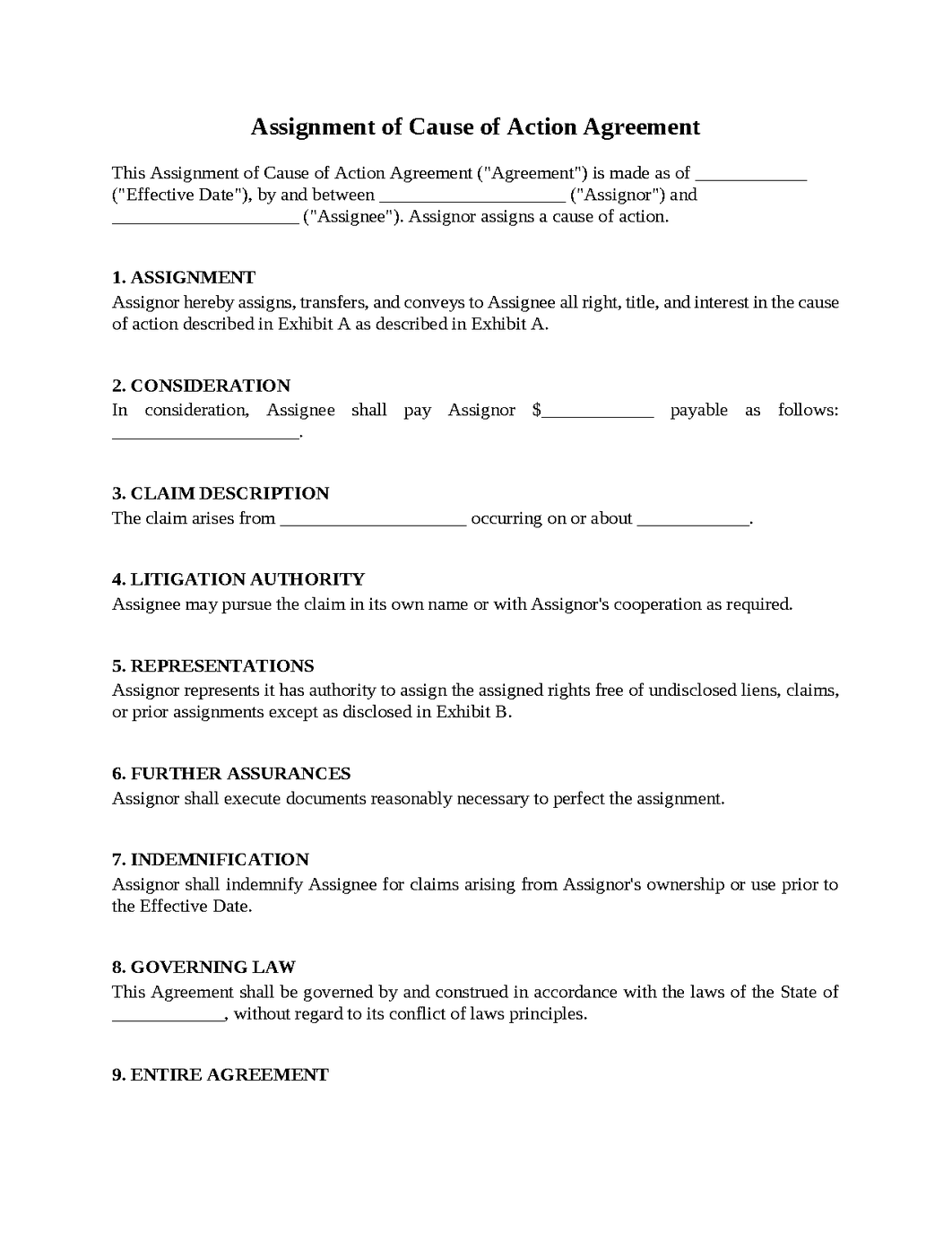
An Assignment of Cause of Action Agreement is a legal contract used when a party transfers its rights to pursue a legal claim to another person or entity. The party transferring the claim is known as the assignor, while the recipient is known as the assignee. Causes of action can arise from breach of contract disputes, business transactions, unpaid debts, property damage claims, commercial litigation, insurance matters, and other legal disputes. In some jurisdictions, certain claims may be assignable while others may not, making careful legal analysis especially important before any transfer occurs. Businesses, lenders, bankruptcy trustees, investors, litigation funding companies, and creditors often use Assignment of Cause of Action Agreements when claims have independent economic value. Because legal claims can involve substantial recoveries, significant risks, and procedural complexities, ownership disputes frequently arise if the assignment is not drafted carefully.
The Parties Discover the Claim Cannot Be Assigned
A manufacturing company believes it has a strong breach of contract claim against a supplier that failed to deliver critical components. Rather than pursuing years of litigation, the company decides to sell the claim to an investment group that specializes in commercial disputes.
The investment group performs preliminary due diligence and agrees to purchase the claim.
Both parties assume the transaction will be relatively straightforward.
Shortly before closing, however, outside counsel raises a concern. Under the law governing the dispute, certain types of claims may not be assignable. While some commercial claims can be transferred freely, others may be subject to restrictions or public policy limitations.
The parties suddenly realize they may be negotiating a transaction that cannot be enforced.
Weeks of legal analysis follow as attorneys review statutes, court decisions, and the underlying facts of the dispute. The investor becomes hesitant to proceed, and the seller worries that the value of the claim may disappear entirely.
What initially looked like a valuable asset now faces significant uncertainty.
To reduce this risk, an Assignment of Cause of Action Agreement should identify the specific claims being transferred, contain representations regarding assignability, and make closing contingent upon legal confirmation that the transfer is valid under applicable law. Careful drafting can prevent parties from paying for rights that cannot legally be transferred.
The Assignee Learns Critical Facts Were Never Disclosed
A construction company assigns a claim against a subcontractor arising from a major project dispute. The assignee reviews pleadings, contracts, and correspondence and concludes the case appears strong.
The purchase price reflects confidence in the potential recovery.
Several months later, during litigation, the assignee uncovers information that was never disclosed during negotiations.
Internal emails suggest that the assignor may have contributed to some of the project delays. Witnesses provide testimony that weakens key allegations. Certain documents contain facts that are far less favorable than originally presented.
The assignee becomes concerned.
From its perspective, the value of the claim was based on incomplete information. Had the undisclosed facts been known, the assignee may have negotiated a different price or declined the transaction entirely.
The assignor argues that litigation is inherently uncertain and that no recovery was guaranteed.
Disputes like this are common because legal claims often involve facts that emerge gradually through discovery and investigation.
To help avoid these problems, an Assignment of Cause of Action Agreement should include detailed representations regarding known facts, pending defenses, prior settlement discussions, and material information affecting the claim. The agreement should also specify what remedies are available if material information was withheld.
The Assignor Settles the Case After Selling It
A software company assigns a valuable breach of contract claim to an investor in exchange for an immediate payment.
The investor becomes the owner of the claim and begins preparing litigation strategy.
Several weeks later, the defendant contacts the original software company and proposes a settlement.
The company's executives are tempted to resolve the dispute. They remember the business relationship, believe a settlement may preserve goodwill, and still feel personally connected to the matter.
Without thinking through the consequences, they engage in discussions with the defendant.
The investor eventually learns about the conversations and becomes furious. From the investor's perspective, the company sold the claim and no longer has authority to negotiate or compromise it.
The situation quickly escalates into a dispute between the assignor and assignee.
Conflicts like this occur because parties often remain emotionally invested in disputes even after transferring ownership.
To avoid these issues, an Assignment of Cause of Action Agreement should clearly state that all settlement authority transfers to the assignee upon closing. The agreement should prohibit the assignor from negotiating independently and require immediate notice if any communication regarding the claim is received after the transfer.
The Assignee Wins the Lawsuit but Cannot Prove Ownership
An investor acquires a commercial claim arising from a failed real estate transaction. After years of litigation, the assignee obtains a favorable judgment worth several million dollars.
The victory appears complete.
Then the defendant challenges the assignee's standing and argues that ownership of the claim was never transferred properly.
The defendant's attorneys begin scrutinizing the assignment documents.
Questions arise regarding whether the agreement adequately described the claim, whether all necessary rights were transferred, and whether supporting documentation exists establishing a complete ownership record.
The assignee is stunned.
After spending years litigating the dispute, ownership issues suddenly threaten to undermine the recovery.
Additional hearings are required. More legal fees are incurred. Enforcement efforts are delayed while courts examine the validity of the assignment itself.
Ownership challenges are particularly dangerous because they often arise at the worst possible time—after substantial resources have already been invested.
To reduce this risk, an Assignment of Cause of Action Agreement should precisely identify the assigned claims, reference related litigation, include supporting schedules where appropriate, and create a clear documentary record establishing the assignee's ownership and enforcement rights.
The Assignee Assumes It Controls Related Claims It Never Purchased
A lender acquires a cause of action arising from a borrower's breach of a commercial agreement. The assignment documents transfer a specific contract claim that the lender believes has substantial value.
As litigation progresses, the lender discovers several related claims involving other parties and different legal theories.
The lender assumes ownership of the original claim automatically includes these additional causes of action.
The assignor disagrees.
According to the assignor, only a narrowly defined claim was transferred. Other claims, defenses, counterclaims, and related rights were intentionally excluded from the transaction.
The disagreement creates confusion regarding litigation strategy.
Attorneys must determine who owns which claims, who controls settlement decisions, and who receives any recovery associated with related causes of action.
The uncertainty complicates an already expensive lawsuit.
This problem occurs frequently because legal claims are often interconnected. A dispute may involve multiple contracts, multiple parties, and multiple theories of recovery.
To avoid misunderstandings, an Assignment of Cause of Action Agreement should clearly define the scope of the assignment. The agreement should specify whether related claims, counterclaims, appeals, settlement rights, attorney fee claims, and future causes of action are included or excluded from the transfer.
Legal claims can be valuable assets that are bought, sold, financed, and transferred in a variety of commercial contexts. However, assigning a cause of action presents unique challenges involving assignability, factual disclosures, settlement authority, ownership documentation, and claim scope. An Assignment of Cause of Action Agreement provides a structured framework for documenting these transfers and clarifying the rights of assignors and assignees. When drafted carefully, it can help reduce disputes, preserve litigation rights, and provide greater certainty regarding ownership and control of valuable legal claims.
:::

Get started with Upsign today!
Easily send, sign and track your documents