

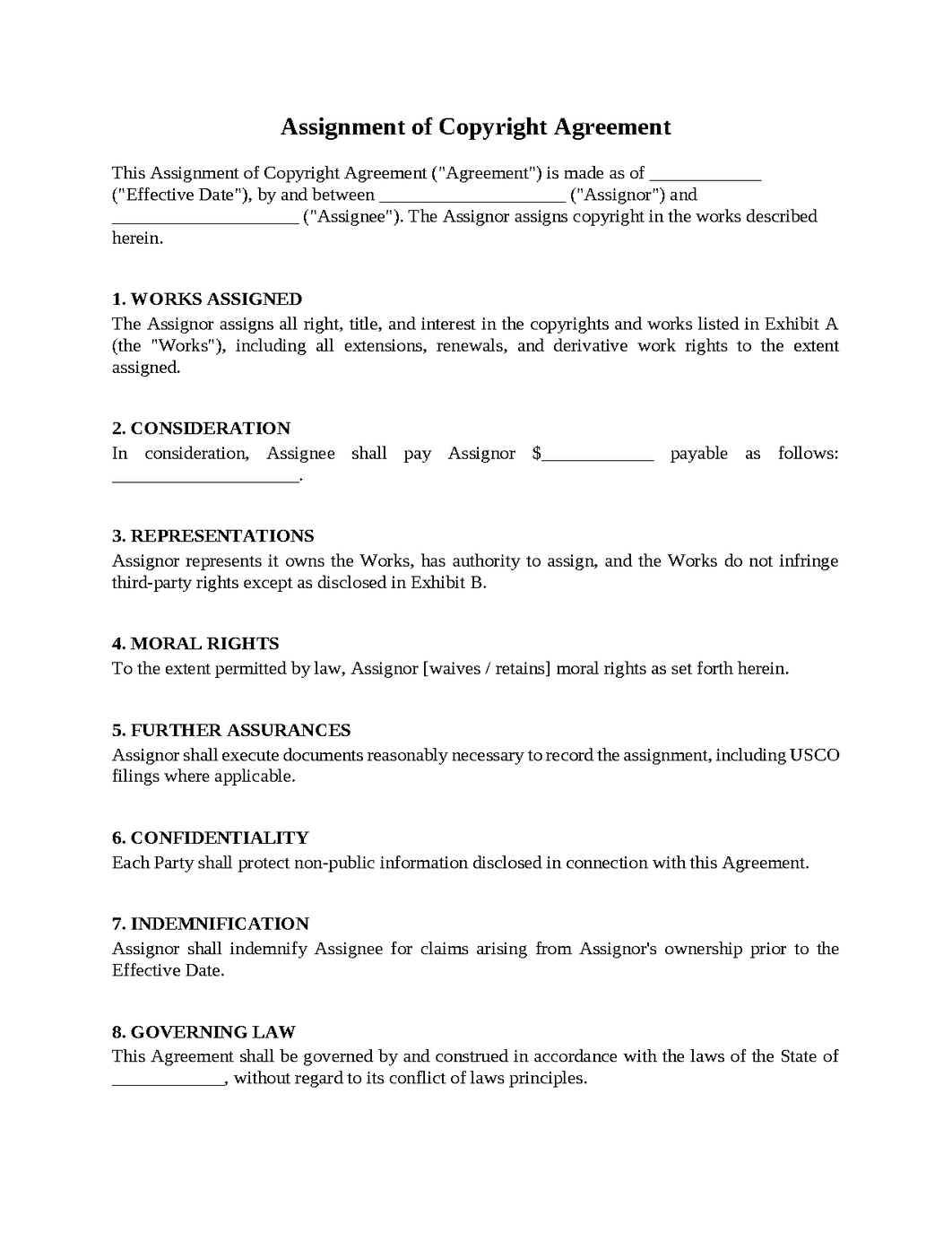
Assignment of Copyright Agreement
An Assignment of Copyright Agreement is a legal contract used when the owner of a copyright transfers ownership of that copyright to another person or entity. The party transferring the copyright is known as the assignor, while the recipient is known as the assignee. Copyrights protect original creative works such as books, articles, software code, photographs, videos, music, artwork, marketing materials, architectural designs, and other forms of creative expression. Copyright assignments are common in publishing transactions, software development projects, employment relationships, marketing engagements, acquisitions, content creation agreements, and intellectual property transfers. Because copyrighted works often generate substantial economic value, ownership disputes can have serious legal and financial consequences. An Assignment of Copyright Agreement helps establish who owns the copyrighted work, what rights are being transferred, and what obligations survive after the assignment is completed.
A Business Pays for Creative Work but Never Receives Ownership
A growing software company hires a freelance designer to create a complete visual identity package, including logos, website graphics, marketing materials, and product illustrations.
The company pays every invoice promptly and assumes it owns everything the designer created.
For several years, no issues arise.
Eventually, the company begins acquisition discussions with a larger competitor. During due diligence, the buyer requests documentation proving ownership of all intellectual property associated with the business.
The company provides contracts, invoices, and payment records.
The buyer's attorneys quickly identify a problem.
Although the company paid for the work, the agreement never expressly assigned copyright ownership. Under copyright law, payment alone does not necessarily transfer ownership rights.
The designer may still own the copyrights despite having been fully compensated.
The acquisition timeline immediately slows while attorneys attempt to resolve the ownership issue.
What appeared to be a simple contractor engagement suddenly becomes a significant business risk.
To avoid this problem, an Assignment of Copyright Agreement should clearly transfer all copyright ownership rights, identify the works being assigned, and state that ownership transfers upon creation, delivery, or execution of the agreement. The agreement should also require the assignor to execute future documents needed to confirm ownership if questions arise later.
Multiple Creators Claim Ownership of the Same Work
A media company produces an educational video series involving scriptwriters, videographers, editors, graphic designers, and outside consultants.
The project becomes highly successful and begins generating substantial licensing revenue.
Several years later, a licensing opportunity arises with a major educational platform.
During negotiations, ownership questions emerge.
One contractor claims ownership of portions of the script. A graphic designer asserts rights to certain visual assets. Another contributor argues that parts of the content were developed independently before joining the project.
The licensing partner becomes concerned.
Instead of negotiating a simple licensing arrangement, attorneys must now investigate who created various portions of the work and whether ownership was ever transferred properly.
The uncertainty threatens the entire transaction.
Collaborative creative projects frequently generate ownership disputes because multiple contributors may have independent copyright interests in different components of the final product.
To reduce these risks, an Assignment of Copyright Agreement should identify contributors, describe the copyrighted works in detail, require representations regarding ownership, and confirm that all necessary rights are being transferred. The agreement should also address pre-existing materials and clearly identify anything excluded from the assignment.
The Buyer Assumes Future Versions Are Included
A software developer sells the copyright to a specialized business application used within a niche industry.
The assignment agreement transfers ownership of the existing software and related documentation.
Several months after closing, the developer releases a significantly enhanced version of the software incorporating new features, updated code, and improved functionality.
The buyer is surprised.
From the buyer's perspective, the acquisition was intended to transfer the software platform and its future development potential. The developer argues that only the existing version was assigned and that future enhancements remain independently owned.
The disagreement becomes increasingly valuable as the updated software gains market traction.
Neither party anticipated that future development rights would become such an important issue.
This type of dispute occurs regularly because creative works often evolve over time. Software receives updates, books receive revisions, educational materials are expanded, and marketing content is continually refined.
To avoid these conflicts, an Assignment of Copyright Agreement should clearly address future versions, updates, derivative works, revisions, enhancements, and modifications. The agreement should specify whether future developments are included in the transfer or remain the property of the original creator.
The Assignor Continues Using the Copyrighted Work
A publishing company acquires ownership of a successful training course from an industry expert.
The transaction includes course materials, workbooks, videos, presentations, and related educational content.
The publisher assumes it now owns the exclusive rights to the materials.
Several months after closing, the expert launches a new consulting business.
Although the expert changes the title and updates portions of the content, many of the materials remain substantially similar to those sold to the publisher.
Customers begin noticing similarities.
Some assume the expert and publisher remain affiliated. Others question who actually owns the content.
The publisher becomes concerned that the value of the acquired intellectual property is being undermined.
The expert argues that they are simply using knowledge gained through years of professional experience.
Disputes like this frequently arise when assignment agreements fail to address future use restrictions.
To reduce these risks, an Assignment of Copyright Agreement should specify whether the assignor retains any rights to use the copyrighted materials after the transfer. The agreement should address derivative works, future adaptations, license-back rights, and restrictions on creating substantially similar content that could interfere with the assignee's ownership interests.
A Copyright Infringement Claim Raises Questions About Who Can Sue
A marketing company acquires the copyright to a library of advertising materials through a business acquisition.
Two years later, the company discovers that a competitor has been using portions of the content without authorization.
The company immediately considers filing a copyright infringement lawsuit.
During legal review, a critical question emerges.
Who owns the right to pursue infringement claims that occurred before the copyright assignment?
The seller argues that any claims arising before the assignment remain with the original copyright owner unless transferred specifically. The buyer believes ownership of the copyright automatically includes all infringement rights.
The disagreement creates uncertainty regarding litigation strategy and potential damages.
Attorneys spend significant time reviewing assignment language and relevant case law.
The outcome could affect the value of the lawsuit substantially.
This issue occurs frequently because copyright ownership and ownership of infringement claims are not always identical. Historical claims, future claims, settlements, and recoveries may require separate treatment.
To avoid these disputes, an Assignment of Copyright Agreement should expressly address enforcement rights, including past infringement claims, future infringement claims, litigation authority, settlement authority, and ownership of any resulting recoveries.
Copyrights often represent valuable business assets capable of generating revenue for many years. Whether copyrights are transferred through contractor relationships, publishing agreements, software transactions, acquisitions, or creative collaborations, ownership must be documented carefully. An Assignment of Copyright Agreement provides a structured framework for transferring copyright ownership and clarifying expectations regarding future use, derivative works, enforcement rights, and ownership documentation. When drafted properly, it can help reduce disputes, strengthen intellectual property portfolios, and provide confidence regarding ownership and control of valuable creative works.
:::

Get started with Upsign today!
Easily send, sign and track your documents