

Assignment of Debt Agreement
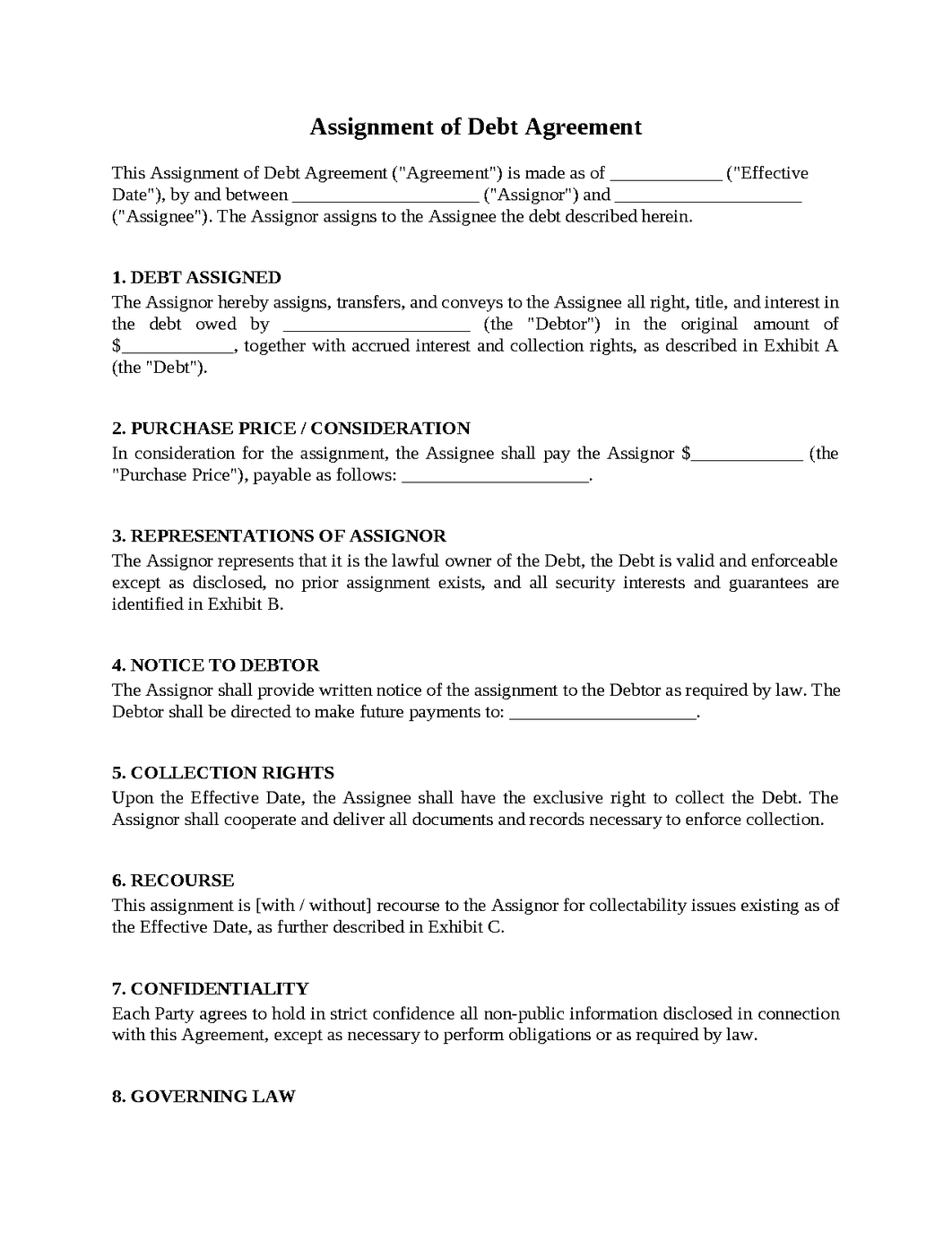
An Assignment of Debt Agreement is a legal contract used when the rights associated with a debt are transferred from one party to another. The party transferring the debt rights is known as the assignor, while the party receiving those rights is known as the assignee. Assignment of Debt Agreements are commonly used in commercial lending, consumer debt transactions, business acquisitions, loan portfolio sales, debt collection arrangements, financing transactions, and investment activities. Banks, finance companies, private lenders, investors, and businesses frequently assign debt obligations as part of broader financial strategies. Because debt assignments involve payment rights, collection authority, borrower relationships, and legal enforcement rights, disputes can arise if the transfer is not documented carefully. An Assignment of Debt Agreement helps establish who owns the debt, who may collect payments, and what rights are transferred as part of the transaction.
A Borrower Continues Paying the Original Creditor
A regional equipment finance company sells a portfolio of business loans to an investment fund. The transaction closes successfully, and ownership of the loans transfers to the buyer.
The investment fund expects future loan payments to begin arriving immediately.
Unfortunately, many borrowers are never properly notified of the transfer.
As monthly payments come due, borrowers continue sending checks to the original finance company because that is where they have always made payments. The borrowers have no reason to suspect ownership of their loans has changed.
The investment fund quickly notices that expected payments are not arriving. The original lender begins receiving funds that no longer belong to it. Accounting departments become involved, payment histories must be reconciled, and borrowers receive conflicting communications regarding where future payments should be sent.
What should have been a routine portfolio transaction becomes an administrative mess.
To help avoid this problem, an Assignment of Debt Agreement should clearly identify the assigned debts, establish the effective date of the transfer, require borrower notification procedures, and specify how payments mistakenly sent to the assignor will be handled after the assignment becomes effective.
The Assignee Discovers the Debt Is Disputed
A medical services company assigns a portfolio of outstanding patient receivables to a debt purchaser. Before closing, the purchaser reviews account balances and collection histories and concludes the portfolio represents a valuable investment opportunity.
Several months after the acquisition, collection efforts begin.
The purchaser quickly discovers that a number of debtors dispute the underlying obligations. Some claim insurance payments were not credited properly. Others argue that charges were incorrect. A few maintain that they never owed the amounts being claimed in the first place.
The debt purchaser becomes concerned.
From its perspective, it paid for enforceable debts that should be collectible. The seller responds that disputes are a normal part of collections and that no guarantees were made regarding every account.
The disagreement affects the value of the transaction and creates tension between the parties.
This situation is common in debt assignments because the assignee often knows less about the history of the debt than the assignor. A debt may appear valid on paper while still being subject to disputes, offsets, defenses, or collection challenges.
To reduce this risk, an Assignment of Debt Agreement should contain representations regarding the validity of the assigned debts, disclosure requirements for known disputes, and provisions addressing what happens if a material portion of the assigned obligations proves unenforceable.
The Same Debt Is Assigned More Than Once
A struggling finance company faces liquidity challenges and begins using multiple financing sources to raise capital.
At one point, the company assigns a group of commercial loans to a lender as collateral for a financing arrangement. Several months later, management enters into another transaction involving many of the same debt assets.
Initially, no one notices the overlap.
The problem emerges when borrowers begin making payments and two different parties claim ownership of the same debts.
The borrowers are confused. Each claimant insists it owns the loans and demands payment. Collection notices begin arriving from multiple sources, creating uncertainty and frustration.
The dispute quickly escalates into litigation.
The finance company faces allegations that it improperly assigned the same assets multiple times. Both claimants incur legal expenses attempting to establish ownership rights.
Competing claims like these occur more frequently than many businesses realize, particularly when companies have complex financing arrangements or poor recordkeeping practices.
To help prevent these disputes, an Assignment of Debt Agreement should include representations that the assigned debts are free from conflicting assignments, disclose existing liens or encumbrances, and require the assignor to indemnify the assignee if ownership disputes arise.
A Business Acquisition Reveals Problems with the Debt Portfolio
A specialty lender agrees to acquire another finance company whose primary assets consist of outstanding loans and receivables.
The buyer places significant value on the debt portfolio and expects it to generate substantial future income.
After the acquisition closes, however, troubling information begins to surface.
Many of the loans are significantly delinquent. Some borrowers have filed bankruptcy. Others have ceased operations entirely. Several accounts are subject to legal disputes that were never disclosed during negotiations.
The buyer realizes that the portfolio is worth far less than anticipated.
Management becomes frustrated and argues that material information should have been disclosed before closing. The seller responds that collection risk exists in every lending business.
The disagreement threatens to evolve into post-closing litigation.
Debt portfolios often appear stronger on spreadsheets than they do in practice. Collection rates, borrower financial health, legal defenses, and economic conditions can significantly affect value.
To reduce these risks, an Assignment of Debt Agreement should include detailed representations regarding delinquency status, borrower defaults, pending litigation, bankruptcy filings, and other material facts affecting collectability. The agreement may also include purchase price adjustment mechanisms if certain performance assumptions prove inaccurate.
The Assignee Assumes It Has Broader Collection Powers Than Intended
A private lender assigns a portfolio of loans to an investor as part of a financing transaction. Both parties agree that the investor should receive future loan payments associated with the assigned debts.
Problems emerge when collection activity begins.
The investor believes ownership of the debt includes authority to modify payment terms, negotiate settlements, waive defaults, and pursue aggressive collection strategies.
The original lender disagrees.
According to the lender, the assignment was intended to transfer payment rights only. The lender remains concerned about protecting customer relationships and maintaining its reputation in the marketplace.
The disagreement creates uncertainty regarding who controls the borrower relationship.
Some borrowers receive communications from both parties. Others receive conflicting information regarding repayment options and settlement opportunities.
The situation becomes increasingly difficult to manage.
Debt assignments often involve more than simply collecting money. Authority over restructurings, settlements, litigation, and collection tactics can be just as important as ownership of the payment stream itself.
To avoid these conflicts, an Assignment of Debt Agreement should clearly define the assignee's collection authority, identify which decisions require assignor approval, establish procedures for settlements and modifications, and specify who controls litigation and enforcement actions.
Debt obligations are frequently bought, sold, financed, and transferred as part of modern commercial and financial transactions. However, assigning debt rights can create significant legal and operational challenges involving borrower communications, disputed obligations, competing ownership claims, portfolio valuations, and collection authority. An Assignment of Debt Agreement provides a structured framework for documenting these transfers and clarifying expectations for assignors, assignees, borrowers, and other interested parties. When drafted carefully, it can help reduce disputes, improve collection outcomes, and provide greater confidence regarding ownership and enforcement rights associated with the assigned debt.
:::

Get started with Upsign today!
Easily send, sign and track your documents