

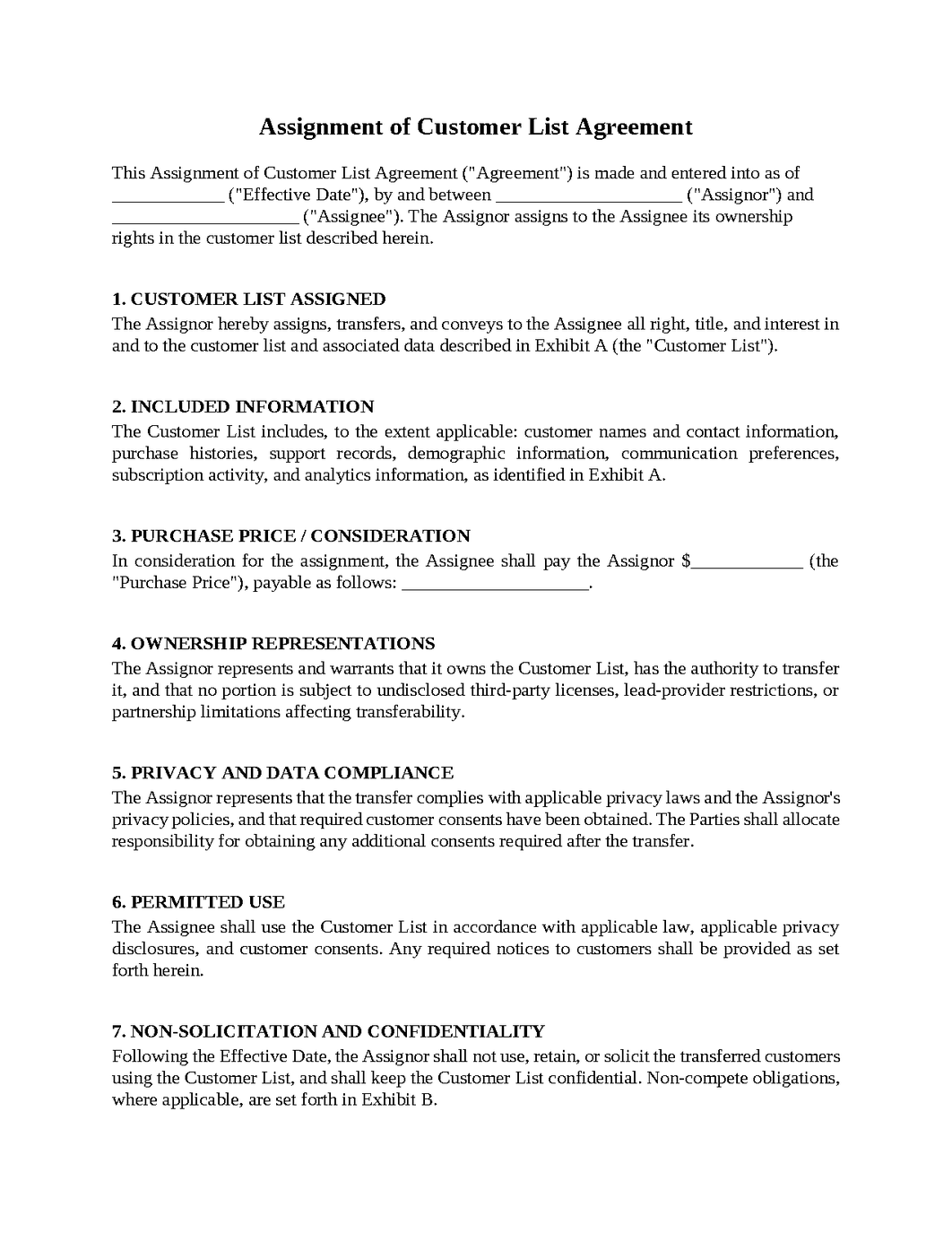
Assignment of Customer List Agreement
An Assignment of Customer List Agreement is a legal contract used when a person or business transfers ownership rights in a customer list to another party. The party transferring the customer list is known as the assignor, while the recipient is known as the assignee. Customer list assignments commonly occur during business acquisitions, asset sales, mergers, franchise transactions, succession planning, sales of online businesses, and intellectual property transfers. A customer list can be one of the most valuable assets a business owns because it often represents years of marketing investment, relationship building, purchasing history, and proprietary business intelligence. Because customer lists frequently involve confidential information, privacy obligations, and ongoing business relationships, disputes can arise regarding ownership, data usage rights, confidentiality, and customer communications. An Assignment of Customer List Agreement helps establish who owns the customer information and what rights are transferred as part of the transaction.
The Buyer Discovers the Customer List Cannot Be Used as Expected
A regional home services company sells its business to a larger competitor. One of the primary reasons for the acquisition is the company's customer database, which contains thousands of homeowners who have purchased services over many years.
The buyer views the customer list as a valuable growth opportunity.
After closing, the buyer begins preparing marketing campaigns targeting the acquired customers.
Before the campaigns launch, legal counsel reviews the company's privacy policies and customer communications.
A serious issue emerges.
Many customers were told their information would only be used by the original business. The privacy disclosures never addressed transfers to third parties or future acquisitions. Certain customer consents may not permit the buyer's intended marketing activities.
The buyer becomes concerned.
The customer list was one of the most valuable assets acquired, yet legal restrictions may significantly limit its usefulness.
What initially appeared to be a straightforward asset transfer now involves privacy, regulatory, and compliance risks.
To help avoid this problem, an Assignment of Customer List Agreement should require disclosure of applicable privacy policies, customer consent practices, regulatory obligations, and restrictions affecting data use. The agreement should also address responsibility for obtaining any additional consents required after the transfer.
The Seller Does Not Actually Own All of the Customer Data
A software company agrees to sell its customer list to a strategic buyer seeking access to a specialized industry audience.
The list contains thousands of contacts and appears highly valuable.
During the transition process, however, the buyer learns that portions of the database were obtained from third-party lead providers under limited-use licenses.
Additional records originated through marketing partnerships with other businesses. Certain customer information was gathered through affiliate programs that imposed restrictions on transferability.
The buyer is surprised.
From its perspective, it purchased a customer list outright. Instead, it discovers that portions of the data may not belong exclusively to the seller.
Questions quickly arise regarding ownership and future usage rights.
The value of the transaction becomes uncertain.
This issue occurs frequently because businesses often combine customer information from multiple sources over many years without maintaining clear records regarding ownership and usage rights.
To reduce these risks, an Assignment of Customer List Agreement should contain representations regarding ownership of customer data, identify third-party restrictions, disclose licensing arrangements, and confirm that the assignor has the authority necessary to transfer the information being sold.
The Seller Starts Contacting the Customers Again
A landscaping company sells its business, including its customer list, to a competitor.
The buyer pays a premium price because recurring customers generate predictable revenue each year.
Several months after closing, the former owner launches a new landscaping business in a neighboring market.
The buyer soon notices a troubling trend.
Longtime customers begin leaving. Some explain that the former owner contacted them directly and offered discounted services. Others report receiving marketing emails and promotional materials from the seller's new company.
The buyer becomes frustrated.
From its perspective, the customer list was one of the primary assets acquired in the transaction. The seller argues that many of the customers were personal relationships developed over decades.
The disagreement quickly escalates.
Customer list transfers frequently create disputes when parties fail to address future solicitation rights.
To avoid these problems, an Assignment of Customer List Agreement should clearly prohibit unauthorized use of transferred customer information after closing. The agreement should address solicitation restrictions, confidentiality obligations, non-compete provisions where appropriate, and remedies if customer relationships are targeted improperly following the transfer.
The Buyer Assumes More Information Is Included
A business broker facilitates the sale of an online subscription company.
As part of the transaction, the seller agrees to assign its customer list to the buyer.
The buyer assumes the transfer includes complete customer profiles, purchasing histories, support records, demographic information, communication preferences, and subscription activity.
After closing, the buyer discovers that only basic contact information was provided.
Much of the historical data remains stored in systems that were never included in the transaction. Customer support records are unavailable. Purchase histories are incomplete. Marketing segmentation data cannot be accessed.
The buyer becomes disappointed.
The information received is far less valuable than anticipated.
The dispute centers on expectations.
Customer information can consist of far more than names and email addresses. The practical value of a customer list often depends on the depth and quality of the associated data.
To prevent these misunderstandings, an Assignment of Customer List Agreement should define the transferred information precisely. The agreement should identify customer records, purchase histories, support data, marketing preferences, subscription records, analytics information, and any other related data included in the assignment.
A Security Breach Reveals Hidden Problems
A private equity firm acquires a specialty e-commerce company whose customer database contains hundreds of thousands of records.
The customer list is one of the transaction's most valuable assets.
Several months after closing, a cybersecurity review uncovers troubling information.
The database contains duplicate records, outdated information, incomplete consent records, and evidence of prior unauthorized access attempts. Security procedures were inconsistent, and certain data may have been exposed before the acquisition occurred.
The buyer becomes alarmed.
Regulatory obligations may apply. Customer trust could be affected. The value of the customer database is now less certain than originally believed.
The seller argues that no major breach occurred and that data quality issues are common in large databases.
The disagreement creates tension and potential legal exposure.
Customer lists often involve significant privacy and security risks because they contain sensitive information that must be protected carefully.
To reduce these risks, an Assignment of Customer List Agreement should require disclosure of known security incidents, privacy concerns, data quality issues, regulatory inquiries, and compliance matters affecting the customer information. The agreement should also establish responsibility for pre-closing and post-closing data-related liabilities.
Customer lists are often among the most valuable assets a business owns because they represent years of customer acquisition efforts, purchasing behavior, and relationship development. However, transferring ownership of customer information can create significant challenges involving privacy compliance, ownership rights, data quality, customer relationships, and post-closing use restrictions. An Assignment of Customer List Agreement provides a structured framework for documenting these transfers and clarifying expectations regarding ownership and permissible use. When drafted carefully, it can help reduce disputes, protect customer relationships, preserve business value, and provide confidence regarding the lawful transfer of valuable customer information.

Get started with Upsign today!
Easily send, sign and track your documents