

Assignment of Source Code Agreement
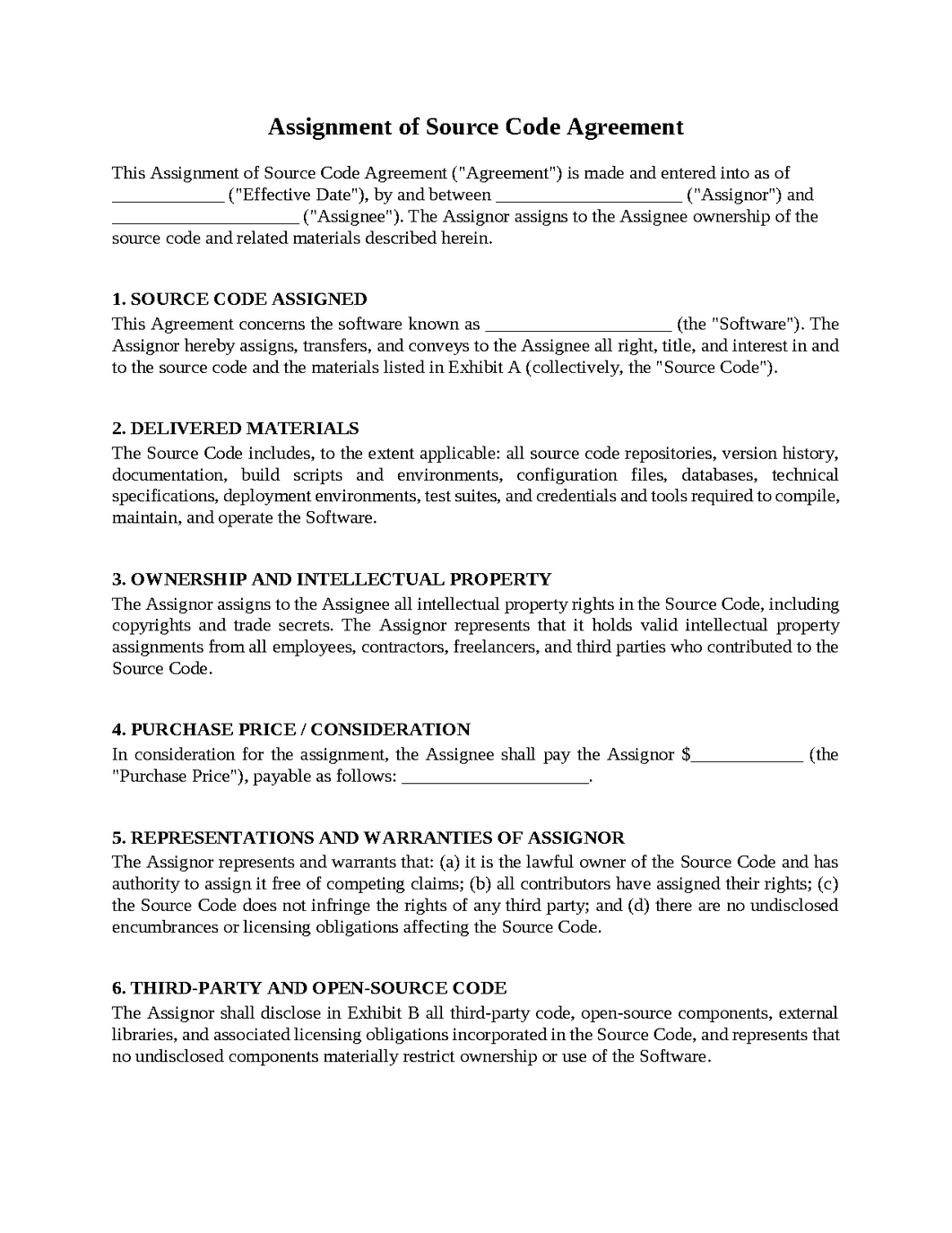
An Assignment of Source Code Agreement is a legal contract used when ownership of software source code is transferred from one person or entity to another. The party transferring the source code rights is known as the assignor, while the recipient is known as the assignee. Source code assignments commonly occur during software development projects, startup acquisitions, contractor engagements, technology transfers, intellectual property transactions, mergers and acquisitions, and business sales. Because source code often represents the foundation of a software product and may contain years of development effort, ownership disputes can have substantial financial and operational consequences. An Assignment of Source Code Agreement helps establish who owns the source code, what rights are being transferred, and what obligations remain after the transfer occurs.
A Company Pays for Development but Never Receives the Source Code
A financial services company hires an independent software development firm to create a custom loan origination platform. Over two years, the company invests hundreds of thousands of dollars into the project.
The platform performs exactly as expected.
Management assumes the software belongs to the company because it paid for every phase of development.
Several years later, the company decides to upgrade the platform and hire a new development team. The new developers request access to the source code so they can begin making enhancements.
The original development firm refuses.
According to the firm's interpretation of the contract, the company received a license to use the software but never acquired ownership of the underlying source code.
The financial services company is shocked.
Without source code access, it cannot maintain the software independently. Future development becomes expensive, timelines are delayed, and business operations become dependent on a vendor relationship that management thought had ended years earlier.
What seemed like a routine software project becomes a major operational problem.
To help avoid this issue, an Assignment of Source Code Agreement should clearly identify the source code being transferred, specify that ownership rights are assigned to the assignee, and require delivery of all source code repositories, documentation, build environments, and related development materials. The agreement should also clarify whether any license rights remain with the assignor after the transfer.
Multiple Developers Claim Ownership of Key Components
A startup develops a cloud-based analytics platform using employees, contractors, freelancers, and offshore development teams.
The project grows rapidly and eventually attracts acquisition interest from a larger technology company.
During due diligence, the buyer begins reviewing ownership of the source code.
Questions quickly emerge.
One contractor claims ownership of a reporting engine they created. An offshore development company argues that certain modules were licensed rather than assigned. A freelance developer insists that portions of the code were based on pre-existing proprietary libraries.
The startup becomes concerned.
What appeared to be a unified software platform may actually consist of components owned by multiple parties.
The buyer begins questioning whether the company can deliver clear ownership of the source code.
The acquisition timeline slows as attorneys review contracts, repository histories, development records, and intellectual property assignments.
This type of problem is common because modern software development often involves contributions from numerous individuals and organizations.
To reduce these risks, an Assignment of Source Code Agreement should contain detailed ownership representations, identify all relevant contributors, disclose third-party code, and confirm that the assignor has authority to transfer the source code free of competing ownership claims.
The Buyer Discovers Critical Pieces Are Missing
A healthcare technology company acquires ownership of a software platform that manages patient scheduling and billing.
The transaction includes an assignment of the source code and related intellectual property.
Following closing, the buyer's engineers begin reviewing the code base.
Almost immediately, problems emerge.
Certain repositories are missing. Important configuration files cannot be located. Documentation is incomplete. Build instructions are outdated. Several critical integrations rely on credentials and tools that were never transferred.
Although the buyer technically owns the source code, the software cannot be compiled or maintained easily.
The platform becomes far more difficult to operate than anticipated.
Management realizes that ownership of source code alone does not necessarily provide everything needed to support a software product.
Software ecosystems often include development environments, databases, deployment tools, testing systems, documentation, and operational knowledge that are just as important as the code itself.
To avoid these issues, an Assignment of Source Code Agreement should clearly identify all materials being transferred, including repositories, documentation, build scripts, databases, credentials, technical specifications, deployment environments, and supporting tools required to maintain the software effectively.
The Assignor Continues Using the Same Source Code
A software company sells ownership of a specialized logistics platform to a strategic buyer.
The buyer expects exclusive ownership of the source code and all associated intellectual property.
Several months after closing, the seller launches a new business serving a similar market.
The new software appears remarkably familiar.
Customers notice that workflows, features, interfaces, and functionality closely resemble the platform that was sold.
The buyer becomes concerned.
Although the seller claims it developed a new application independently, evidence suggests portions of the original source code may still be in use.
The dispute quickly escalates.
The buyer argues that the value of the acquired software depends on exclusivity. The seller insists it is merely applying technical expertise accumulated over many years.
Questions regarding ownership, derivative works, and code reuse become central to the dispute.
To reduce these risks, an Assignment of Source Code Agreement should clearly address post-transfer use rights, derivative works, future development activities, and restrictions on reuse of assigned code. The agreement should define what constitutes prohibited use and establish remedies if unauthorized copying or modification occurs.
A Security Breach Reveals Embedded Third-Party Code
A private equity firm acquires a software company whose primary asset is a proprietary enterprise platform.
The source code appears valuable and well-developed.
Following the acquisition, an independent security review is conducted.
During the review, engineers discover that portions of the platform contain third-party code incorporated years earlier by former developers.
Some components are governed by restrictive open-source licenses. Others appear to have been copied from commercial software products without proper authorization.
The buyer becomes alarmed.
The company may not actually own all of the source code it believed it acquired. Certain licensing obligations could require disclosure of proprietary code or expose the business to legal claims.
The issue affects both valuation and future commercialization plans.
Source code ownership problems frequently arise when development practices are poorly documented or when third-party components are incorporated without proper review.
To help avoid these situations, an Assignment of Source Code Agreement should require disclosure of all third-party code, open-source components, external libraries, and licensing obligations. The agreement should also contain representations confirming that the assignor has the right to transfer the source code and that no undisclosed restrictions materially affect ownership or use.

Get started with Upsign today!
Easily send, sign and track your documents