

Barter Agreement
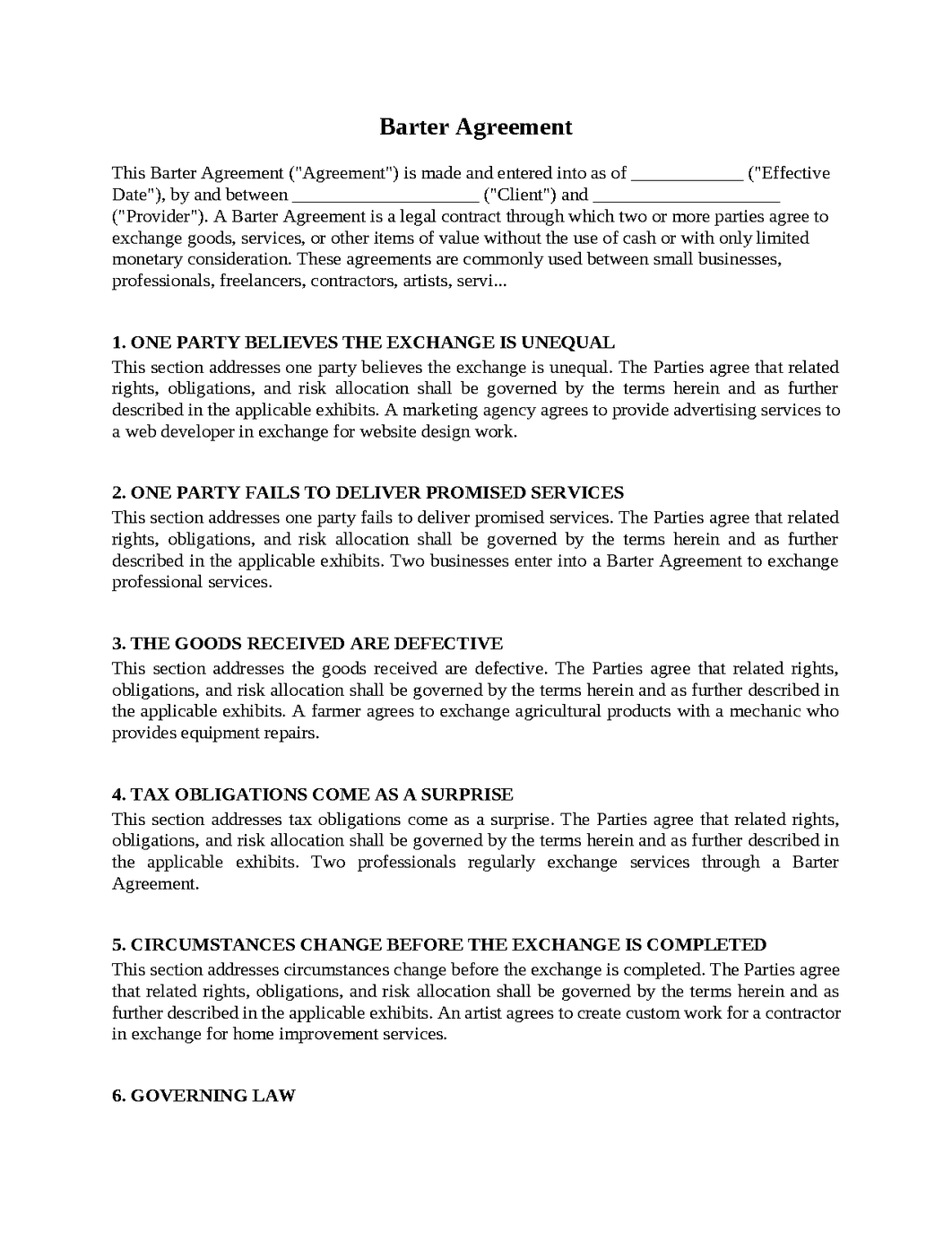
A Barter Agreement is a legal contract through which two or more parties agree to exchange goods, services, or other items of value without the use of cash or with only limited monetary consideration. These agreements are commonly used between small businesses, professionals, freelancers, contractors, artists, service providers, agricultural producers, and organizations seeking to obtain needed products or services while conserving cash. A Barter Agreement typically addresses the items being exchanged, delivery obligations, valuation methods, timing, warranties, taxes, and remedies if one party fails to perform. Because barter transactions often involve subjective valuations and non-cash consideration, disputes can arise when expectations regarding value and performance are not documented clearly. A carefully drafted Barter Agreement helps establish certainty and protect all parties involved.
One Party Believes the Exchange Is Unequal
A marketing agency agrees to provide advertising services to a web developer in exchange for website design work.
At the beginning of the relationship, both parties believe the arrangement will provide mutual benefits and reduce out-of-pocket expenses. Each side estimates that the value of the services being exchanged is roughly equivalent.
As the work progresses, the marketing agency spends considerably more time on the project than originally expected. The agency begins believing that the value of its contribution exceeds the value of the website services being received.
The web developer believes both parties voluntarily agreed to the exchange and that differences in effort do not necessarily mean the arrangement is unfair. The marketing agency believes the original assumptions no longer reflect reality.
The disagreement centers on whether the exchange remains economically balanced.
To help avoid this problem, a Barter Agreement should clearly describe the value assigned to the exchanged goods or services and establish procedures for handling changes in scope.
One Party Fails to Deliver Promised Services
Two businesses enter into a Barter Agreement to exchange professional services.
One company provides accounting assistance while the other agrees to provide information technology support. Both businesses expect to benefit from the arrangement without spending cash.
The accounting work is completed promptly and delivered according to expectations. However, the technology company experiences staffing issues and repeatedly delays providing its services.
The accounting firm becomes frustrated because it has already fulfilled its obligations and believes it has received little in return. The technology company argues that the delays are temporary and that performance will eventually occur.
The disagreement focuses on what remedies should be available when one side performs before the other.
To help prevent these issues, a Barter Agreement should clearly establish deadlines, performance requirements, and remedies available in the event of nonperformance.
The Goods Received Are Defective
A farmer agrees to exchange agricultural products with a mechanic who provides equipment repairs.
Both parties complete their obligations and initially believe the transaction has been successful. Shortly after delivery, however, one party discovers that some of the products received are damaged or unusable.
The receiving party believes the goods failed to meet expectations and seeks compensation or replacement. The other party believes the products were delivered in good faith and that some deterioration is normal.
Questions arise regarding warranties, quality standards, and responsibility for defects.
The disagreement becomes more complicated because the transaction involved an exchange rather than a cash payment.
To help avoid these problems, a Barter Agreement should clearly address quality standards, warranties, and procedures for resolving disputes involving defective goods or services.
Tax Obligations Come as a Surprise
Two professionals regularly exchange services through a Barter Agreement.
The arrangement allows each party to conserve cash while obtaining valuable assistance. Over time, the exchanges become increasingly valuable and represent a meaningful part of each business's operations.
Later, one party learns that barter transactions may have tax consequences and that the value of exchanged services may need to be reported. The party becomes concerned because these obligations were never considered when the arrangement began.
The other party believes tax matters are each person's individual responsibility. Both sides realize they had different assumptions regarding reporting requirements.
The disagreement centers on whether additional obligations exist beyond the exchange itself.
To help prevent these issues, a Barter Agreement should clearly identify the agreed value of the exchanged goods or services and acknowledge that each party remains responsible for applicable tax obligations.
Circumstances Change Before the Exchange Is Completed
An artist agrees to create custom work for a contractor in exchange for home improvement services.
Initially, both parties are enthusiastic and expect the arrangement to benefit everyone involved. The artist completes the artwork and delivers it according to the agreed schedule.
Before beginning the home improvement work, the contractor experiences financial difficulties and no longer has the time or resources necessary to complete the project. The artist believes the exchange should still be honored.
The contractor argues that unforeseen circumstances have made performance difficult and requests modifications to the arrangement. The artist believes the original agreement should be enforced.
The disagreement focuses on whether changing circumstances justify altering the agreed exchange.
To help avoid these problems, a Barter Agreement should clearly establish timelines, procedures for modifying obligations, and remedies available if one party becomes unable to perform.
Barter Agreements provide businesses and individuals with flexible ways to exchange value without relying exclusively on cash payments. However, issues involving unequal value, delayed performance, defective goods, tax consequences, and changing circumstances can become significant sources of conflict when expectations are not documented clearly. A carefully drafted Barter Agreement provides a structured framework for defining obligations and allocating risk. When prepared thoughtfully, it can reduce uncertainty, preserve business relationships, support creative transactions, and provide greater confidence for everyone involved.

Get started with Upsign today!
Easily send, sign and track your documents