

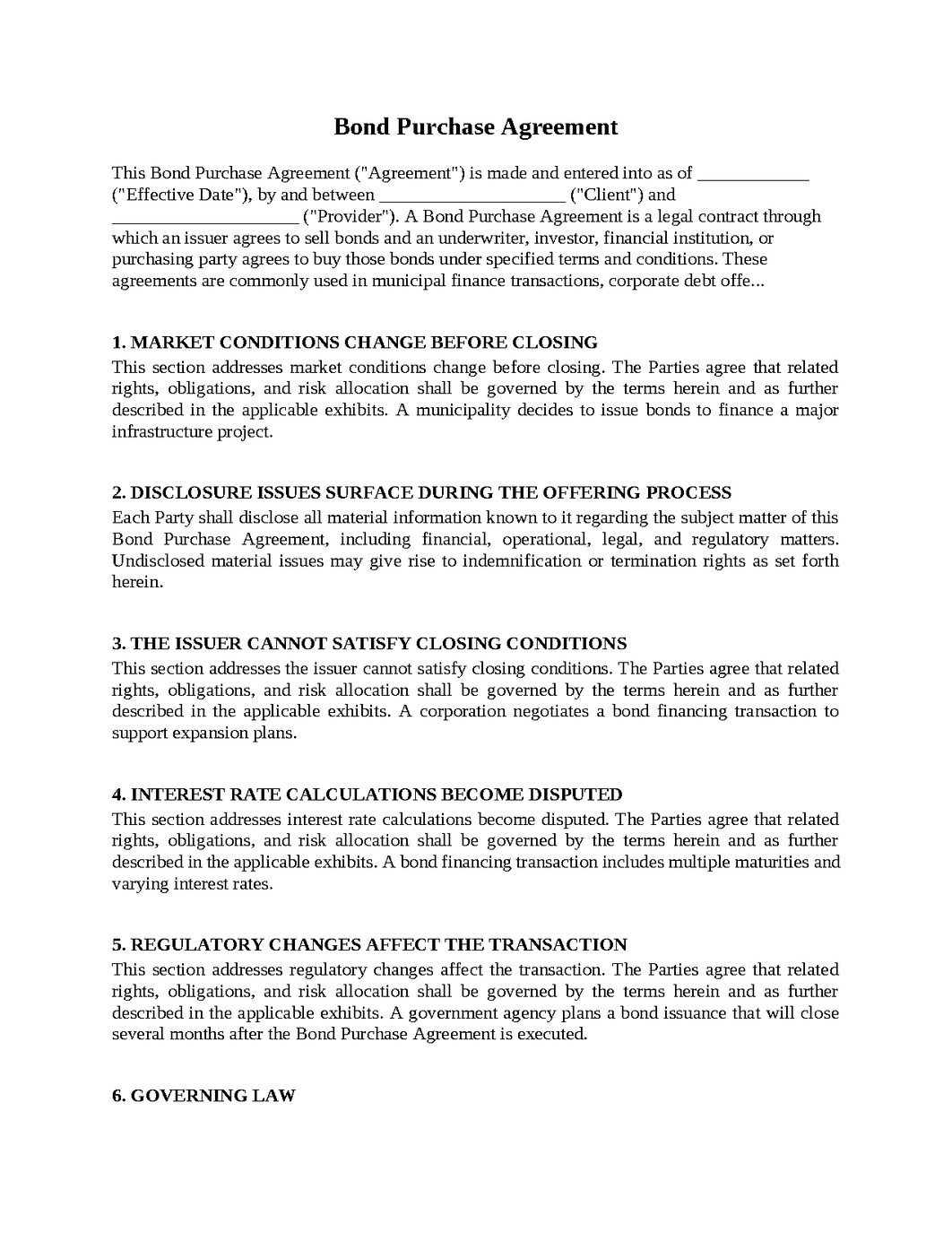
Bond Purchase Agreement
A Bond Purchase Agreement is a legal contract through which an issuer agrees to sell bonds and an underwriter, investor, financial institution, or purchasing party agrees to buy those bonds under specified terms and conditions. These agreements are commonly used in municipal finance transactions, corporate debt offerings, government financing projects, infrastructure developments, educational institution financing, and public improvement initiatives. A Bond Purchase Agreement typically addresses the principal amount of the bonds, interest rates, maturity schedules, closing conditions, representations and warranties, disclosure obligations, and responsibilities of the parties involved. Because bond offerings often involve substantial amounts of capital and long-term financial obligations, disputes can arise when expectations regarding disclosures, market conditions, or closing requirements are not documented clearly. A carefully drafted Bond Purchase Agreement helps provide certainty and facilitate successful financing transactions.
Market Conditions Change Before Closing
A municipality decides to issue bonds to finance a major infrastructure project.
After extensive preparation, the issuer and underwriter negotiate a Bond Purchase Agreement and establish pricing based on prevailing market conditions. Both parties expect the transaction to close according to schedule.
Before closing occurs, interest rates increase significantly and investor demand weakens. The underwriter becomes concerned that the bonds may be more difficult to sell than originally anticipated.
The issuer believes the agreed pricing and terms should remain binding. The underwriter argues that extraordinary market changes have materially altered the economics of the transaction.
The disagreement centers on whether either party may modify or withdraw from the arrangement due to changing market conditions.
To help avoid this problem, a Bond Purchase Agreement should clearly address market-related risks and establish conditions under which closing obligations may be affected by significant changes in the financial markets.
Disclosure Issues Surface During the Offering Process
A public entity prepares a bond offering to fund long-term capital improvements.
As part of the transaction, the issuer provides financial information, operational data, and disclosures intended to help investors evaluate the bonds. The underwriter relies on this information when marketing the securities.
Shortly before closing, new information emerges regarding financial conditions, litigation, regulatory concerns, or operational challenges that were not included in the original disclosures.
The underwriter believes the information may affect investor decisions and potentially expose participants to liability. The issuer argues that the information is either immaterial or does not require additional disclosure.
The disagreement focuses on whether the offering materials remain accurate and complete.
To help prevent these issues, a Bond Purchase Agreement should clearly establish disclosure obligations and require prompt communication regarding material developments occurring before closing.
The Issuer Cannot Satisfy Closing Conditions
A corporation negotiates a bond financing transaction to support expansion plans.
The Bond Purchase Agreement includes various conditions that must be satisfied before the bonds can be issued. These conditions may involve legal opinions, regulatory approvals, financial certifications, and organizational authorizations.
As the closing date approaches, the issuer encounters unexpected difficulties satisfying one or more of the required conditions. The underwriter becomes concerned about proceeding with the transaction.
The issuer believes the issues are minor and can be resolved quickly. The underwriter believes strict compliance with the agreement is necessary to protect investors and minimize risk.
The disagreement delays the transaction and increases uncertainty regarding the financing.
To help avoid these problems, a Bond Purchase Agreement should clearly identify closing requirements and establish procedures for addressing unmet conditions.
Interest Rate Calculations Become Disputed
A bond financing transaction includes multiple maturities and varying interest rates.
The parties spend considerable time negotiating pricing terms and documenting the financial structure of the offering. Everyone believes the terms have been described accurately.
Later, questions arise regarding yield calculations, pricing adjustments, interest assumptions, or other financial metrics used during the transaction. Different participants interpret certain provisions differently.
The issuer believes the bonds should be priced according to one methodology. The underwriter believes the agreement supports a different approach.
The disagreement becomes significant because small differences in calculations can affect large amounts of money.
To help prevent these issues, a Bond Purchase Agreement should clearly define pricing methodologies, financial calculations, and procedures for resolving discrepancies.
Regulatory Changes Affect the Transaction
A government agency plans a bond issuance that will close several months after the Bond Purchase Agreement is executed.
During the intervening period, new laws, regulations, tax rules, or regulatory guidance affect the treatment of the bonds or the transaction structure. Both parties must evaluate how the changes impact the financing.
The issuer believes the transaction should proceed substantially as planned. The purchaser or underwriter believes modifications may be necessary to comply with new requirements.
The parties disagree regarding responsibility for addressing the consequences of the regulatory changes.
The dispute focuses on how unforeseen legal developments should affect an already negotiated transaction.
To help avoid these problems, a Bond Purchase Agreement should clearly address regulatory changes and establish procedures for adapting the transaction when legal requirements evolve before closing.
Bond Purchase Agreements are essential documents in debt financing transactions because they establish the rights and responsibilities of issuers and purchasers before bonds are issued. However, issues involving market volatility, disclosure obligations, closing conditions, pricing calculations, and regulatory developments can become significant sources of conflict when expectations are not documented clearly. A carefully drafted Bond Purchase Agreement provides a structured framework for allocating risk and facilitating successful capital-raising transactions. When prepared thoughtfully, it can reduce uncertainty, support investor confidence, protect all parties involved, and contribute to the efficient completion of complex financing arrangements.

Get started with Upsign today!
Easily send, sign and track your documents