

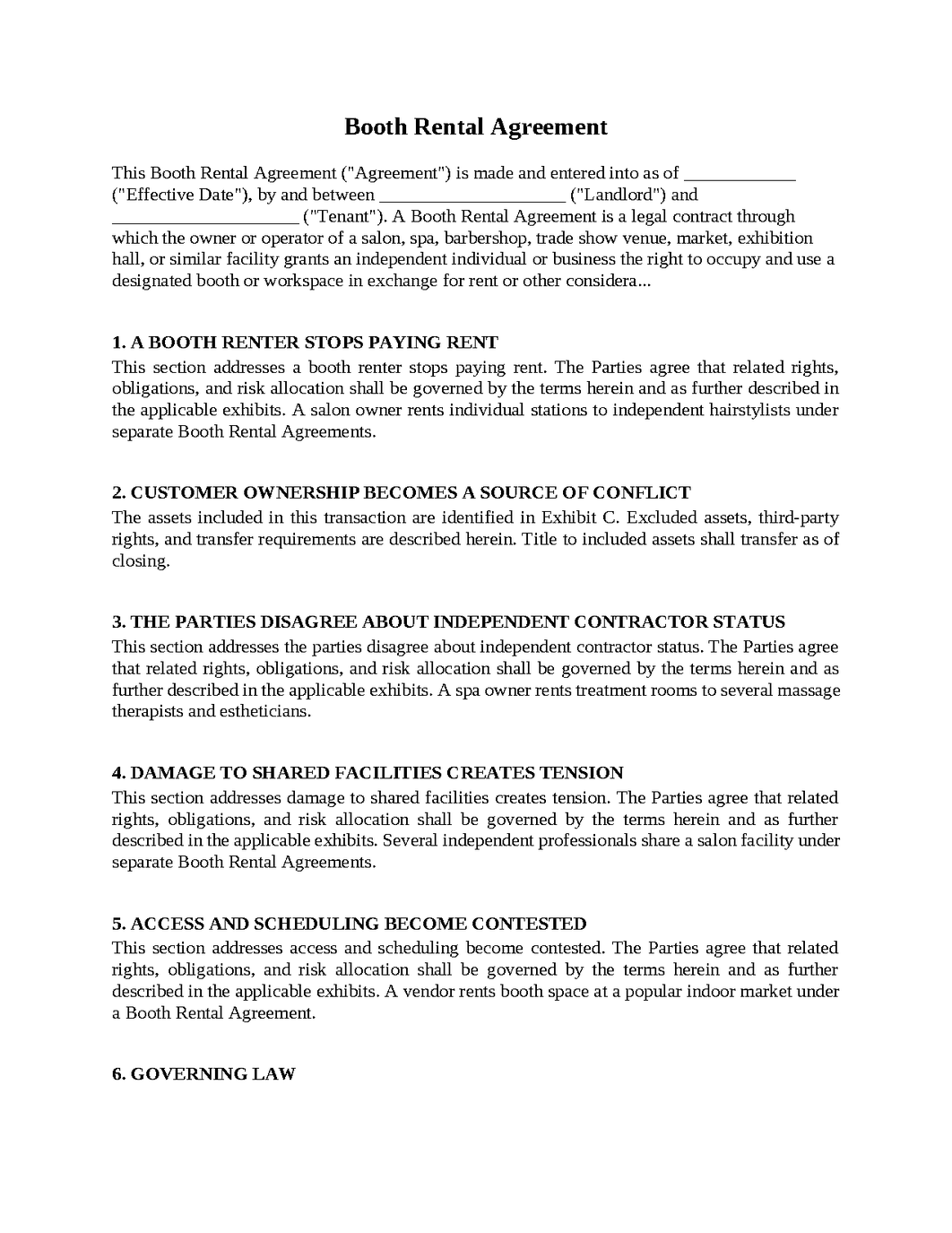
Booth Rental Agreement
A Booth Rental Agreement is a legal contract through which the owner or operator of a salon, spa, barbershop, trade show venue, market, exhibition hall, or similar facility grants an independent individual or business the right to occupy and use a designated booth or workspace in exchange for rent or other consideration. These agreements are commonly used by hairstylists, barbers, estheticians, tattoo artists, nail technicians, massage therapists, vendors, craft exhibitors, and temporary merchants. A Booth Rental Agreement typically addresses rent, access rights, utilities, scheduling, independent contractor status, insurance requirements, customer relationships, and maintenance responsibilities. Because booth arrangements often involve shared spaces and independent business operations, disputes can arise when expectations regarding responsibilities and rights are not documented clearly. A carefully drafted Booth Rental Agreement helps establish certainty and maintain productive business relationships.
A Booth Renter Stops Paying Rent
A salon owner rents individual stations to independent hairstylists under separate Booth Rental Agreements.
For several years, the arrangement functions smoothly and both parties benefit from the relationship. One stylist develops a loyal clientele and operates a successful business within the salon.
Over time, the stylist experiences financial difficulties and begins missing rental payments. The salon owner becomes concerned because overhead expenses continue regardless of whether rent is received.
The stylist believes temporary flexibility should be granted while business improves. The salon owner believes consistent rent payments are essential to operating the facility.
The disagreement centers on whether the stylist may continue occupying the booth despite falling behind on payments.
To help avoid this problem, a Booth Rental Agreement should clearly establish payment obligations, grace periods, and procedures for terminating occupancy in the event of nonpayment.
Customer Ownership Becomes a Source of Conflict
A beauty professional rents a booth inside a well-established salon and gradually develops strong relationships with customers.
The salon provides facilities, utilities, and walk-in traffic that contribute to the stylist's success. Over time, the stylist builds a substantial client base and becomes an important part of the business.
Eventually, the stylist decides to relocate to another location. Questions arise regarding who owns the customer relationships and whether the stylist may contact former clients after leaving.
The salon owner believes the customers were developed through the salon's reputation and resources. The stylist believes personal relationships with clients belong to the independent business.
The disagreement becomes emotional because both parties contributed to building the clientele.
To help prevent these issues, a Booth Rental Agreement should clearly address customer ownership, solicitation rights, and post-termination communications with clients.
The Parties Disagree About Independent Contractor Status
A spa owner rents treatment rooms to several massage therapists and estheticians.
The Booth Rental Agreement describes the professionals as independent contractors responsible for managing their own schedules, clients, and business operations. Initially, the arrangement works efficiently.
As time passes, the spa owner begins establishing work hours, requiring attendance at meetings, and exercising increasing control over daily activities. Some renters begin questioning whether they are truly operating independent businesses.
The renters believe the level of control resembles an employment relationship. The owner believes the arrangement remains a booth rental relationship despite operational requirements.
The disagreement focuses on whether the parties have unintentionally created an employment relationship.
To help avoid these problems, a Booth Rental Agreement should clearly define the nature of the relationship and ensure that operational practices remain consistent with independent contractor status.
Damage to Shared Facilities Creates Tension
Several independent professionals share a salon facility under separate Booth Rental Agreements.
Everyone benefits from common areas, utilities, and shared amenities. For years, the environment remains cooperative and productive.
One day, significant damage occurs to equipment, furniture, or plumbing serving multiple booths. No one is certain who caused the damage, and repair expenses are substantial.
The salon owner believes the responsible renter should pay for the repairs. The renters argue that common facilities are the owner's responsibility and that blame cannot be assigned fairly.
The disagreement spreads among the tenants and affects the atmosphere of the business.
To help prevent these issues, a Booth Rental Agreement should clearly allocate responsibility for maintenance, repairs, and damage to shared property.
Access and Scheduling Become Contested
A vendor rents booth space at a popular indoor market under a Booth Rental Agreement.
Initially, access hours and scheduling expectations are informal because demand for space is manageable. As the market becomes more successful, customer traffic increases and booth availability becomes more valuable.
The vendor wishes to expand operating hours and store additional inventory on-site. The market owner believes certain limitations are necessary to maintain order and accommodate other renters.
The parties disagree regarding access rights, storage privileges, and the extent to which the booth may be used.
What began as a simple rental arrangement evolves into a dispute regarding operational expectations.
To help avoid these problems, a Booth Rental Agreement should clearly establish access hours, storage rights, and permitted uses of the rented space.
Booth Rental Agreements are important tools for creating flexible business relationships between facility owners and independent professionals or vendors. However, issues involving rent payments, customer ownership, independent contractor status, property damage, and access rights can become significant sources of conflict when expectations are not documented clearly. A carefully drafted Booth Rental Agreement provides a structured framework for defining responsibilities and protecting the interests of all parties. When prepared thoughtfully, it can reduce uncertainty, support successful independent businesses, preserve professional relationships, and provide the stability necessary for shared commercial environments.

Get started with Upsign today!
Easily send, sign and track your documents